Table of Contents
Risshaku-ji Temple, better known as Yamadera, is one of the most atmospheric and worthwhile day trips from Sendai.
The temple complex climbs through a cedar forest to the side of a steep mountain, with historic halls, stone monuments and small wooden buildings appearing between the trees as you make your way up more than 1,000 steps.
The climb is tiring in places, but completely manageable if you take your time. At the top, Godaido Hall looks across the surrounding valley and mountains, giving you one of the most memorable views in Tohoku.
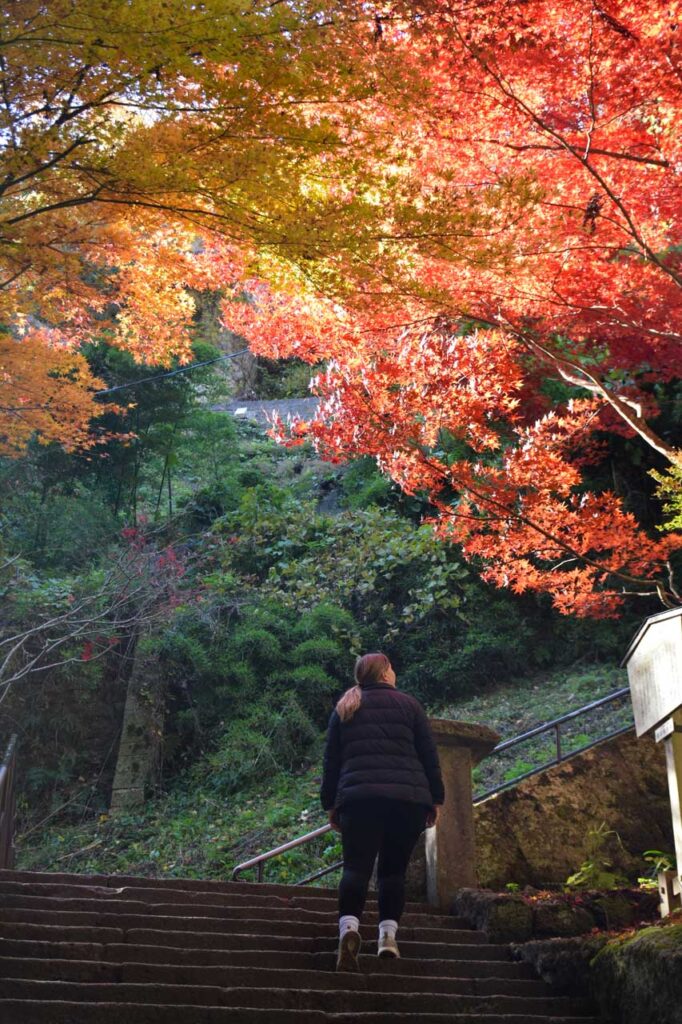
We visited during autumn, when the mountainside was covered in red, orange and yellow leaves. It was incredibly beautiful and absolutely worth every step.
Yamadera: Quick Information
- Official name: Hojusan Risshaku-ji Temple
- Common name: Yamadera, meaning “mountain temple”
- Location: Yamagata Prefecture
- Nearest station: JR Yamadera Station
- Train from Sendai: JR Senzan Line
- Journey time: approximately 60 to 70 minutes
- Train fare: ¥910 with a paper ticket or ¥902 using an IC card
- Changes: none
- Walk from the station: approximately 5 to 10 minutes
- Number of steps: 1,015
- Temple admission: ¥500 for adults
- Payment: Cash
- Climbing time: approximately 40 to 60 minutes each way
- Minimum time in Yamadera: approximately 3 hours
- Recommended time: 4 to 5 hours
- Google Maps: Risshaku-ji Temple
Is Yamadera Worth Visiting?
Definitely.
The view from Godaido Hall is wonderful, but Yamadera is not simply a climb to a viewpoint. The stone staircase, cedar forest, temple gates, caves and old buildings are all part of the experience.
There is something particularly satisfying about seeing the temple from Yamadera Station, looking up at the buildings clinging to the mountainside and then slowly making your way towards them.
Yamadera feels remote and peaceful, but it is surprisingly easy to reach from Sendai. The direct train makes it possible to visit without hiring a car or joining a tour.
If you only have time for one mountain day trip from Sendai, Yamadera would be our choice.
What Is Yamadera?
Yamadera is the popular name for Hojusan Risshaku-ji, a Tendai Buddhist temple founded in 860.
Rather than being a single building, Yamadera is a collection of halls, gates, monuments and sacred spaces spread across the mountainside. The lower buildings sit close to the village, while the upper temple complex is reached by climbing a long stone staircase through the forest.
The name Yamadera simply means “mountain temple”, which describes the location perfectly.
The temple is still an active religious site. Although many people visit for the views and photography, it is worth remembering that the buildings and mountain paths remain places of worship.
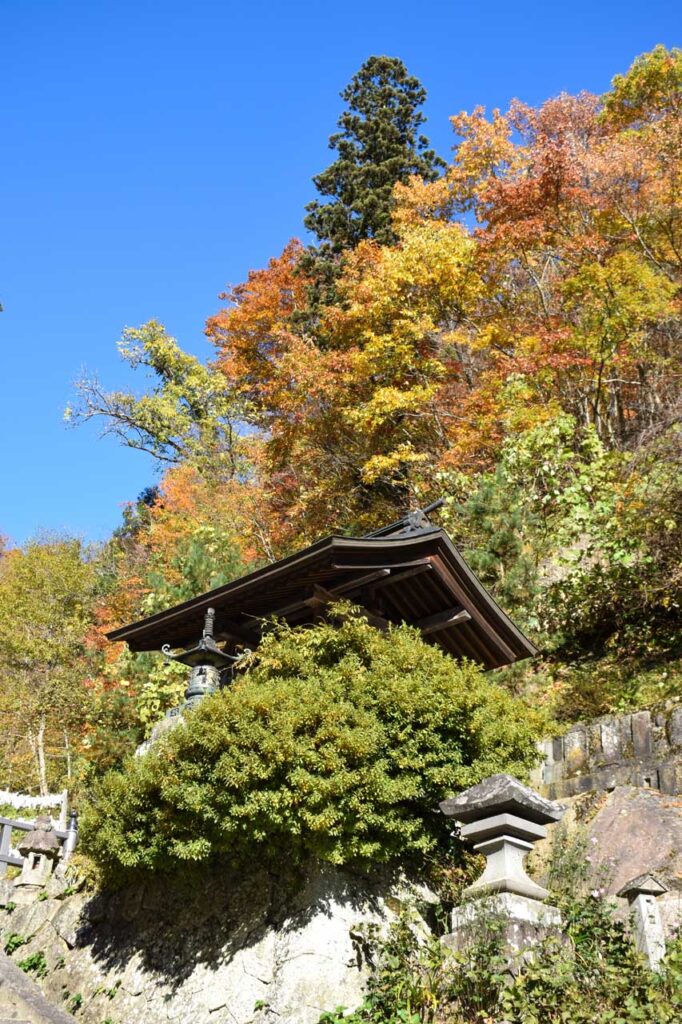
A Short History of Risshaku-ji Temple
Risshaku-ji was founded in 860 by the Buddhist monk Ennin, also known as Jikaku Daishi. He was an important figure in the Tendai school of Buddhism and travelled widely throughout Japan and China.
The temple became one of the most important Buddhist sites in northern Japan. Over the centuries, buildings were damaged or destroyed by fire, conflict and the mountain climate, but the temple continued to be rebuilt and maintained.
At the foot of the mountain is Konponchudo, the temple’s main hall. The present building dates from the fourteenth century and is constructed from beech wood. Inside is a sacred flame associated with Enryaku-ji Temple on Mount Hiei, the centre of Tendai Buddhism in Japan.
Matsuo Basho and Yamadera
Yamadera is also closely connected to Matsuo Basho, one of Japan’s most famous haiku poets.
Basho visited the temple in 1689 during the journey recorded in his travel work The Narrow Road to the Deep North. The silence of the mountain and the sound of cicadas inspired one of his best-known poems.
A monument known as Semizuka marks the connection between Basho, the cicadas and the mountain. You pass it while climbing towards the upper temple complex.
How to Get to Yamadera from Sendai
The easiest way to visit Yamadera is by direct train from Sendai Station.
Sendai Station to Yamadera Station
Take the JR Senzan Line from Sendai Station towards Yamagata.
- Departure platforms: usually Platforms 7 or 8
- Journey time: approximately 60 to 70 minutes
- Paper ticket: ¥910 each way
- IC card fare: ¥902 each way
- Changes: none
- Stops: approximately 12 to 14, depending on the service
Check the destination before boarding. Some Senzan Line trains terminate at Ayashi or Sakunami and do not continue as far as Yamadera.
You need a train travelling towards Yamagata that specifically stops at Yamadera.
The journey becomes increasingly scenic after Sakunami, passing through mountains, forest and smaller rural stations before reaching Yamadera.
Yamadera Station to the Temple Entrance
The temple is easy to find from Yamadera Station.
When you leave the station, you can already see parts of the temple high on the mountainside. Walk towards the river, cross the bridge and continue through the small town towards the temple entrance.
The walk takes approximately 5 to 10 minutes.
Important Warning About Trains from Yamadera
Check your return journey before beginning the temple climb.
Regular trains between Yamadera and Sendai can be infrequent, sometimes with more than an hour between departures. Missing one can leave you with a long wait in a very small town.
There is another complication. Seasonal sightseeing trains sometimes call at Yamadera Station, but some of these services are entirely reserved seating. You cannot simply board them with a normal local ticket or IC card.
This happened while we were waiting to leave Yamadera. A train arrived at the station, but the conductor explained that it was a pre-booked service and we could not use it. We had to wait for the next regular Senzan Line train.
Services such as Irodori SATONO and other seasonal sightseeing trains may appear on the departure board alongside normal local and rapid trains. If a service is marked as all-reserved, you need a seat reservation before boarding.
When planning your return:
- Check the regular Senzan Line timetable.
- Look for trains travelling towards Sendai.
- Do not assume every train stopping at Yamadera accepts ordinary unreserved passengers.
- Ask the station staff or conductor if you are unsure.
- Allow enough time to return from the temple before your chosen train.
- Take a screenshot of the timetable in case your internet connection is poor.
Check the current schedule on the JR East timetable before travelling or on your phone, Google maps works great in Japan.
Arriving in Yamadera
Yamadera Station is small and the town is easy to explore on foot.
From the station, the mountains and temple buildings dominate the view. The area between the station and temple entrance has several cafés, soba restaurants, souvenir shops and places selling local snacks.
It is worth checking restaurant opening hours when you arrive. Some small businesses close early or may not open every day.
If you want coffee before climbing, stop on your way to the temple. If you plan to eat after the climb, make sure your chosen restaurant will still be serving by the time you come back down.
Climbing Risshaku-ji Temple
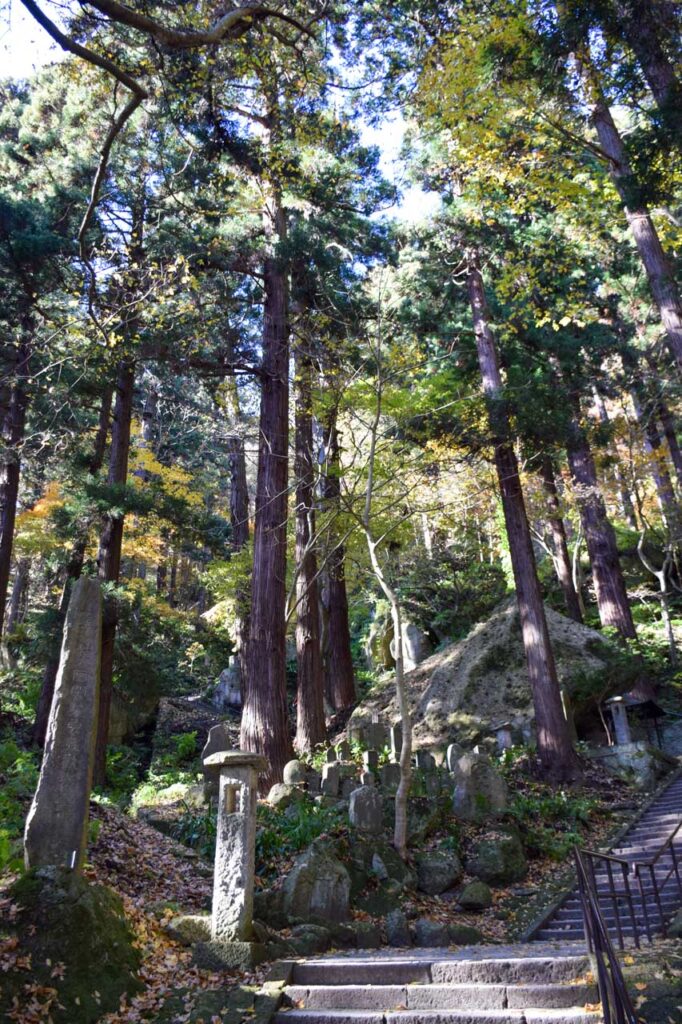
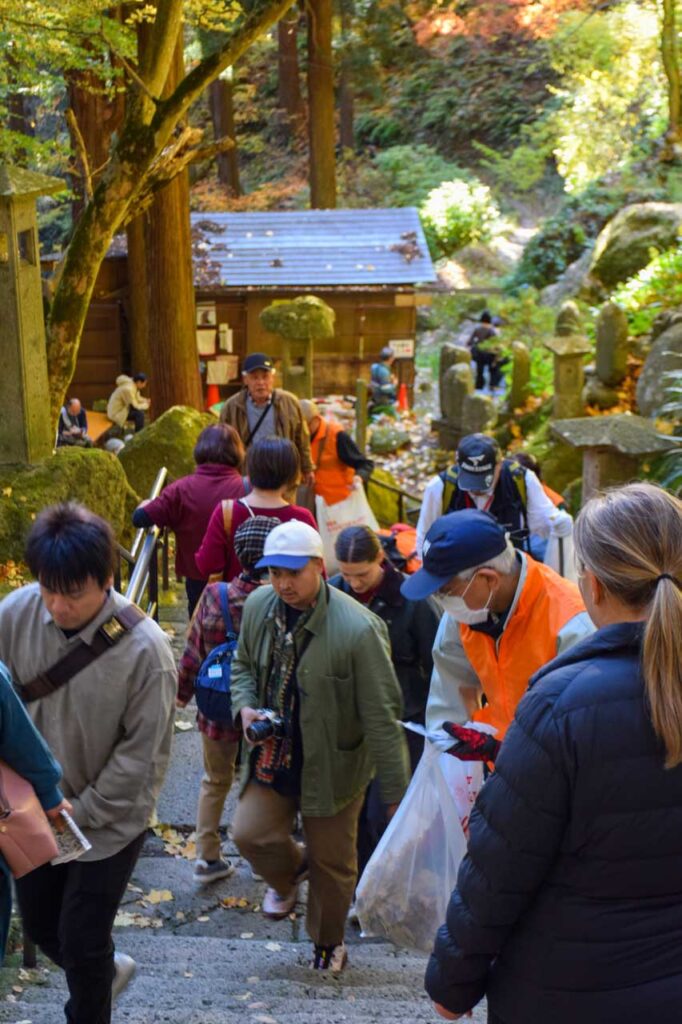
There are 1,015 stone steps between the lower temple area and Okunoin at the top of the complex.
That number sounds intimidating, but the climb is broken up by gates, monuments, statues and temple buildings. You are rarely walking up an uninterrupted staircase for long.
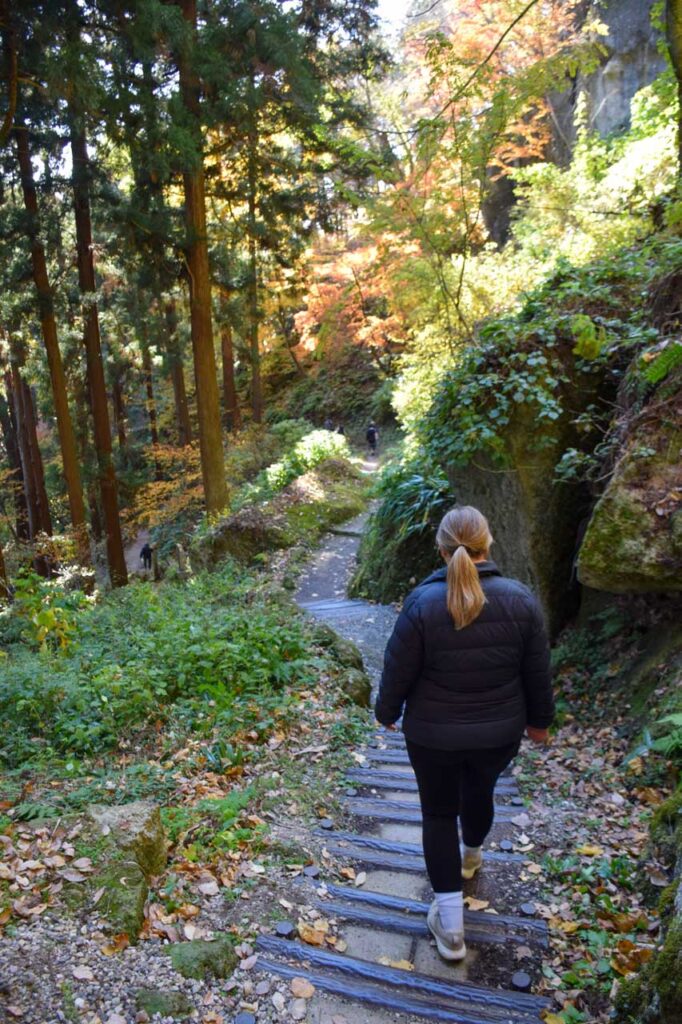
The steps can be uneven, narrow and worn smooth in places. Take your time and stop whenever you need to.
Konponchudo Main Hall
Before reaching the paid mountain entrance, visit Konponchudo.
This is the main hall of Risshaku-ji and one of the oldest surviving beechwood buildings in Japan. The hall contains the temple’s sacred flame and an important image of Yakushi Nyorai, the Buddha of healing.
It is easy to rush past while concentrating on the mountain climb, but it is an important part of the temple’s history.
The Sanmon Gate
The main climb begins at the Sanmon Gate.
This is where you pay the ¥500 adult admission fee. Payment is currently cash only, so make sure you have yen before arriving.
From here, the stone staircase enters the cedar forest and the sounds of the town quickly disappear.
The Cedar Forest and Stone Path
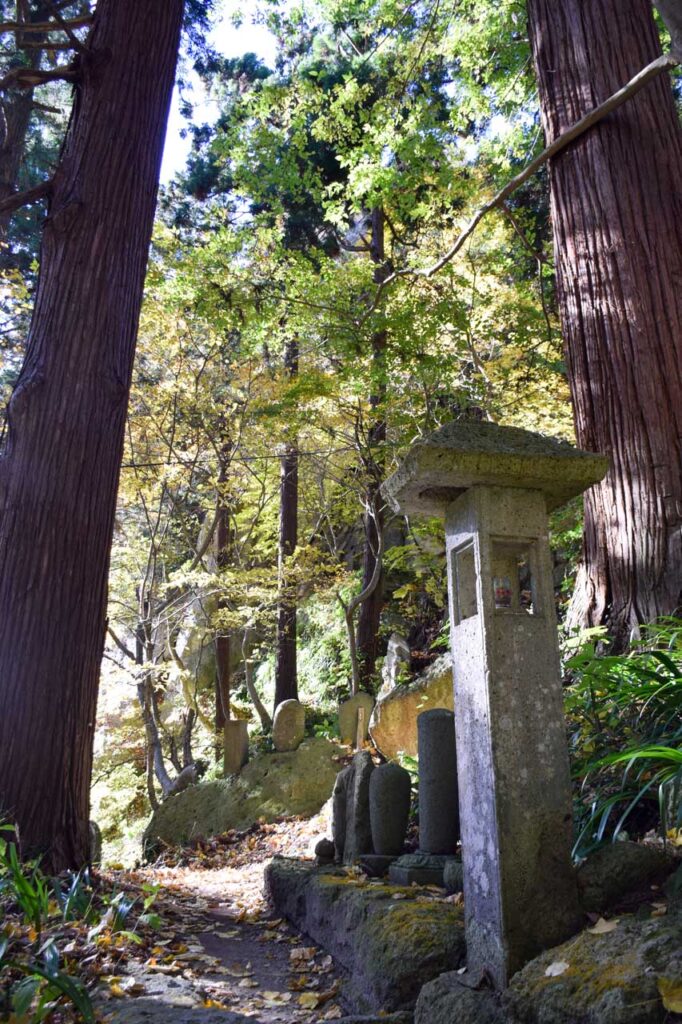
The first part of the climb winds through tall cedar trees, moss-covered stone and small religious monuments.
It is shaded and peaceful, with the forest making the climb feel cooler than the town below. During autumn, fallen leaves cover parts of the path and the colours become more intense as you climb.
According to temple tradition, each step taken up the mountain helps remove a worldly desire. Whether or not you approach the climb spiritually, the slow rhythm of the steps certainly makes you concentrate on where you are and what you are doing.
Semizuka
Semizuka is a stone monument connected to Matsuo Basho’s famous cicada haiku.
The monument is easy to pass without understanding its significance, so look out for it as you climb. It marks one of the strongest historical connections between Yamadera and Basho’s journey through northern Japan.
Niomon Gate
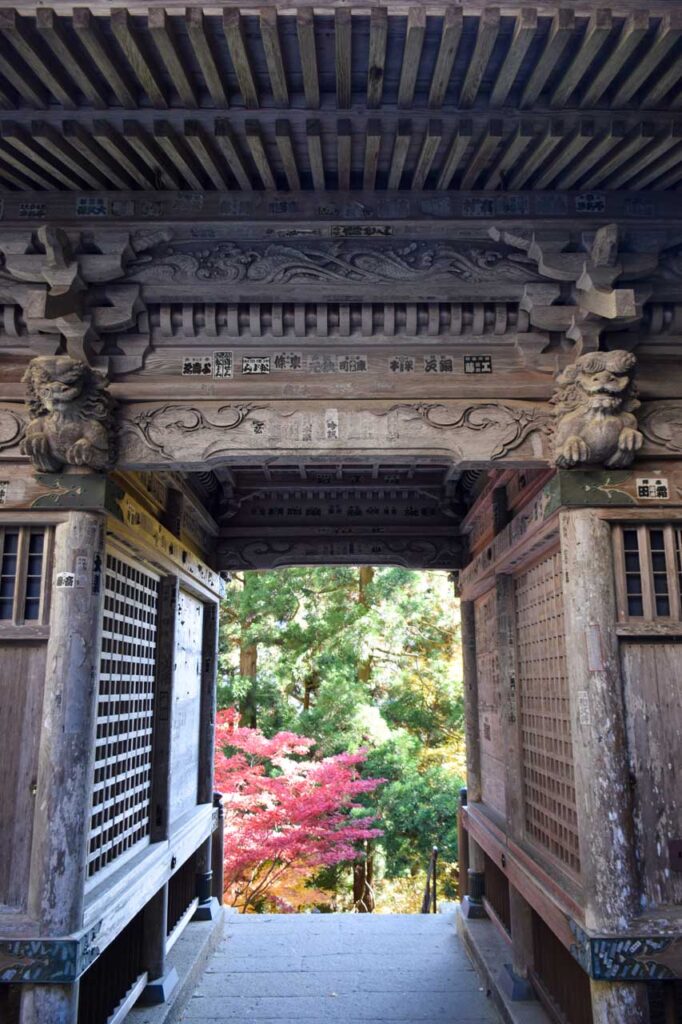
The Niomon Gate is one of the most impressive structures on the route.
The wooden gate stands high on the mountain and contains two guardian figures watching over the entrance to the upper temple area. Reaching it feels like a significant point in the climb, with the path beginning to open towards the cliffs and upper buildings.
Kaizando and Nokyodo
Kaizando is dedicated to Ennin, the founder of Risshaku-ji.
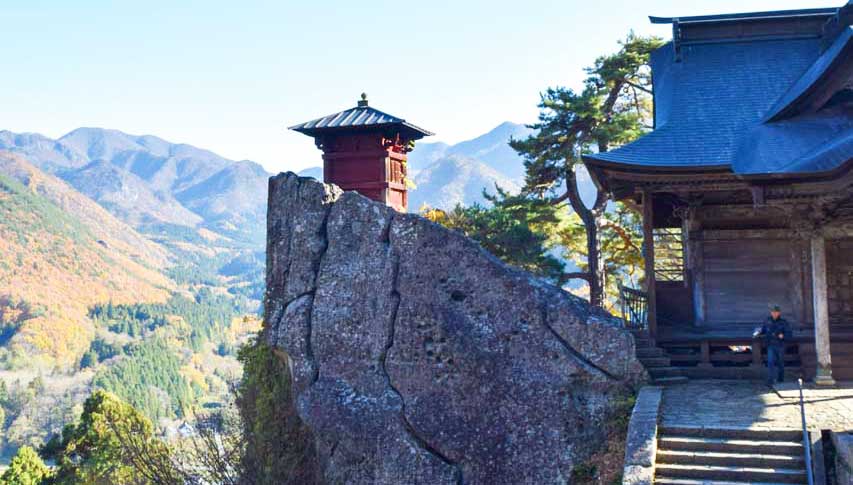
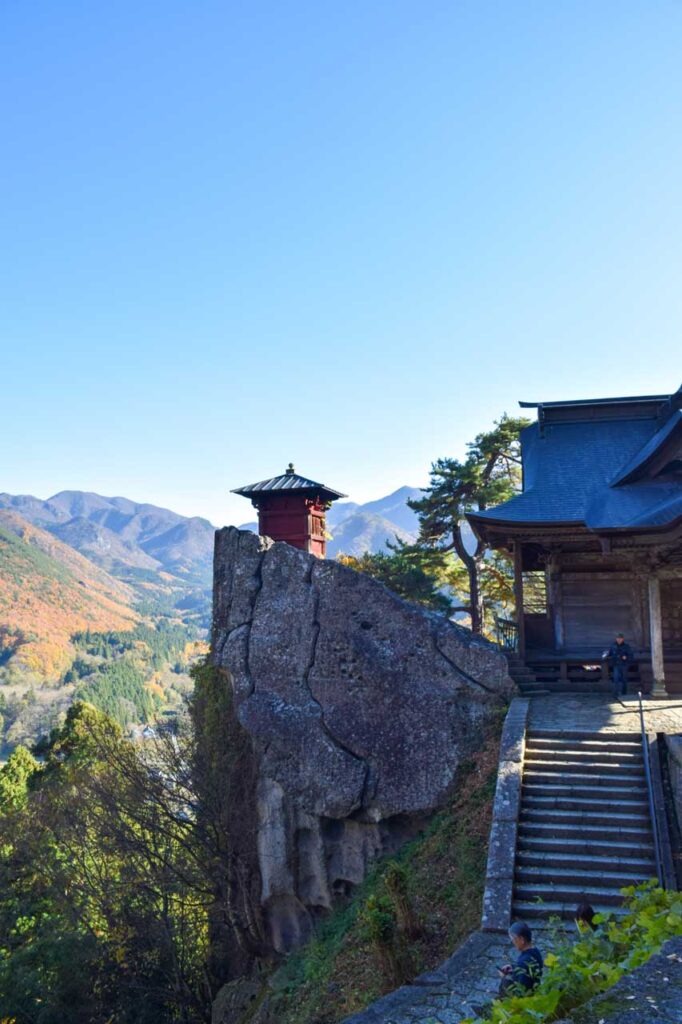
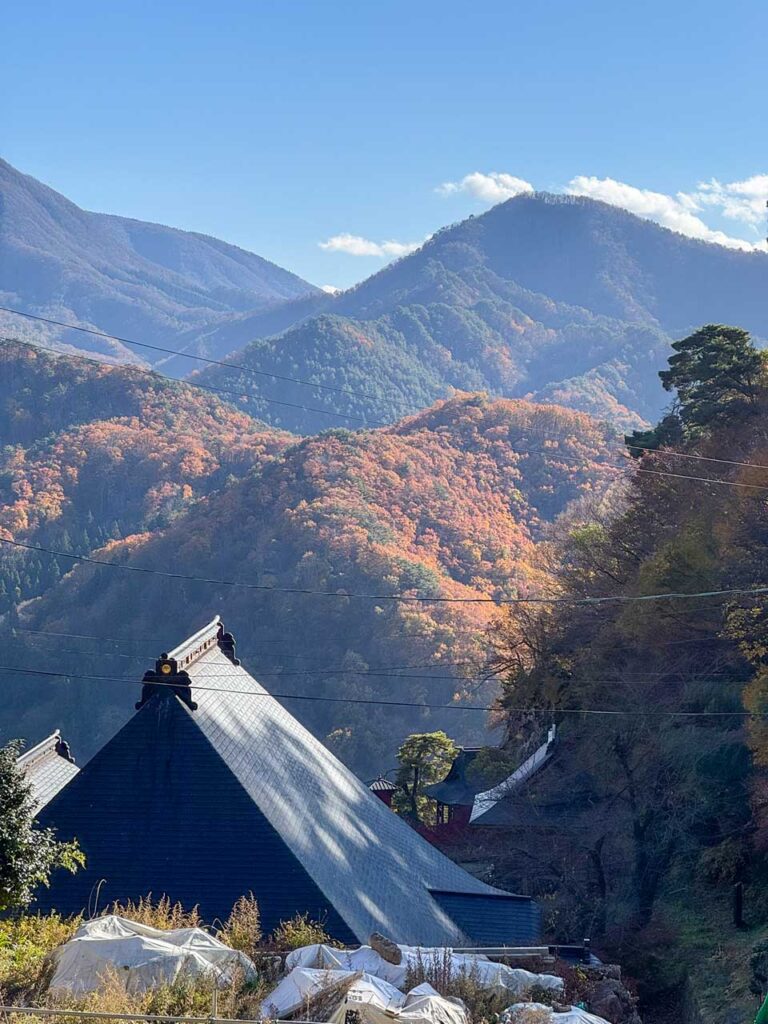
Beside it, perched dramatically on a rocky outcrop, is the small red Nokyodo building. This is one of the most recognisable views at Yamadera and a favourite subject for photographs.
The Nokyodo is not open to visitors, but its position against the mountain and forest is part of what makes the upper complex so memorable.
Godaido Hall and the Best View
Godaido Hall has the most famous viewpoint at Yamadera.
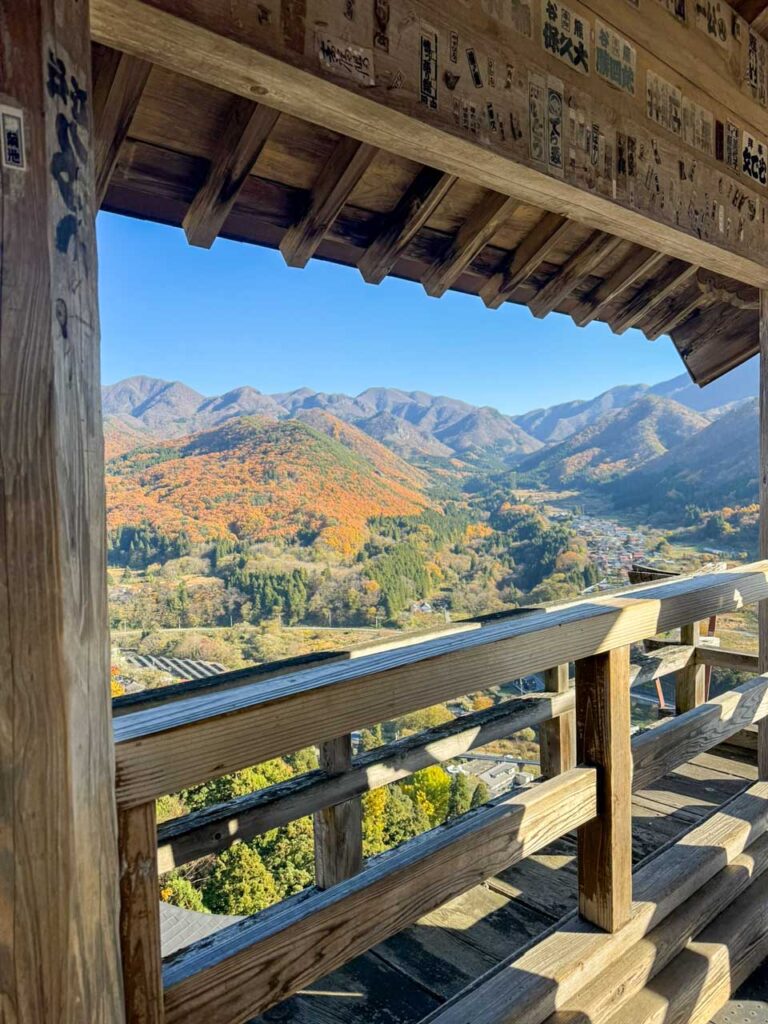
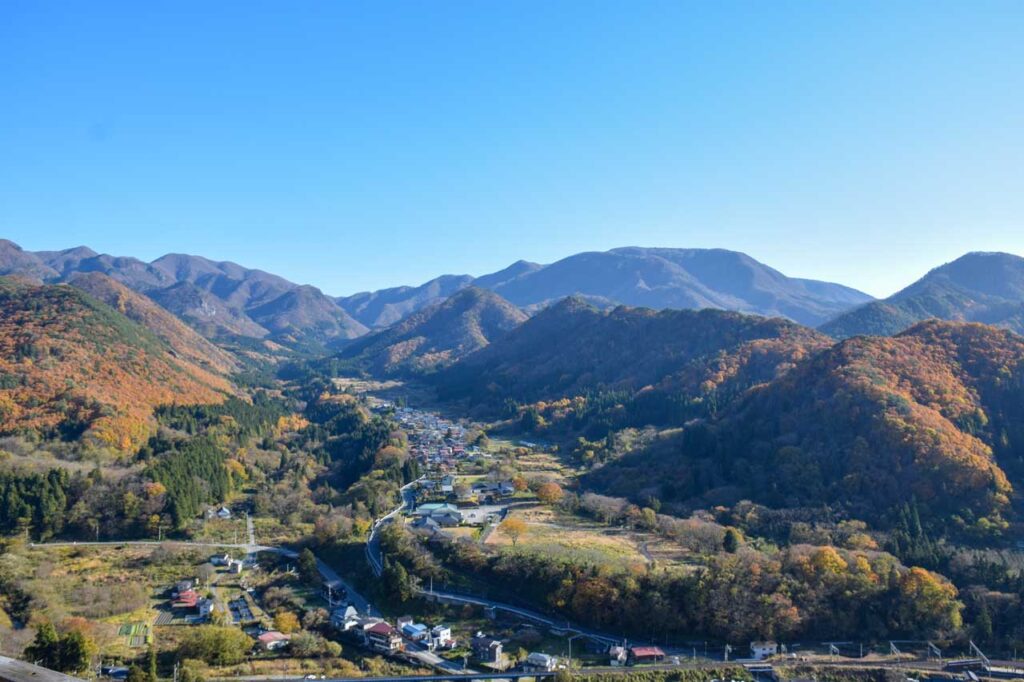
The open wooden platform projects from the side of the mountain and looks across the Tachiya River valley, Yamadera Station and the surrounding countryside.
This is the view most people imagine when they think of Yamadera.
We visited in autumn, and the landscape below was filled with red, orange, yellow and green. The temple roofs appeared between the trees, while the railway and village looked tiny at the bottom of the valley.
It was one of those places where the photographs were beautiful, but still did not quite capture how impressive it felt to stand there.
Take your time at Godaido. It is the reward for the climb, and there is no reason to rush away as soon as you have taken a photograph.
Okunoin
Okunoin marks the end of the 1,015-step route.
The inner sanctuary consists of Nyohodo Hall and Daibutsuden, which houses a large golden statue of Amida Buddha.
Godaido has the more dramatic view, but you should continue to Okunoin to complete the route. It feels quieter and more devotional than the viewpoint, providing a fitting end to the climb.
How Difficult Is the Yamadera Climb?
The climb is tiring but not technically difficult.
There are no ropes, ladders or exposed mountain trails. The entire route follows a maintained stone staircase, although some steps are uneven and there are no step-free alternatives to the upper temple.
A reasonably fit visitor should be able to reach the upper complex in 40 to 60 minutes. That includes short stops but not long photography breaks.
The return is faster, although descending can be harder on the knees.
You do not need hiking equipment, but proper walking shoes or trainers are strongly recommended. Sandals, smooth soles and high heels would make the climb unnecessarily difficult.
How Long Do You Need at Yamadera?
Allow at least four hours in Yamadera itself if you want to climb the temple, enjoy the views and have something to eat.
A sensible breakdown is:
- Walk from the station to the temple: 10 minutes
- Explore the lower temple area: 20 to 30 minutes
- Climb to Okunoin: 40 to 60 minutes
- Explore the upper complex and Godaido: 30 to 45 minutes
- Walk back down: 30 to 45 minutes
- Coffee or lunch in town: 45 to 60 minutes
- Waiting time before your train: depends on the timetable
The temple’s official estimate for the return climb is approximately 90 minutes, but that does not allow much time for photographs, views or exploring the individual buildings.
Including travel from Sendai, treat Yamadera as a full-day outing. It can be completed in half a day, but the train schedule may force you to rush or spend a long time waiting at the station.
A Suggested Yamadera Day Trip from Sendai
A relaxed day could look like this:
- Take a morning JR Senzan Line train from Sendai to Yamadera.
- Check the return train schedule immediately after arriving.
- Walk through the town towards Risshaku-ji.
- Visit Konponchudo and the lower temple buildings.
- Pay the mountain admission at Sanmon Gate.
- Climb through the cedar forest towards Niomon Gate.
- Visit Kaizando and photograph Nokyodo.
- Stop at Godaido for views across the valley.
- Continue to Okunoin.
- Walk back down to the town.
- Have soba at Maidoya Shokudo.
- Stop for coffee at TsukiCoffee.
- Return to Yamadera Station in plenty of time for a regular train to Sendai.
Whether you eat before or after climbing will depend on your train time and when the restaurants are open.
Where to Eat in Yamadera
Maidoya Shokudo
Maidoya Shokudo is a small restaurant near the approach to the temple.
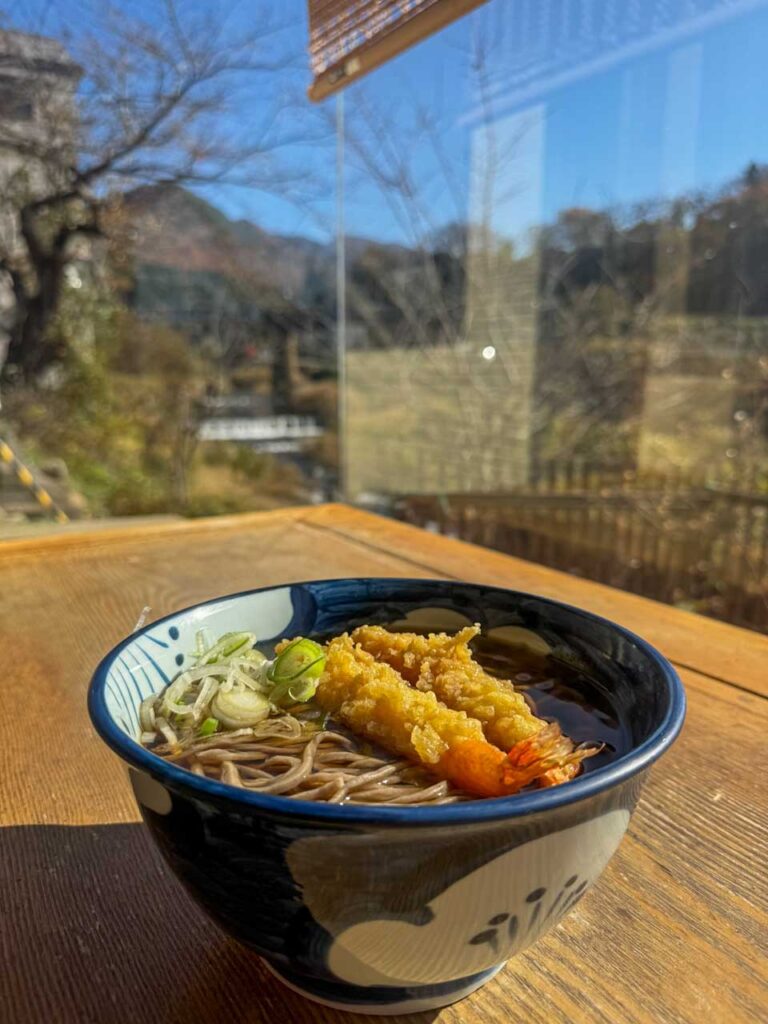
We stopped here for soba noodles with ebi tempura after exploring Yamadera. It was exactly what we wanted after climbing more than 1,000 steps: simple, filling and comforting.
Soba is one of Yamagata’s best-known foods, so it makes sense to include it in your Yamadera visit.
Small restaurants in the town can have limited opening hours and may close when ingredients sell out. Check before beginning the climb if you are relying on eating there afterwards.
Where to Have Coffee in Yamadera
TsukiCoffee
TsukiCoffee is a good place to stop for coffee while exploring the town.
It works well either before the climb or while waiting for your return train. After the stairs, sitting down with a properly made coffee feels particularly welcome.
As with other small businesses in Yamadera, check the opening day and hours before making it part of a fixed schedule.


Visiting Yamadera in Autumn
Autumn is a wonderful time to visit Yamadera.
The cedar forest remains deep green while the surrounding deciduous trees turn yellow, orange and red. From Godaido, the colours stretch across the valley and around the roofs of the temple buildings.
It can also be one of the busiest times of year. Travel early if possible, particularly during the peak autumn colour period and at weekends.
The stone steps may be damp or covered with leaves, so wear shoes with a reasonable grip.
Visiting Yamadera in Winter
Yamadera remains beautiful in winter, but snow and ice make the climb much more demanding.
Opening hours are shorter, the temple can close early because of weather conditions and sections of the stone staircase may be slippery.
If visiting in winter:
- Wear waterproof footwear with strong grip.
- Consider carrying removable ice cleats.
- Check the weather before travelling.
- Start early because daylight is limited.
- Confirm that the upper temple route is open.
- Check the Senzan Line for weather-related disruption.
Do not underestimate the combination of snow, stone steps and steep drops.
What to Bring
- Comfortable trainers or walking shoes
- Cash for temple admission and small restaurants
- Water
- A light layer for the cooler upper mountain
- Rain protection if the weather is uncertain
- A small towel during warmer weather
- A charged phone
- A screenshot of the return train timetable
- Ice grips if visiting during snowy or freezing conditions
There are shops and vending machines around the town, but fewer facilities once you begin climbing.
Opening Hours and Admission
Current adult admission to the upper temple complex is ¥500, paid in cash at the Sanmon Gate.
The temple generally opens from 8:00 until 16:00 during the warmer months. Winter admission normally begins at 8:30, with the last entry around 15:00. Closing can be brought forward because of snow or poor weather.
Check the official Risshaku-ji website before travelling, particularly if visiting late in the day or during winter.
Practical Tips for Visiting Yamadera
- Check the outward and return train schedules before leaving Sendai.
- Make sure your train continues beyond Ayashi or Sakunami to Yamadera.
- Do not assume every train at Yamadera accepts normal tickets.
- Watch for sightseeing trains marked as reserved seating only.
- Carry cash for the temple entrance and small local businesses.
- Wear proper shoes for the stone steps.
- Start early during autumn weekends.
- Allow more time than the basic 90-minute climbing estimate.
- Visit both Godaido and Okunoin.
- Check restaurant hours before beginning the climb.
- Take your time descending because it can be harder on the knees.
- Avoid flying a drone because the temple and surrounding trails are a no-fly area.
Final Thoughts on Visiting Yamadera from Sendai
Yamadera was one of our favourite day trips from Sendai.
The 1,015 steps sound like the main challenge, but they are also what makes the experience so rewarding. The route passes through a beautiful cedar forest, beneath old wooden gates and alongside buildings that seem to grow from the mountain itself.
Reaching Godaido and looking across the valley would be memorable at any time of year. Seeing it surrounded by autumn colour made it genuinely spectacular.
The train service requires some planning, particularly on the return journey, but Yamadera is still easy to visit independently. Check your trains, wear comfortable shoes, leave enough time for soba and coffee, and do not rush the climb.
If you are deciding which excursions to include around the city, our guide to the best day trips from Sendai also covers Matsushima and Nikka Whisky Miyagikyo Distillery.
You can also read our complete Sendai travel guide for where to stay, what to do and some of our favourite places to eat in the city.