Table of Contents
Before booking the Hidden Jakarta Tour, we spent quite a bit of time discussing whether we actually felt comfortable doing it.
Tours that take visitors into low-income communities are controversial, and understandably so. At their worst, they can turn people’s everyday lives and difficult circumstances into a tourist attraction. We didn’t want to spend an afternoon simply walking around looking at how other people lived.
But the more we read about Hidden Jakarta, the more interested we became in how this particular tour worked. It was presented as a community-based initiative, with money from the tours supporting projects within the communities and local people involved in the organisation.
Eventually, we decided to go.
There were moments when we felt uncomfortable and initially weren’t quite sure how to behave. But the experience turned out to be very different from what we’d feared, and gave us an insight into a side of Jakarta we’d never experienced before.
What Is the Hidden Jakarta Tour?
Hidden Jakarta is a community-based initiative that takes visitors into some of Jakarta’s kampungs to meet residents and learn more about everyday life in these communities.
Today, Hidden Jakarta describes its approach around three principles: Emergency, Education and Empowerment, or the 3Es. Tour fees and donations help fund emergency assistance, school supplies, meals and education, as well as support for small businesses and other community initiatives.
The organisation also emphasises local guides, small groups and community consent as part of its approach to responsible tourism.
We took the Hidden Jakarta Tour in 2018, so some of the practical details may have changed since our visit. Everything below is based on our own experience at the time.
Starting at Fatahillah Square
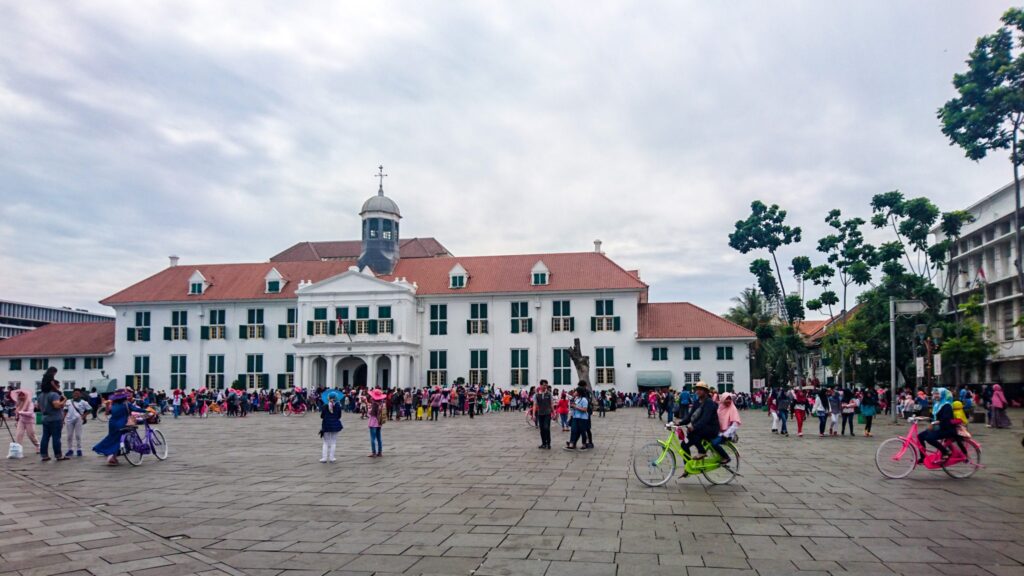
Our day started somewhere much more familiar to visitors: Fatahillah Square in Jakarta’s Old Town.
The square is one of Jakarta’s main sightseeing spots and was busy with visitors, street vendors and groups of students.
As foreigners, we were regularly approached by students wanting to practise their English. The routine was usually similar: your name, where you’re from and why you’ve come to Indonesia, often recorded on camera, followed by a selfie.
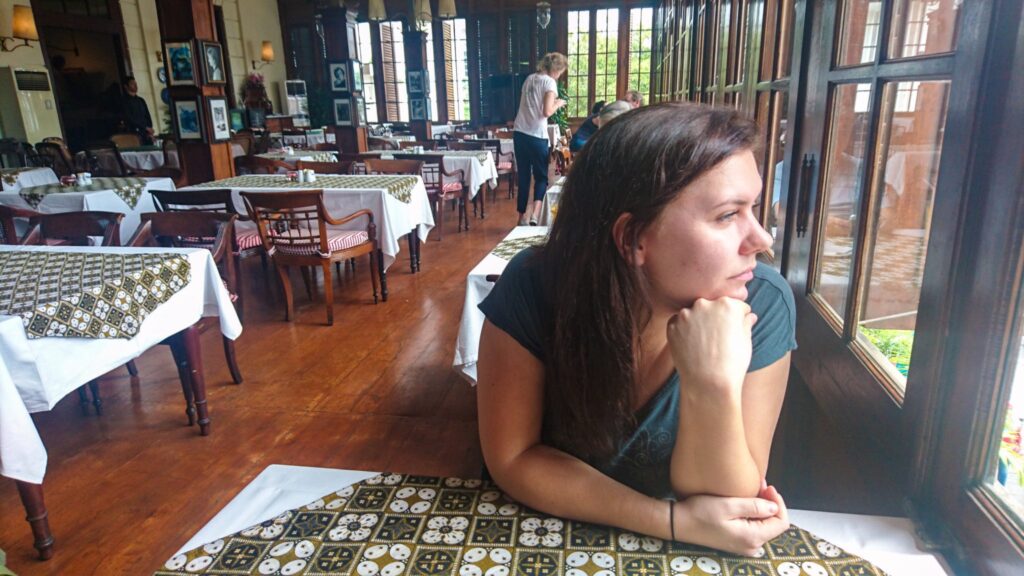
We stopped for coffee at the famous Café Batavia overlooking the square. The food was fine, but you’re definitely paying partly for the historic setting and location. The coffee, however, was excellent, with different coffees from across Indonesia to choose from.
From there, we met our guide at a local café just around the corner.
Over lunch and iced tea, we talked about what we were going to see and, importantly, about taking photos. This was something we’d been concerned about beforehand. Walking into someone’s neighbourhood and immediately pulling out a camera didn’t feel right. Our guide explained that we should judge each situation individually and that he could check with people when necessary. As it turned out, some of the people we met actively asked us to take their photos.
Leaving Tourist Jakarta Behind
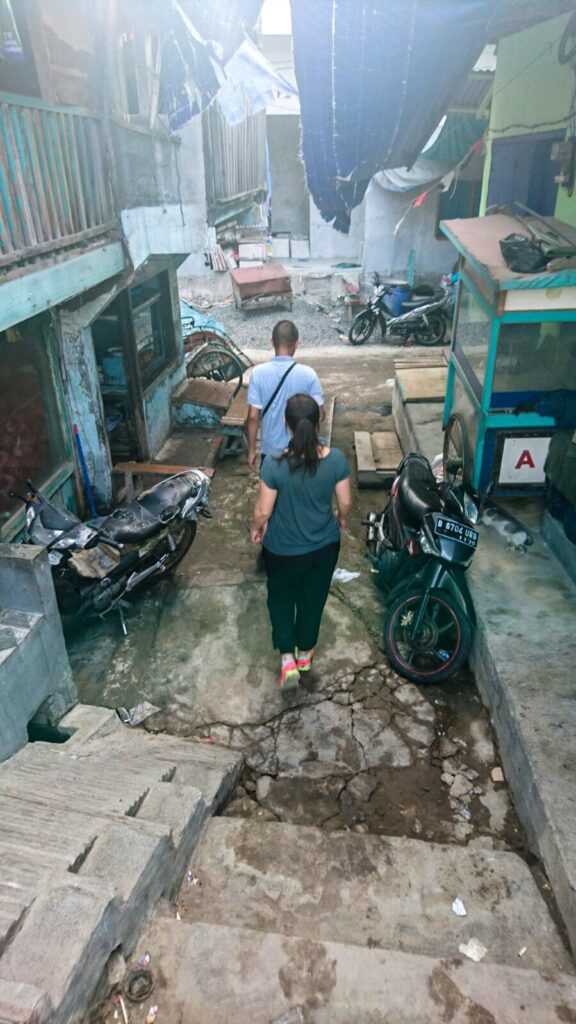
After lunch, the three of us climbed into a microlet, one of Jakarta’s small local buses, and headed off.
We got out near Jembatan Kota Intan, Jakarta’s historic Dutch drawbridge. After dodging the traffic, we ducked into a narrow alley and continued towards the railway tracks.
This was where the experience became very different from the Jakarta we’d seen until then.
Visiting the Communities
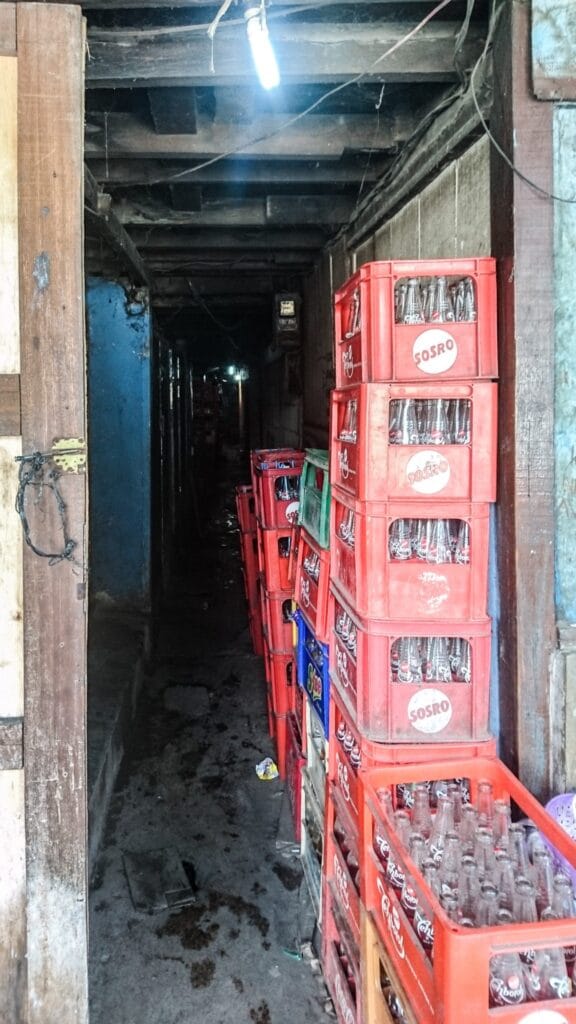
One of our first meetings was with a woman living in a small, dark space beneath the railway. She explained to our guide that she lived there with her husband, who worked nearby as a parking attendant and earned around $2 a day at the time. Their belongings were carefully arranged around the small room. They had electricity, a fridge and a fan moving the hot Jakarta air around the space.
This first meeting felt awkward. Not because of anything she did, but because we weren’t entirely sure how we were supposed to act. We were standing inside someone’s home, seeing living conditions completely different from our own and very aware that we were there as visitors.
But as the day continued, we relaxed.
Back in the narrow corridor, we climbed a ladder and walked along a thin plywood floor between different homes before eventually emerging back into the daylight.
We passed people chatting, cooking and cleaning, while children ran around playing. We said hello as we passed and gradually the whole experience began to feel less awkward and more about simply meeting people.
Heading Towards the Docks
From there, we continued towards the docks.
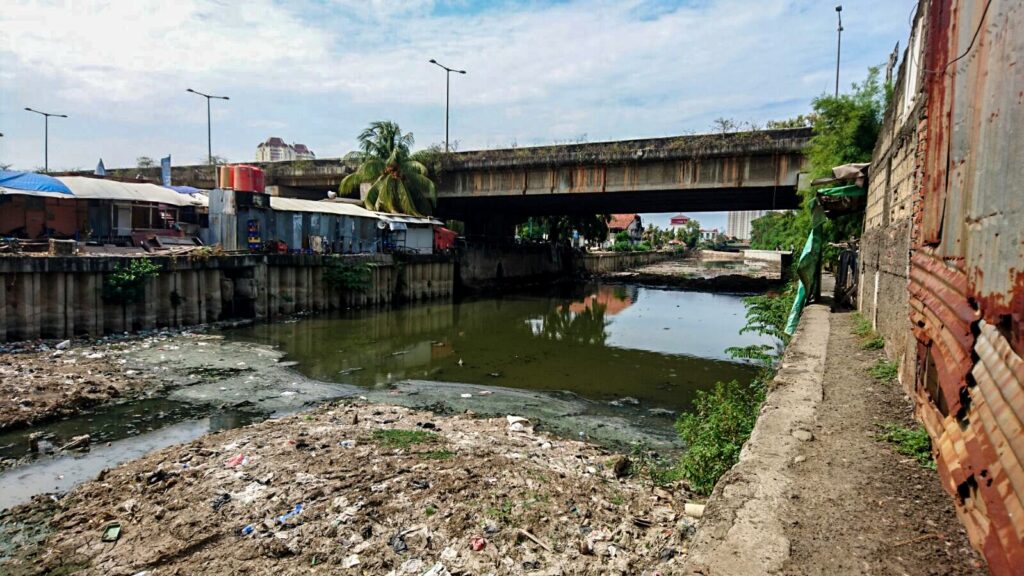
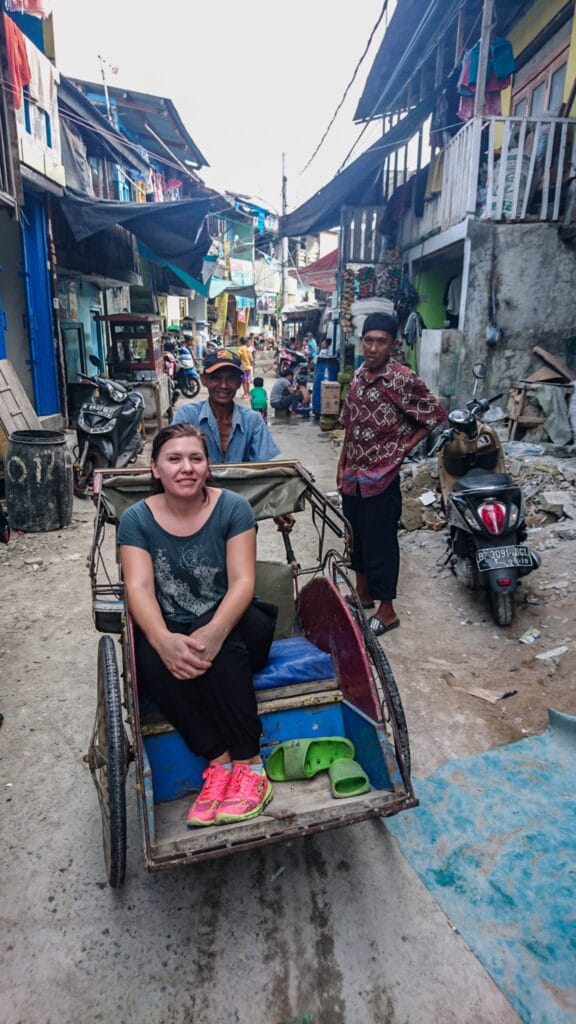
This time we climbed into a bicycle tuk-tuk and travelled through a low-income, working-class part of northern Jakarta. Eventually, we reached a small local ferry crossing a waterway. It was essentially a covered wooden platform pulled from one side to the other using a rope. On the other side, we climbed into an even smaller wooden boat.
A local man took us out through the harbour towards an old green lighthouse, with his young grandson sitting proudly at the front.
We passed dozens of boats and ships in different states of repair. After around half an hour, we reached more open water, with the lighthouse ahead and enormous container ships scattered across the horizon.
Sitting in our little wooden boat surrounded by them certainly put their size into perspective.
Life Around the Docks
Back on land, our guide took us through an area beside the docks where families were living in makeshift homes constructed from whatever materials were available.
The ground was covered with rubble, bricks, concrete and pieces of cable. Homes had been built using timber, metal sheets, tarpaulins and other materials, with some floors and beds raised above the ground.
One of the women we met lived there with her six children. At the time, she told us that her husband worked on a cargo boat travelling between Indonesia and the UAE and returned every few months.
Our guide also explained that the homes in this area weren’t officially permitted and that residents faced the possibility of them being demolished. This was what we were told during our visit in 2018, and we can’t comment on the situation there today.
We sat down with one family and spent some time talking. And the questions certainly weren’t all coming from us. Were we married? Where did we live? Where were we from? How much did we earn? How much did we pay in rent? Some of those questions would probably feel very personal back home, but here they were asked with genuine curiosity.
It was one of the things that stayed with us from the day. These weren’t completely one-sided encounters where we arrived, asked questions and left. The people we met were often just as interested in our lives as we were in theirs.
Seeing a Different Side of Jakarta
We’d already spent quite a bit of time in Jakarta before taking the tour, but this was completely different from the city we’d experienced until then.
Jakarta is a city of enormous contrasts. Modern shopping malls, skyscrapers and luxury hotels exist alongside communities where people live with very little security. The tour made those contrasts much harder to ignore. Our guide also talked to us about how little visibility some of these communities had within Jakarta itself and why he believed bringing visitors into the area could help raise awareness.
We can only describe what we personally saw and what we were told during our visit in 2018, but it certainly gave us a different perspective on the city.
Is the Hidden Jakarta Tour Ethical?
After actually taking the tour, did we feel differently about the ethical concerns we’d had beforehand? Yes, although we still don’t think there’s a simple answer when it comes to this type of tourism.
What made the difference for us was how much of the day involved interaction rather than observation. We sat and talked with people, answered their questions as well as asking our own, travelled around with a local guide and discussed photography and consent before entering the communities. Some people even asked us to take their photos or took photos of us.
It didn’t feel as though we were simply being led around to look at poverty, which had been our biggest concern before booking.
The community-based model was also an important part of why we chose Hidden Jakarta. Today, the organisation continues to state that its tours are run with community consent and that tour fees contribute directly to its Emergency, Education and Empowerment programmes.
That doesn’t mean every tour involving low-income communities is automatically ethical, or that there aren’t uncomfortable aspects to being a relatively wealthy visitor in someone else’s neighbourhood.
If you’re considering this type of tour, we think it’s worth looking at where the money goes, whether the community is involved in running the experience, how photography is handled and, importantly, whether residents actually want visitors there.
Based on the tour we experienced in 2018, we’re glad we went.
Our Reflections on the Hidden Jakarta Tour
Parts of the day were difficult. Seeing such different living conditions up close inevitably made us think about the circumstances we were born into and how dramatically those circumstances can shape someone’s opportunities. But some of our assumptions were also challenged.
Before the tour, we’d worried about how people would react to us being there. In reality, many of our interactions were warm, curious and surprisingly ordinary. People chatted. Children played. Someone wanted a photo. Someone else wanted to know if we were married. Those everyday interactions were ultimately what stayed with us most.
It was also another reminder of why we’d grown to enjoy Jakarta so much. “Why did you come to Jakarta?” was a question we were asked constantly during our time in the city. Our answer was usually simple: the food and the people. After taking the Hidden Jakarta Tour, that felt even more true.
Would We Recommend the Hidden Jakarta Tour?
Based on our experience in 2018, yes. The Hidden Jakarta Tour showed us a part of the city we would never have experienced travelling independently and led to conversations and encounters we wouldn’t otherwise have had. However, we’d still recommend doing your own research before booking. Organisations, communities and tours can change, and our experience was several years ago.
Hidden Jakarta currently describes itself as a community-based tourism initiative operating with local guides, small groups and community consent, with tour fees helping fund its 3E programmes.
If that’s the kind of experience you’re looking for, we’d recommend reading more about how Hidden Jakarta operates today before deciding whether it’s right for you.
For us, the tour wasn’t about seeing the “real Jakarta”, because there isn’t one single version of a city this enormous. It was about understanding another part of it.


This site is protected by reCAPTCHA and the Google Privacy Policy and Terms of Service apply.