Top Posts
Namibia Self Drive Safari vs Guided Tour: Which Is Better?
Namibia Self Drive: Everything We Learned Driving a 4×4 Across Namibia
Bosnia and Herzegovina Itinerary: Our 1 Month Route by Bus
Our 2 Week Albania Itinerary
Using Trusted House Sitters to Support Your Travels
Sam’s Fulltime Travel Packing List
Our 9-Day Namibia Tour with Chameleon Safaris: An Honest Review
Best Satay in Yogyakarta: Where to Eat Sate in Jogja
How to Hike to Salto El Limon, Las Terrenas
Where to Eat in Belgrade: Best Restaurants & Local Spots
LBSB World
  • Home
  • Destinations
    • Africa
      • Namibia
    • Asia
      • Indonesia
    • Europe
      • Albania
      • Bosnia-Herzegovina
      • Croatia
      • Montenegro
      • North Macedonia
      • Serbia
  • Travel Itineraries
    • Our 9-Day Namibia Tour with Chameleon Safaris: An Honest Review
    • Our 2 Week Albania Itinerary
    • Bosnia and Herzegovina Itinerary: Our 1 Month Route by Bus
    • Namibia Self Drive: Everything We Learned Driving a 4×4 Across Namibia
  • Plan Your Trip
    • How to Deal with Travel Burnout (And Start Enjoying Travel Again)
    • Sam’s Fulltime Travel Packing List
    • Using Trusted House Sitters to Support Your Travels
    • Namibia Self Drive Safari vs Guided Tour: Which Is Better?
  • About Us
    • About Sam & Livia
    • The Story Behind Our Full-Time Travel Life
    • abearcalledpaddington
Tag:

How to

Plan Your Trip

Using Trusted House Sitters to Support Your Travels

by Sam May 20, 2026
written by Sam

Travel does not always need to revolve around hotels, bookings, and nightly rates, and house sitting offers a refreshing alternative that can completely reshape how you move through the world. Instead of paying for accommodation, you exchange your time and care for a place to stay, often in locations you might not otherwise afford.

One of the most well-known platforms for this is TrustedHousesitters, which connects homeowners with travellers who are willing to look after their homes and pets while they are away. It is a simple idea on the surface, but in practice it opens the door to a much more grounded and sustainable way of travelling

What Is House Sitting?

The Basic Idea

At its core, house sitting is an exchange based on trust and mutual benefit, where you stay in someone’s home while they travel, and in return you take care of their property and, in many cases, their pets. Rather than a financial transaction, the agreement is built on being an exchange.

Why It Works

This setup works because both sides gain something meaningful, as homeowners can leave knowing their home and pets are in safe hands, while travellers gain access to comfortable accommodation without the usual cost. As a result, it creates a balanced arrangement that feels practical rather than transactional.

Why It’s Great for Long-Term Travel

Reduce Accommodation Costs

Accommodation is often the single biggest expense when travelling long-term, and removing or reducing that cost can significantly extend how far your budget goes. With house sitting, you can stay in homes for days, weeks, or even months without paying rent, which allows you to allocate money to experiences instead.

Live Like a Local

While hotels are designed for convenience and short stays, living in someone’s home naturally slows things down and changes your perspective, as you begin to shop locally, cook your own meals, and settle into everyday routines. Over time, destinations feel less like temporary stops and more like places you genuinely experience.

Better Work-Life Balance

For remote workers, house sitting provides a level of stability that is often difficult to achieve while constantly moving, since you typically have access to WiFi, a proper workspace, and a comfortable environment. This makes it much easier to maintain productivity while still enjoying the benefits of travel.

What You’re Responsible For

Pet Care

In many cases, house sitting involves caring for pets, which can range from feeding and walking dogs to simply keeping animals company throughout the day, depending on their needs. While this adds responsibility, it also brings a unique element to the experience, as pets often create a sense of routine and connection.

Home Care

Beyond pet care, you are expected to look after the home itself by keeping it clean, secure, and well-maintained, which may include tasks like watering plants or handling small day-to-day responsibilities. Clear communication with the homeowner beforehand ensures that expectations are understood on both sides.

How to Get Started

Create a Strong Profile

Your profile is one of the most important parts of getting started, as it acts as your introduction to potential homeowners and sets the tone for how trustworthy and reliable you appear. Including clear photos, a detailed description, and relevant experience can make a significant difference.

Apply Thoughtfully

Rather than sending generic messages, it is much more effective to tailor each application to the specific house sit, showing that you have read the listing carefully and understand what the homeowner is looking for. This extra effort often increases your chances of being selected.

Build Reviews

The first few house sits are usually the most important, as positive reviews help build trust and credibility on the platform, which in turn makes it easier to secure future opportunities. Over time, a strong profile can open doors to more desirable and longer-term stays.

What to Expect

Competition Can Be High

Popular destinations often attract a large number of applicants, which means that timing and the quality of your application both play a crucial role in whether you are chosen. Applying early and writing thoughtful messages can help you stand out.

Not Completely Free

Although accommodation is covered, there are still other travel costs to consider, such as transport, food, and activities, and platforms like TrustedHousesitters also require a membership fee. However, even with these costs, the overall savings can be substantial.

Commitment Matters

House sitting comes with real responsibility, as you are looking after someone’s home and, in many cases, animals that rely on you, so reliability and consistency are essential. Unlike a hotel booking, you cannot simply cancel last minute without consequences.

Is It Right for You?

Ideal For

House sitting tends to work best for travellers who value flexibility and are comfortable with a certain level of responsibility, particularly remote workers and those who prefer slower, more immersive travel experiences. Animal lovers often find it especially rewarding.

Less Ideal For

On the other hand, it may not suit travellers who prefer fast-paced trips or complete flexibility, as house sits require planning and commitment to specific dates and responsibilities. Also you will need to put some hours into pet care, as well as not being able to leave the pets alone for too long. If your schedule changes frequently, this style of travel can feel restrictive.

In the end

House sitting is not just a way to save money, but rather a different approach to travel that shifts the focus from constant movement to meaningful stays and everyday experiences. Instead of passing through destinations, you spend time in them, which often leads to a deeper connection with the place.

For many travellers, that change in pace and perspective becomes one of the most valuable parts of the journey.

GET 25% OFF Trusted House Sitters!

Use this link to get 25% off your first Annual Membership!
You get a great discount and we get 2 months for free, so it’s totally win-win!

May 20, 2026 0 comments
FacebookTwitterPinterestLinkedinRedditStumbleuponWhatsappTelegramThreadsOpenAIChatGPTEmail
AlbaniaMacedonia

How to cross the land border between Albania and North Macedonia by foot

by Livia August 15, 2019
written by Livia

One of our most googled items during our travels through balkans was how to cross land borders between countries. Most of them were pretty straight forward, especially since we were on busses who knew which borders are open for foreigners etc. However, at one point we had to cross the border by foot, as there were no bus services between our to destinations. This was the border between Albania and North Macedonia. As there wasn’t a lot of updated information around we thought we’d share our story of how to cross the land border between Albania and North Macedonia by foot.

Our last stop in Albania was Korçë, and from there we wanted to go to Ohrid in North Macedonia. There are different borders to cross between these two countries, but the one that made most sense for us was the Tushemisht – St. Naum border (you can see it marked on our Albania travel map and North Macedonia travel map). We quickly realized we had to do this in steps, and also cross this border by foot.

How to cross the land border between Albania and North Macedonia by foot

Step 1: Korçë to Pogradec

From Korçë we jumped on a bus to the small town Pogradec. Which is also a quite popular place to stop for a few days, as its just on Lake Ohrid, which is shared between North Macedonia and Albania. But we had decided to head straight to Ohrid. The busride was about an hour and only cost us 150 lek each and there was a bus every hour, so this part was really easy.
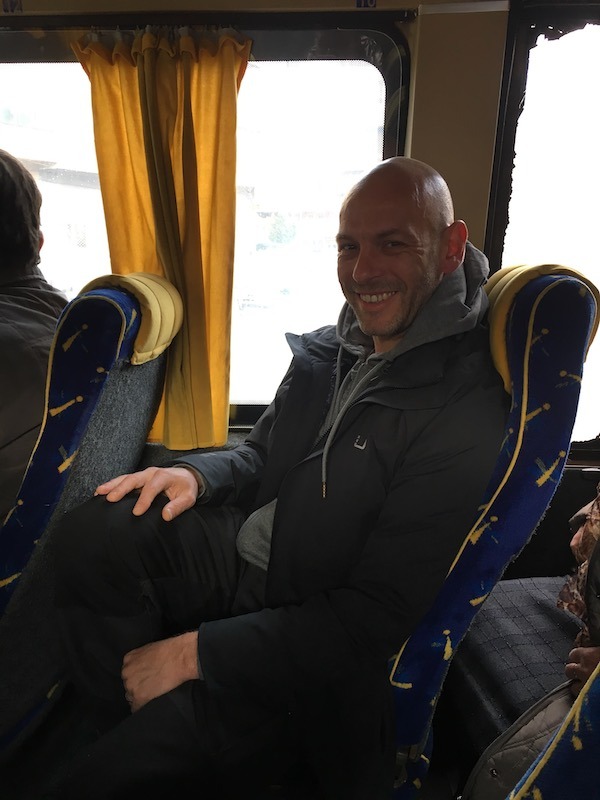
Happy Sam on the first part of our border crossing

Step 2: Pogradec to Tushemisht (Albanian border control)

From Pogradec to the actual border we had no choice than to take a taxi. You could walk, but it is quite far from the town where the bus stops and we didn’t find any busses going that way. There is probably some local bus going that way, but since the 15-20 minute taxi is only 700 lek it was just easier to catch one from the bus stop in Pogradec. Pogradec is also where you want to get rid of all your Lek (but save enough to pay the taxi!!) since there’s nothing by the border control.

Step 3: Tushemisht border control (leaving Albania)

Arriving at the border control there was a few cars asking if we wanted a taxi somewhere, but since it would be quite expensive to go all the way to Ohrid from there we had already decided to walk over the border and catch a bus on the other side.

The Albanian border control here is situated right on the lake, so you have beautiful views from here. Normally  that wouldn’t really have mattered, but when we arrived the computers were all down so we had to wait for 30 minutes or so before we could cross the border and leave Albania.

The crossing itself was really easy once the computers were running, they even had a walking lane in addition to the car lanes. It was also very quick. I’m not sure about the opening times, but during day time you won’t have any issues, and if you cross by foot you will want to do this at day time since it is quite a lot of walking included.
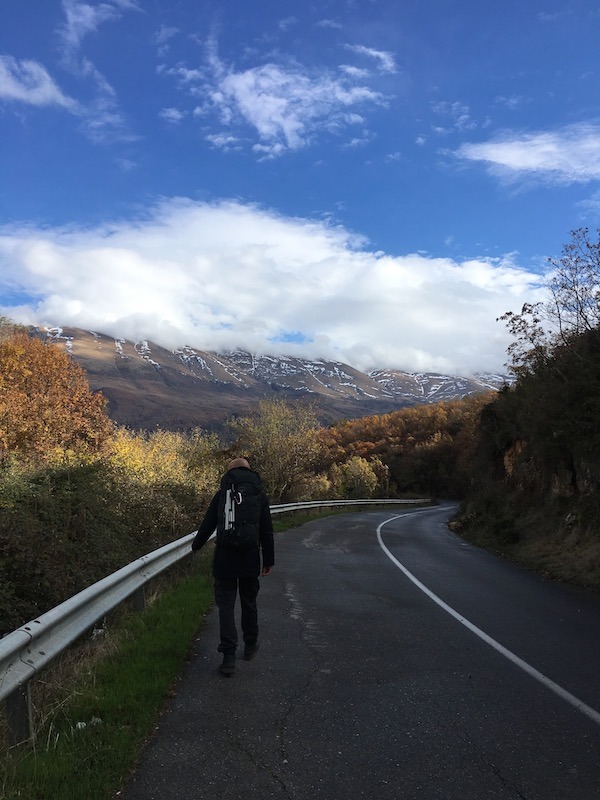
The walk in between the two border controls

Step 4:  St. Naum border control (entering North Macedonia)

This was the only border  where the two border controls were quite far from each other, we had to walk for about 10-15 minutes along a road before even coming to the North Macedonian border control. However, the walk was nice and we were lucky with the sun.

This border control was probably the hardest one of all borders we crossed in Balkans. First we had to queue up with the cars as there was no walking lane, and even if it just was 2 cars in front of us it took quite some time as they checked papers very, very throughly.

After having our passports checked we had to walk to 2 other people who asked us lots of questions. Or actually they asked Sam lots of questions, they just looked at my passport and said “ah Swedish, welcome”. However, Sam, not sure if it was because he’s Brittish, got loads of questions, such as “Why are you here?”, “How long did you spend in Albania?”, “How long will you spend in North Macedonia?”, “Where are you staying in North Macedonia?”, “Are you carrying any drugs with you?” etc. etc. It was quite a difference between how they welcomed me and Sam. But after all the questions we were allowed to enter North Macedonia.
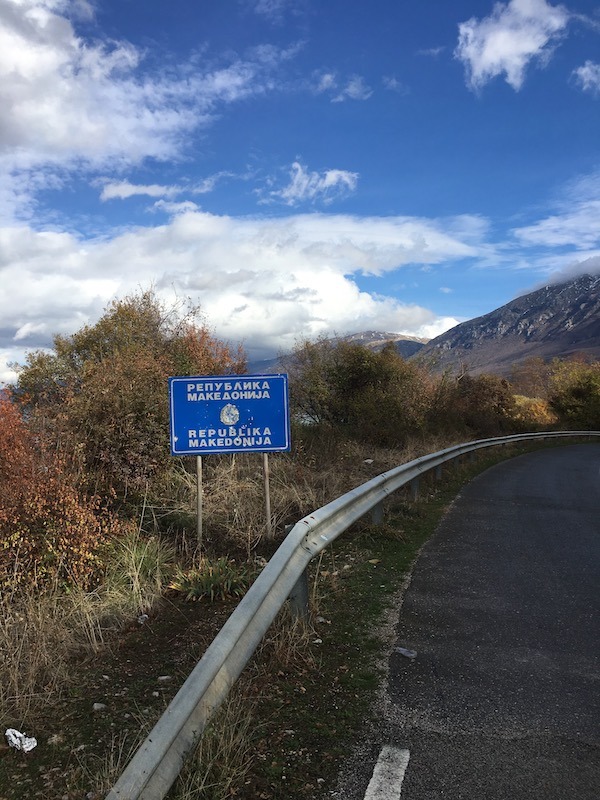
Welcome to North Macedonia

Step 5: Walking from the border to St. Naum

This bit was quite a miss on our part, we hadn’t really realized how far it was to walk from the border control to the nearest bus station in St. Naum. There is also some military zones that you’re not allowed to enter. Our biggest tip for this part is to have downloaded any type of map, as you most likely wont have internet when you’ve enterd North Macedonia and it’s not just to follow the road.

To start with you will follow the asphalt road leading from the border control, however, at one point you will want to head into a little path on the left (there is a small signpost for a church ‘✝’) through the forest/nature area as this is much closer than following the road the whole way. This little path is not really marked except for the little sign post, so this is where you will need your downloaded maps. There is also military zones in this area which you need to stay clear from.

After some discussions we did find the path. Sam has a backpack so he had no issues walking here, however, my bag is a rolling bag.. this is an issue on this road as its just a path with grass and mud. I can tranform my bag into a backpack, but it’s too heavy for me… Anyway, in the end we found the way and got to St. Naum after a 30ish minute walk.

If you don’t want to carry all your luggae it might be worth taking a taxi or cross the border on the north part of Lake Ohrid where you can go by bus.

Step 6: St. Naum to Ohrid

St. Naum is supposed to be a beautiful place for a stop. However, we skipped it as we didn’t want to carry around our bags anylonger so started walking towards the bus station, which is situated just outside the entrence to the St. Naum area.

The bus takes about 1 hour and should cost 100 denar per person. But, if an older man stops in a car and asks if you want to ride with him instead, take the oppotrunity. Not sure if more than one man does this now, but the one we went with is a retired proffessor and drives tourists between Ohrid and St. Naum for the same price as the bus, as a way to get a little bit more money. I had actually read about him on a blog before going, otherwise I’m not sure if I would have taken the offer. But we did, which was great – as it didn’t cost us more and was much quicker than the bus. He dropped us off close to our AirBnb in Ohrid, I think you can ask him to drop you anywhere as long as it’s not a detour.

August 15, 2019 0 comments
FacebookTwitterPinterestLinkedinRedditStumbleuponWhatsappTelegramThreadsOpenAIChatGPTEmail
Albania

How to Travel Albania by Bus

by Livia June 9, 2019
written by Livia

Last updated: May 2026

Before we went to Albania we had read some horror stories about bus travel in Albania. These blogs left us quite uncertain and even a little worried. We got on a bus in Kotor, Montenegro that would take us to Shkoder, in the Northern part of Albania.

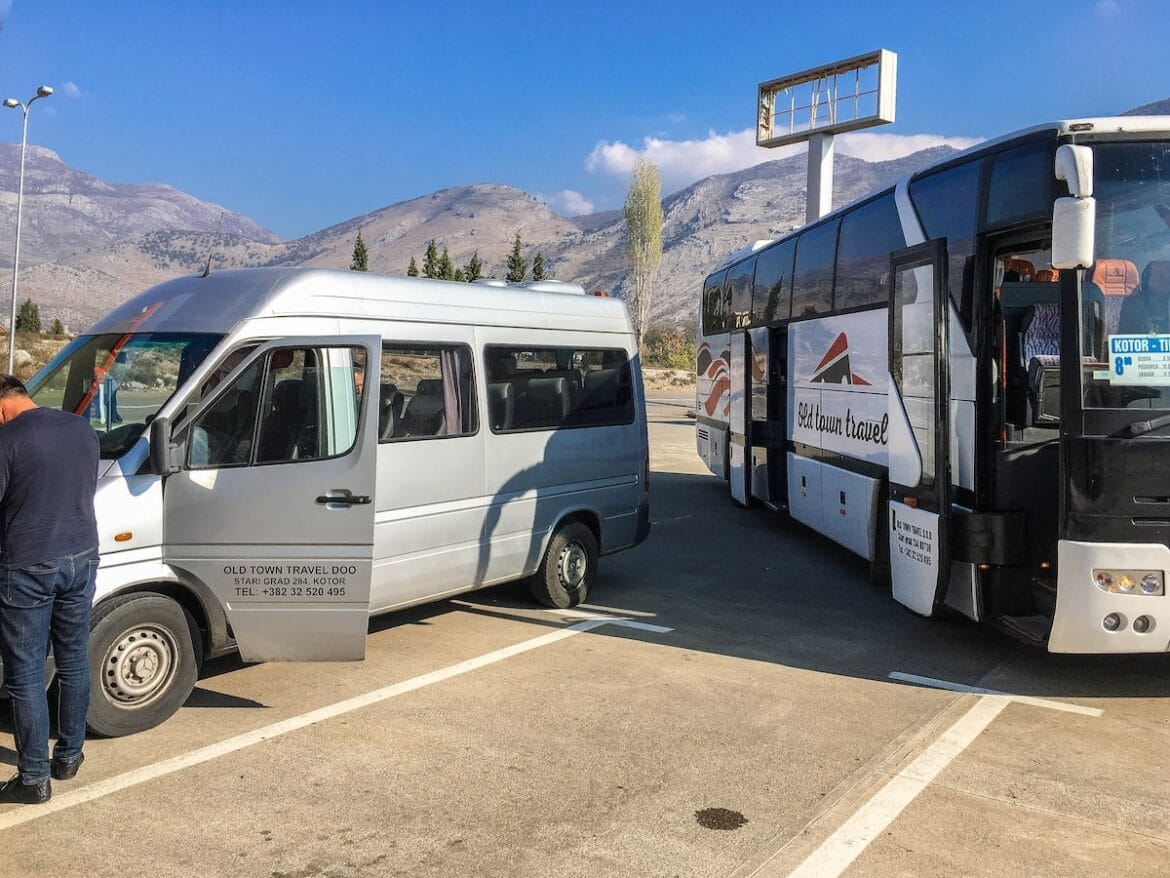
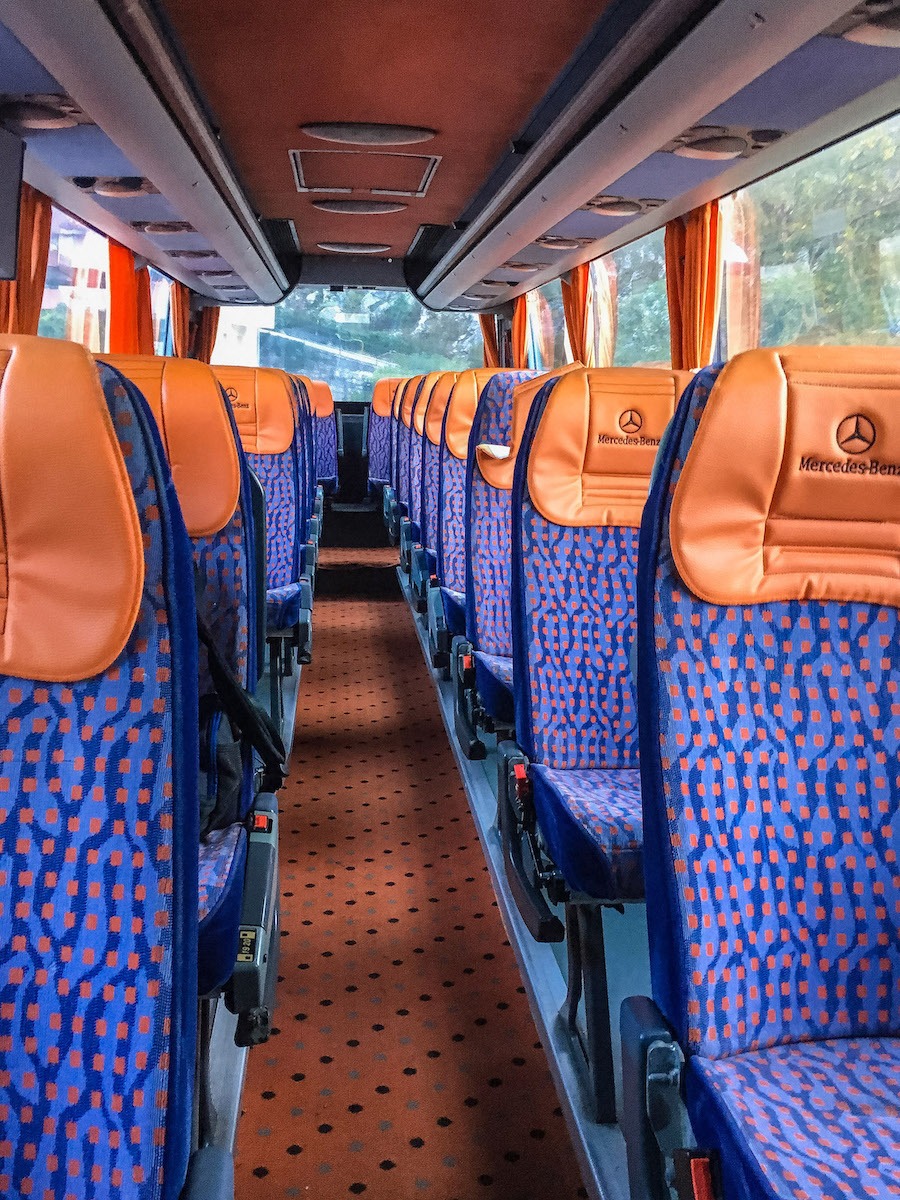
We started off in a big bus with only one other passenger going through the mountains and south towards Albania. It all went very well and immigration at both borders was quick and easy, we didn’t even have to get off the bus.

Our almost private bus from Montenegro to Albania

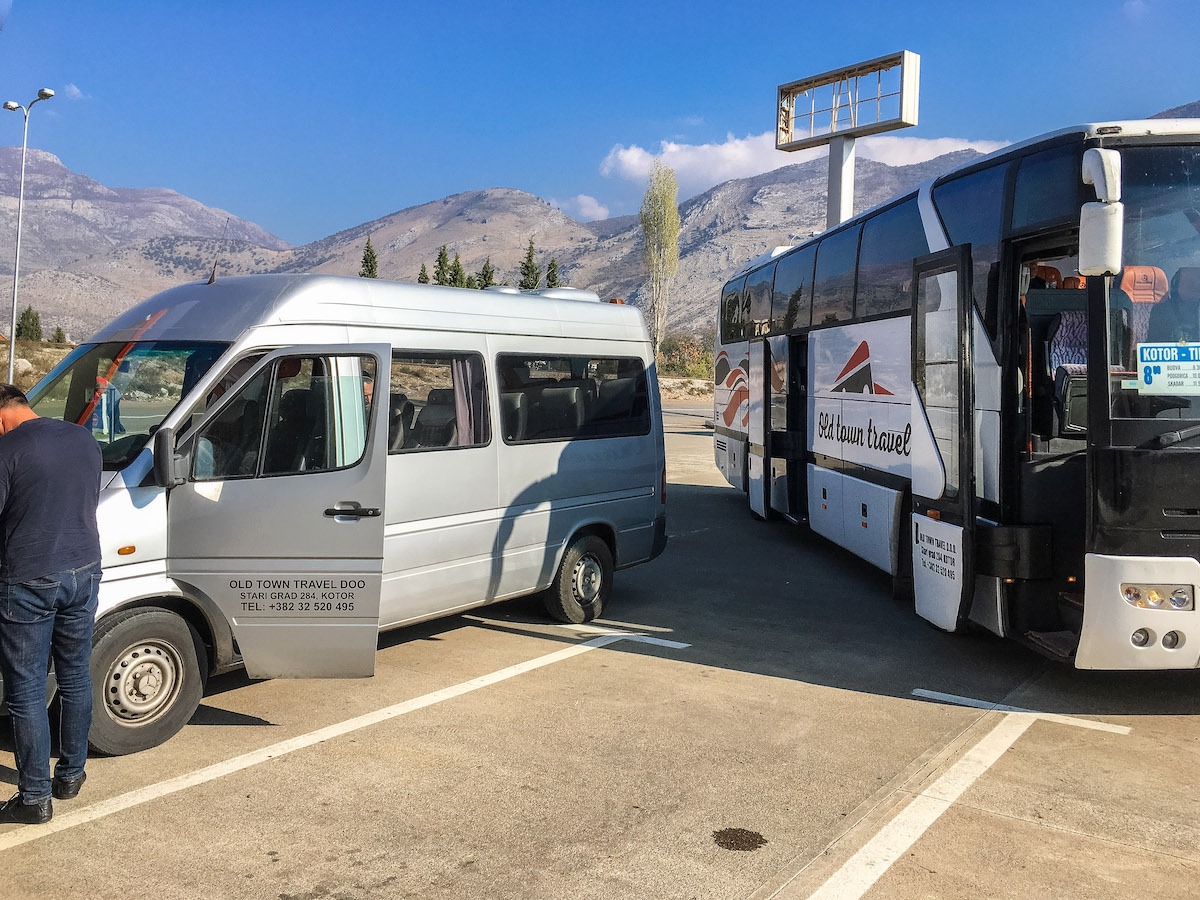
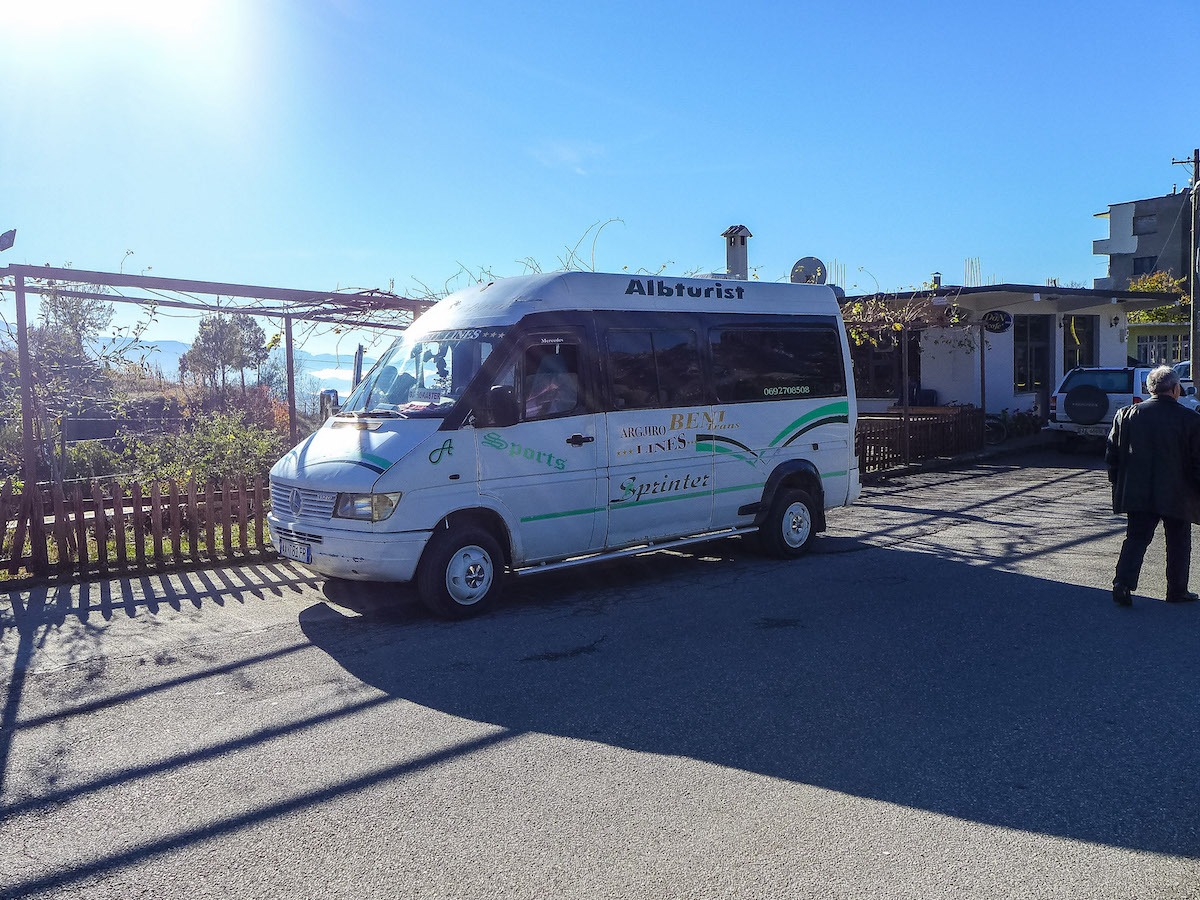
Shortly after we entered Albania the bus stopped at a petrol station and we had to change into a so called Furgon, a minivan, which are very common public transport options in Albania. After the change we continued south and got to Shkodra without any hick ups. The bus stopped at a roundabout in the centre of the city, we got our bags and jumped out.

Swap from big bus to furgon after entering Albania

We quickly learned that this roundabout was Shokdra’s “busstation”. We would quickly realize this is what many “bus stations” are like in Albania and you just had to know where in the roundabout your bus would stop. However, there are always guys shouting out where the buses are going and help you with your bags, so leaving Shkodra was no issues at all. We first asked at our hotel where the bus to Tirana was going from and they showed us on a map, where a guy was standing on the sidewalk shouting out Tirana, so we doubled checked and then got on.

So our first leg of our journey by bus through Albania was no issues, and it actually continued that way fortunately. So don’t get worried about other information you might find on the internet. Yes, you will have to ask people for help a bit more than in other countries, but people were always happy to help and we always got on the right bus.

Busstations in Albania

Busstations in Albania are not the same as in many other European countries, only a handful of places has an actual busstation, such as the one in Berat. But this busstation was also quite far out of the centre of Berat. Most busstations was just a parking lot. Without any station house or anywhere to buy food or drinks, so make sure to get that before leaving for the bus. Other times it was just on the mainstreet or in a roundabout at the edge of the city or town.

The one place it got a bit confusing for us was in Tirana. As there are a few different “busstations” depending on which direction you’re going.

Another good thing to note is that there are no specific busstops or stations really, you can jump off and on wherever you want on the road, just tell the guy taking payment and he will ask the driver to stop.

Bus schedules and Timetables in Albania

Do not try to check time tables online for busses in Albania. You won’t find the information, and if you do it is most likely wrong. Most busses we were on shouldn’t even have existed according to google searches. Yet, we could still find the bus we wanted by asking.

As there usually aren’t any real busstation, you won’t find time tables either. So what you have to do is ask a local. In some places they had a small little office next to the parking lot where the bus would stop. In Gjirokaster this was the case, and on arrival we asked how to get to Korca and that’s how we got on a bus that shouldn’t have existed and had our most memorable bus journey to date.

To common destinations you will have plenty of busses per day, however, if you’re like us and going to some less traveled places, there will only be a couple of busses per day or just one per day. So it’s always good to ask upon arrival or a couple of days in advance so you can plan your next leg of the journey. If it’s only 1 bus a day it’s very likely it leaves early morning, which is even more reason to check at least a day before to not miss it.

We found people extremely helpful and even if we had no clue how to get to our next destination there was always someone around to help out.

Another perk of going by bus in Albania is toilet/food stops like this one

Cost of travel by bus in Albania

Busses in Albania were affordable with short bus rides, 1-2 hours costing a few euros per ticket, and longer trips could be up to 10 euro per ticket. But we only had one long domestic bus for that price, otherwise we never paid more than 2-3 Euros for a ticket. It also always included bags, it’s not like the other balkan countries where you often had to pay extra for luggage.

If you’re a group of people you could also rent a furgon, mini bus, with a driver. We were 9 people who were going to the same place, and there was only one bus a day which we all wanted to catch. However, as this was a furgon bus we would never all fit with our bags and other passengers. So for 10 euro p.p. we could rent our own furgon with driver, for a 5 hour journey, Berat to Gjirokaster. Which only worked out to be 3 euros more per person than catching the scheduled bus, plus we got picked up right at the hostel instead of the busstop. This could definitely be a good option for a bigger group of people.

Is it safe to travel by bus in Albania?

In general, people drive a bit more crazy in the balkan countries than what were used to, especially compared to Sweden. Between big cities it’s usually a big pretty straight highway, so it will be an easy ride. And most likely quite fast.

If you go through the mountains however, you might have some moments of holding your breath. We had one of those bus rides, on small mountain roads, and to make it worse, parts were in fog. Everyone drove quite fast on these roads, faster than we were comfortable with. There wasn’t much traffic but still enough for us to be a bit uneasy parts of the ride. But we made it to our destination safely and I think the people that go on these roads are so used to driving on them so it isn’t as dangerous as you might think as a passenger. That’s what we told ourselves anyway…

Our furgon we took through the mountains from Gjirokaster to Korca

The verdict: How easy is it to travel through Albania by bus?

Super easy! We had no hick ups and no issues. It might not be the newest most comfortable busses, but they will take you where you need to go for a small price. You just have to be prepared to ask locals for help, and if you want to go to more off beat destinations there might be only one bus per day.

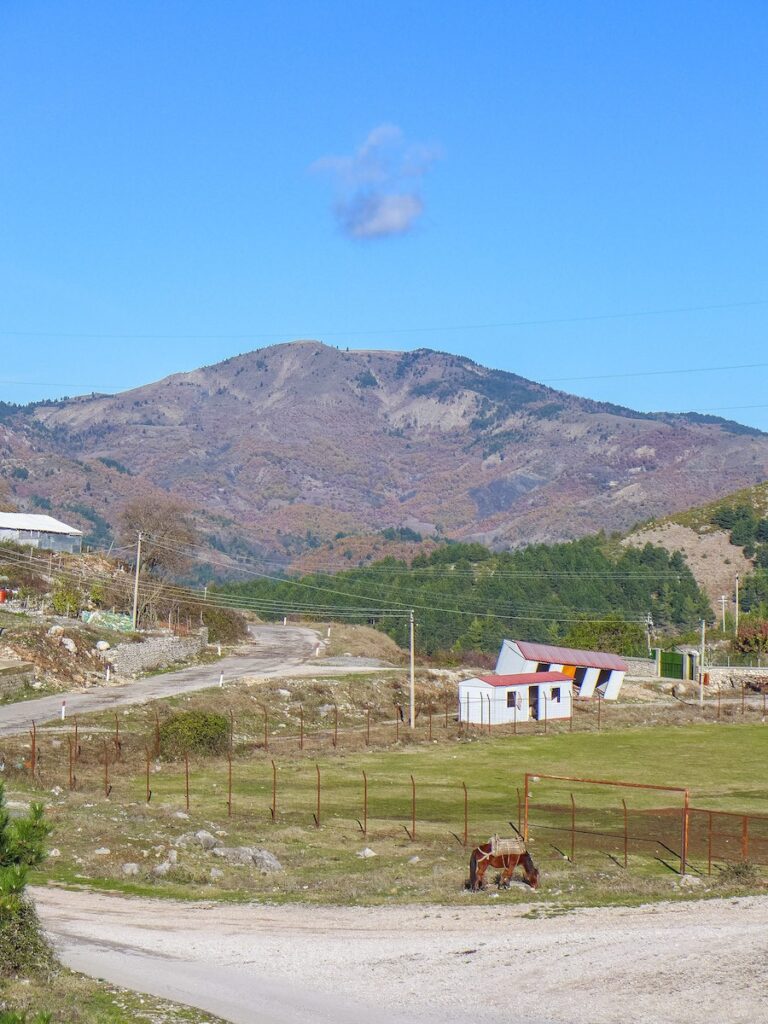
So even if it might be a tiny bit more hassle than other countries, it’s still super easy. You will also be blessed with amazing views of beautiful landscapes and nature wherever you go in the country. It can also be very social, especially on the furgos where you get close to the other passengers. We shared a long bus ride with some very sweet Albanians, who tried to talk to us and we all shared our food and snacks in the bus.

All in all, we really recommend travelling by bus in Albania. It was such a great experience and we were left with memories for life.

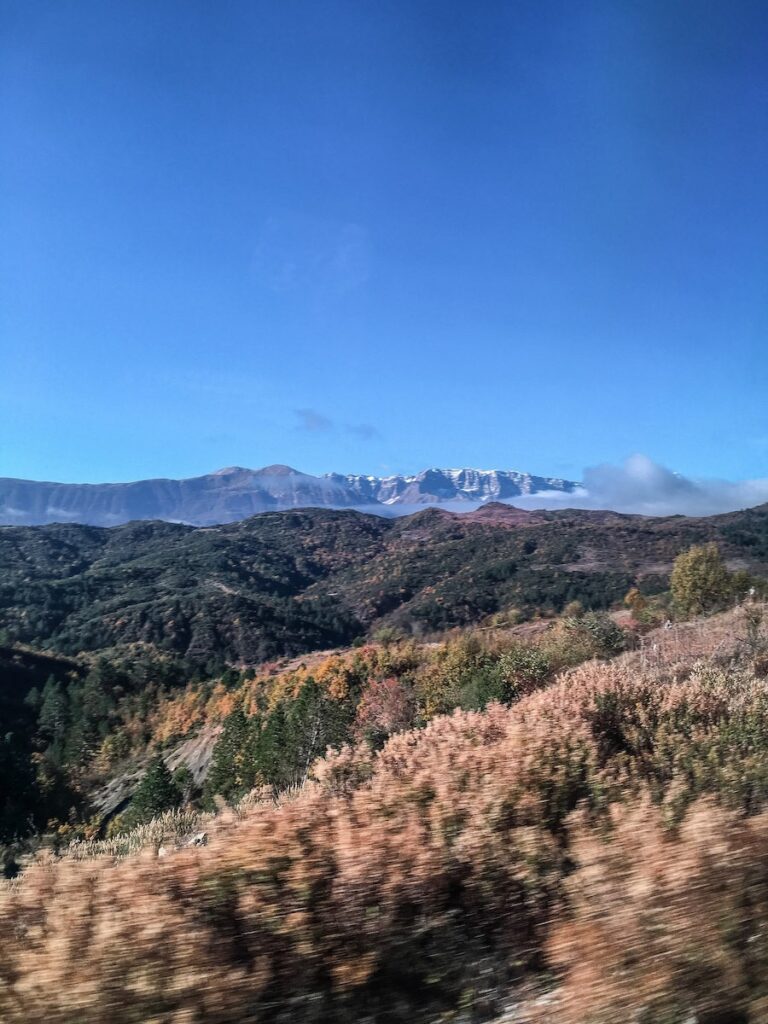
Beautiful views over the mountains from the bus window
June 9, 2019 0 comments
FacebookTwitterPinterestLinkedinRedditStumbleuponWhatsappTelegramThreadsOpenAIChatGPTEmail
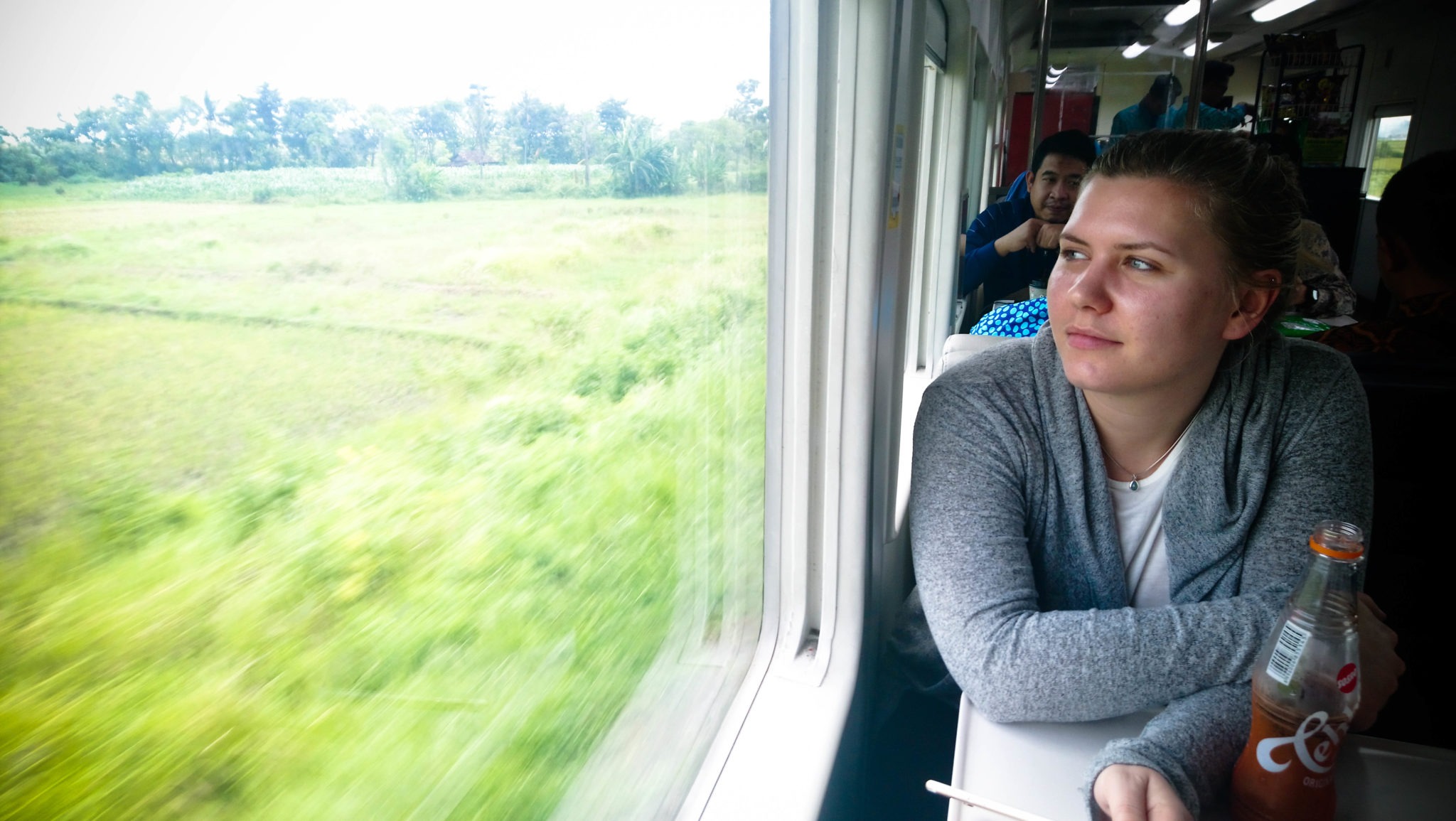
Livia enjoys the peaceful journey through the Java countryside
Indonesia

Jakarta to Yogyakarta by Train: Everything You Need to Know

by Sam July 12, 2018
written by Sam

Both of us absolutely loved the train ride, a chance to relax for a few hours and enjoy the beautiful views outside the window. This is our experience of going from Jakarta to Yogyakarta by train.

Distance: 530km
Time: 8h 40min
Cost: €25 (Executive class with air-con)

Beware – Different trains leave from different stations, this was our experience with the Executive class train travelling from Jakarta Gambir to Yogyakarta Tugu by train.

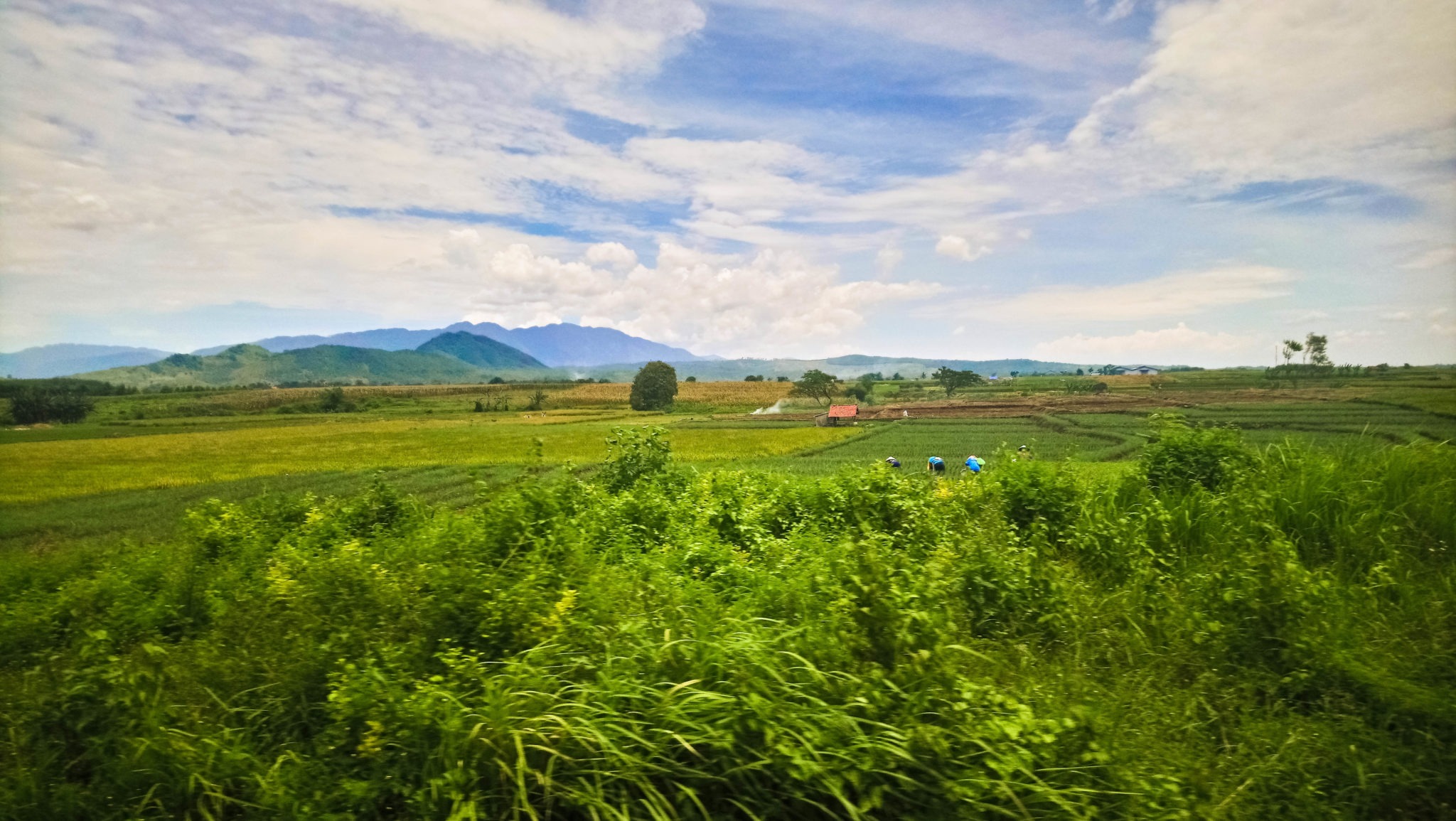
Enjoy the stunning countryside of Java from the train

Enjoy the stunning countryside of Java from the train

Buy your Tickets

You can buy a train ticket at Gambir Station (best to buy at least a day in advance). OK don’t be scared. There’s a bunch of people sitting around waiting for a ticket window… completely ignore that queue. That is for people who wish to buy tickets at a discount (service men/pensioners etc). Turn around and look behind you, there’s an air conditioned office with ‘Service Center’ written above it, inside will be two nice ladies who will sell you your train tickets and tell you what you have to do. They take Cash or Credit Cards and don’t charge anymore than the normal ticket price, and you will need your passport as identification.

Once you have your ticket you must ‘Check-in’, which you can do from 24 hours before you depart until 2 hours before departure. There was a machine where you just show it the bar code and it confirms your seat. After that, we headed back to town to pack for the early start the next day.

The Journey

We booked a blue-bird taxi via the app to collect us at 6am, even though the journey was 10 minutes from our apartment, this is Jakarta and traffic always has the potential to mess with you. So make sure to plan in sufficient time to get to the train station.

When we arrived at the train station we first grabbed a few supplies, coffee, cakes, ice-tea. Then showed our tickets and passports at the gate and headed upstairs to the platform. We found our seats very easily, nice wide, reclining and it’s all air-cooled. It’s not modern by any means, but it’s clean, pretty quiet, the toilets are acceptable (mind your head for the hooks on the inside of the toilet door!). In the main carriage there’s a small TV up front or behind which plays random TV shows and adverts. Train staff come round and check your ticket.

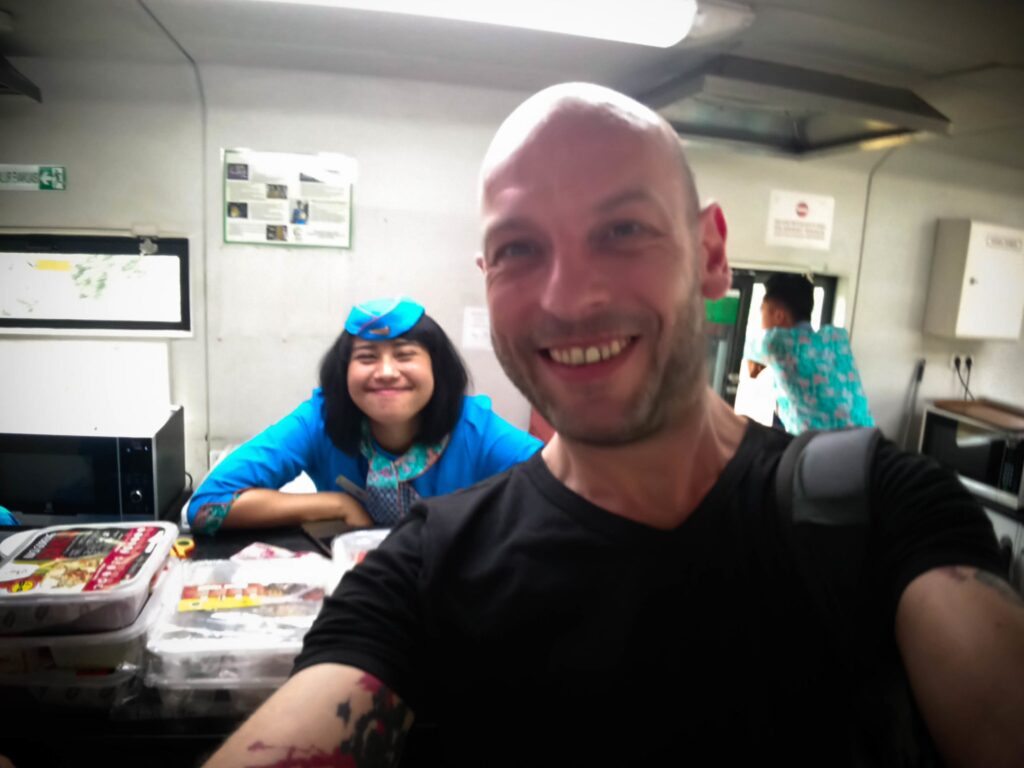
Restaurant Car on the train from Jakarta to Yogyakarta

Restaurant Car on the train from Jakarta to Yogyakarta

After about 20 mins a cart come’s round with two staff asking if you want drinks or food… None of it is great, so I hope you packed some supplies. After we exhausted the pastries we bought we headed for something hot and found the dining car and some instant noodles, which are pretty awesome in their own right. Staff are super friendly and super smiley, and yes they wanted a selfie.

There’s a couple of stops along the way if you want to stretch your legs for 5 mins or get some air, but he journey is really nice, rolling though the country side. For the best view, get the seats on the right (you can choose them when you book), as you’ll be passing through stunning green natural beauty, rice fields and volcano’s. It’s not fast, but if you catch the early train you arrive in Yogya at about 16.30.

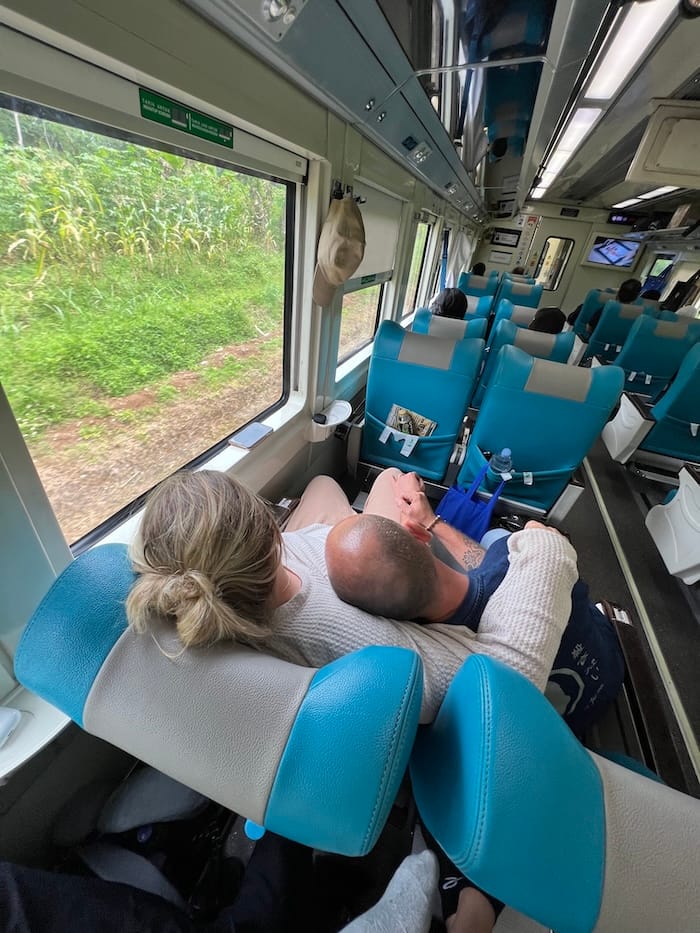
Livia enjoys the peaceful journey through the Java countryside

Livia enjoys the peaceful journey through the Java countryside

Interestingly enough, the train we caught is the same train we saw a year earlier on our Hidden Jakarta Tour.

Gambir to Tugu train passing the slums

Gambir to Tugu train 

July 12, 2018 0 comments
FacebookTwitterPinterestLinkedinRedditStumbleuponWhatsappTelegramThreadsOpenAIChatGPTEmail

Recent Posts

  • Namibia Self Drive Safari vs Guided Tour: Which Is Better?

  • Namibia Self Drive: Everything We Learned Driving a 4×4 Across Namibia

  • Bosnia and Herzegovina Itinerary: Our 1 Month Route by Bus

We use Safetywing

We use THS

Trusted House Sitters

Here’s 25% off your annual membership to TrustedHousesitters - thanks to your pet loving pals at LBSBWorld.

Join now with 25% Off!

We use NordVPN

NordVPN

Get 3 months of NordVPN right now!


The best VPN service for a free, open internet

Get NordVPN!

We use Wise

Wise

Get Zero Fees on a transfer up to €500


Spend in 150+ countries like a local with Wise card

Get Wise!

©2026 LBSBWorld - All Right Reserved - Designed and Developed by Livia & Sam

Powered by
►
Necessary cookies enable essential site features like secure log-ins and consent preference adjustments. They do not store personal data.
None
►
Functional cookies support features like content sharing on social media, collecting feedback, and enabling third-party tools.
None
►
Analytical cookies track visitor interactions, providing insights on metrics like visitor count, bounce rate, and traffic sources.
None
►
Advertisement cookies deliver personalized ads based on your previous visits and analyze the effectiveness of ad campaigns.
None
►
Unclassified cookies are cookies that we are in the process of classifying, together with the providers of individual cookies.
None
Powered by
LBSB World
  • Home
  • Destinations
    • Africa
      • Namibia
    • Asia
      • Indonesia
    • Europe
      • Albania
      • Bosnia-Herzegovina
      • Croatia
      • Montenegro
      • North Macedonia
      • Serbia
  • Travel Itineraries
    • Our 9-Day Namibia Tour with Chameleon Safaris: An Honest Review
    • Our 2 Week Albania Itinerary
    • Bosnia and Herzegovina Itinerary: Our 1 Month Route by Bus
    • Namibia Self Drive: Everything We Learned Driving a 4×4 Across Namibia
  • Plan Your Trip
    • How to Deal with Travel Burnout (And Start Enjoying Travel Again)
    • Sam’s Fulltime Travel Packing List
    • Using Trusted House Sitters to Support Your Travels
    • Namibia Self Drive Safari vs Guided Tour: Which Is Better?
  • About Us
    • About Sam & Livia
    • The Story Behind Our Full-Time Travel Life
    • abearcalledpaddington