Top Posts
Okayama Travel Guide: A Practical Base for Kurashiki and the Kibi Plain
Is Tottori Worth Visiting on a Japan Trip?
North Sumatra Itinerary: Bukit Lawang, Berastagi & Lake Toba
Lake Toba & Samosir Island: Is It Worth Visiting?
Mount Sibayak Sunrise Hike: Our Experience in Berastagi, Sumatra
Orangutan Trekking and Bukit Lawang Travel Guide
A Short Guide to Solo, Indonesia: Palaces, Street Food & Where We Stayed
How to Find the Abandoned Kurayoshi Railway Line
Kurayoshi Travel Guide: Old Town, Pears and Railway Ruins
Is China Difficult to Travel Independently? Our Honest Experience
LBSB World
  • Home
  • Destinations
    • Africa
      • Namibia
    • Asia
      • China
      • Indonesia
      • Japan
    • Europe
      • Albania
      • Bosnia-Herzegovina
      • Croatia
      • Montenegro
      • Netherlands
      • North Macedonia
      • Serbia
    • North America
      • Dominican Republic
  • Travel Itineraries
    • Our 9-Day Namibia Tour with Chameleon Safaris: An Honest Review
    • Our 2 Week Albania Itinerary
    • Bosnia and Herzegovina Itinerary: Our 1 Month Route by Bus
    • Namibia Self Drive: Everything We Learned Driving a 4×4 Across Namibia
    • Our 3-Month Balkans Itinerary: 93 Days by Bus Through Southeast Europe
    • 23 Day Japan Slow Travel Itinerary by Train
    • North Sumatra Itinerary: Bukit Lawang, Berastagi & Lake Toba
  • Plan Your Trip
    • How to Deal with Travel Burnout (And Start Enjoying Travel Again)
    • Sam’s Fulltime Travel Packing List
    • Using Trusted House Sitters to Support Your Travels
    • Trusted House Sitters Promo Code: Save on Your Membership
  • About Us
    • About Sam & Livia
    • The Story Behind Our Full-Time Travel Life
    • abearcalledpaddington
Category:

Asia

China

How to Visit Zhujiajiao Ancient Town Independently: The Perfect Day Trip from Shanghai

by Livia August 1, 2026
written by Livia

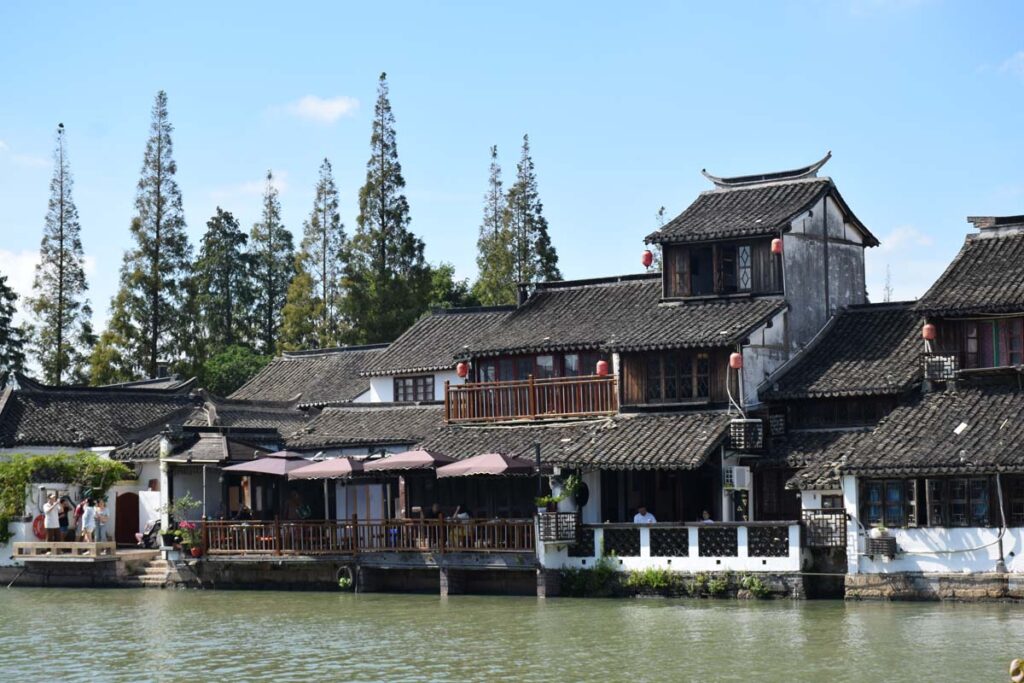
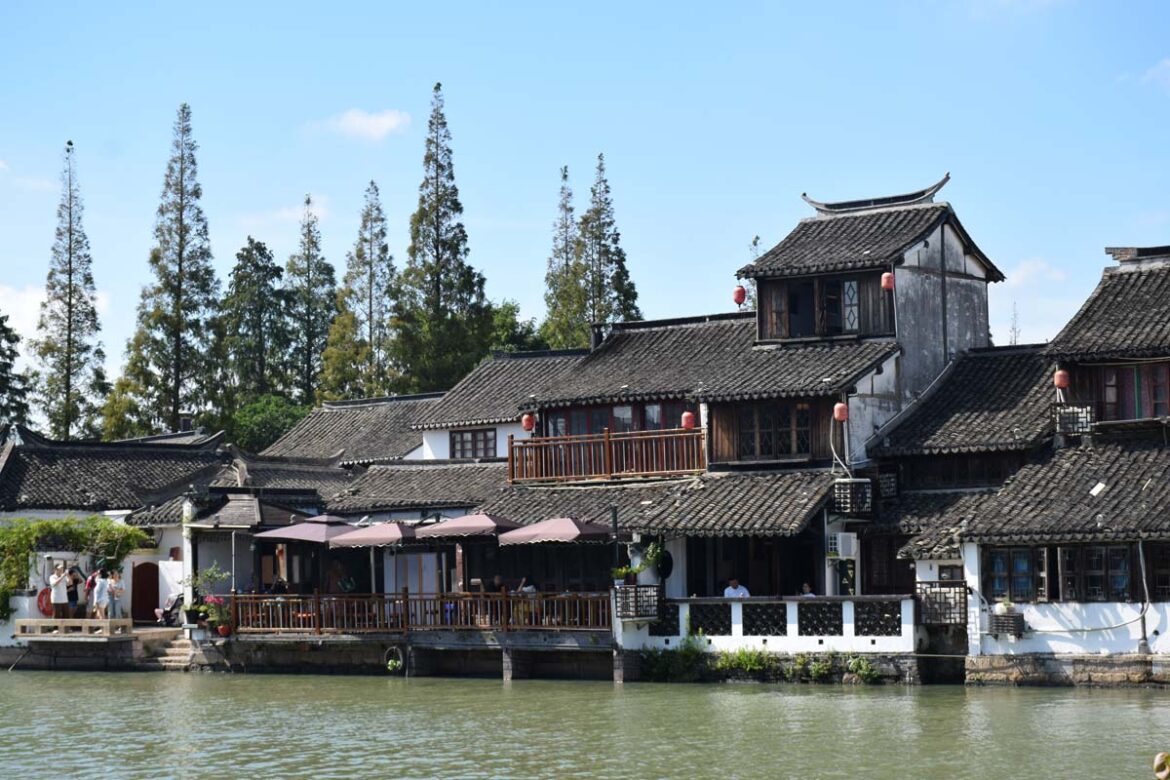
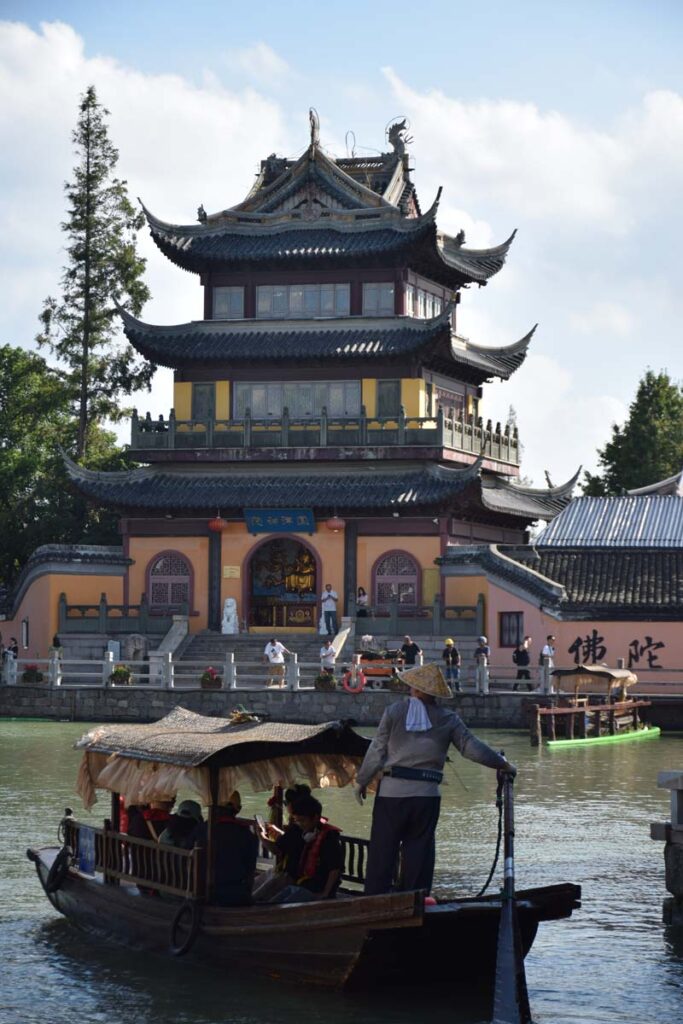
Just over an hour from the skyscrapers of central Shanghai, Zhujiajiao Ancient Town feels like stepping into a completely different world. Instead of busy roads and towering buildings, you’ll find quiet canals, centuries-old stone bridges, narrow alleyways and traditional houses lining the water.

We spent a full day exploring Zhujiajiao independently using public transport and found it to be one of the highlights of our time in Shanghai. If you’re wondering whether you need to book a guided tour, you don’t. Zhujiajiao is easy to visit on your own using public transport, making it one of the easiest day trips from Shanghai. If you’re looking to escape the pace of the city for a day, it’s a worthwhile addition to your itinerary.

Zhujiajiao Ancient Town

Is Zhujiajiao Worth Visiting?

We definitely think so.

While Shanghai is known for its modern skyline and bustling streets, Zhujiajiao offers a glimpse of a much older side of the region. Walking through the ancient town, crossing its stone bridges and wandering beside the canals felt worlds away from the city we had left behind that morning.

It’s touristy in places, but because the town is larger than many people expect, it’s easy to wander away from the busiest streets and enjoy a slower pace.

How to Get to Zhujiajiao from Shanghai

One of the best things about Zhujiajiao is how easy it is to visit without joining an organised tour.

From central Shanghai, the journey takes just over an hour using the metro:

  • Metro Line 2 to Hongqiao Railway Station
  • Change to Line 17
  • Get off at Zhujiajiao Station

From the station, you can either walk for around 25 to 30 minutes into the ancient town or catch a local bus.

We chose to walk there, which was straightforward and gave us a chance to see a little more of the area before arriving at the canals. On the way back, we caught the local bus back to the metro station, which was quick, inexpensive and very easy.

What to Do in Zhujiajiao Ancient Town

Wander the Canals

The best way to experience Zhujiajiao is simply by walking. Small alleyways weave between canals, traditional houses and local shops, with something interesting around almost every corner. Unlike central Shanghai, there isn’t really a checklist of attractions. The town itself is the attraction.

Cross the Historic Stone Bridges

Zhujiajiao is famous for its many stone bridges, each offering a different view across the canals.

Some are wide and gently curved, while others are steep enough to give you fantastic views over the rooftops and waterways below.
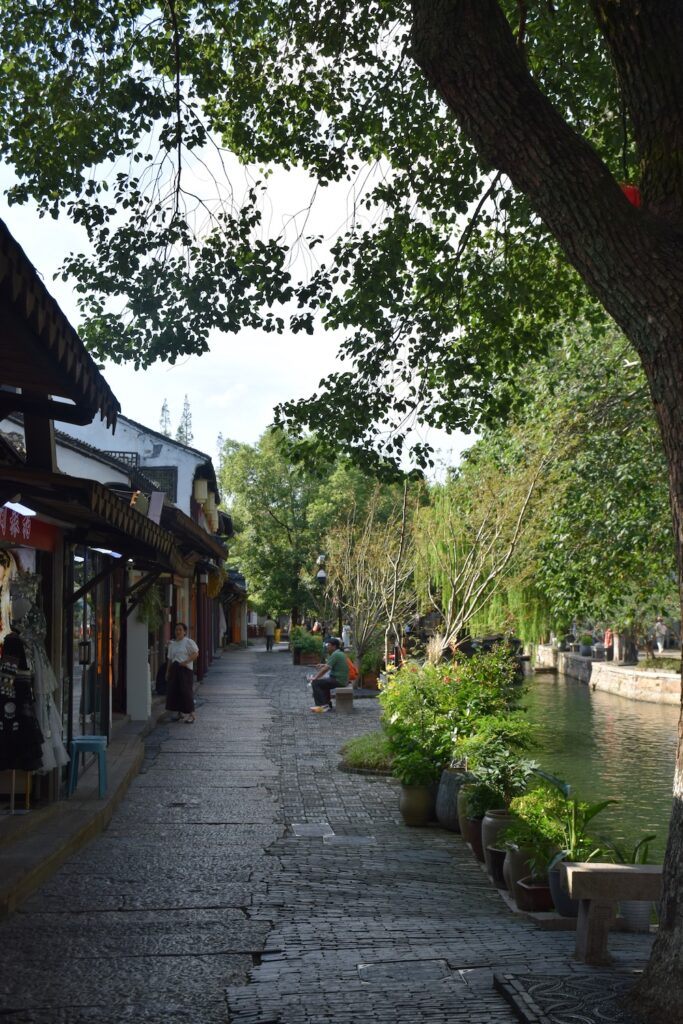
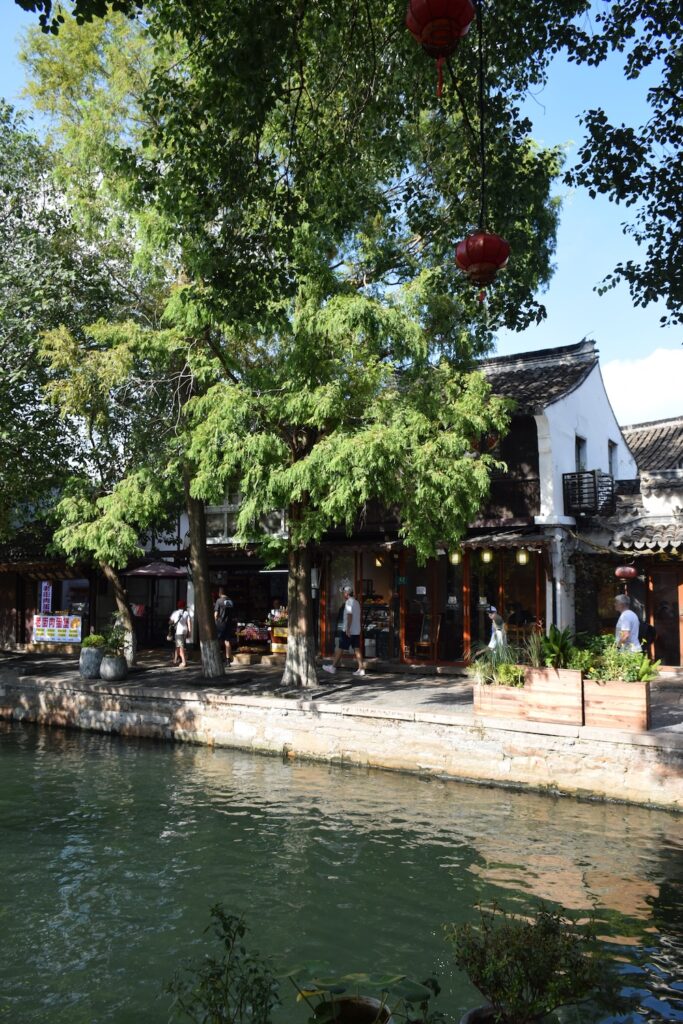
Zhujiajiao Ancient Town

Visit Kezhi Garden

While most people come to Zhujiajiao for its canals and historic streets, we also spent some time exploring Kezhi Garden. Filled with traditional pavilions, ponds, rockeries and peaceful pathways, it offered a welcome break from the busier parts of the ancient town.

We found it to be one of the most peaceful places we visited in Zhujiajiao and a worthwhile addition to the day. If you’re planning to spend several hours exploring the town, it’s definitely worth stepping inside.
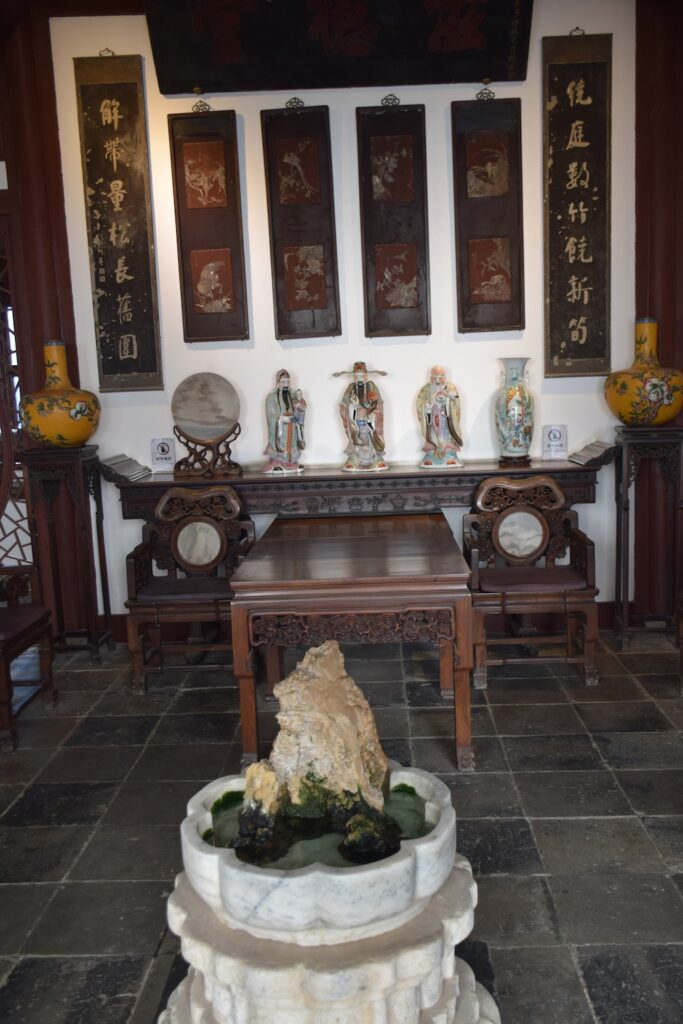
Zhujiajiao Ancient Town

Browse the Local Shops

One of our favourite parts of the day was simply wandering through the small independent shops. From handmade souvenirs and local crafts to tea, sweets and local snacks, there was plenty to browse and we found lots of unique gifts to take home for family.

Many of the food and tea shops offered free samples, so it was easy to try different teas, sweets and local delicacies before deciding what to buy. The shop owners could be a little enthusiastic in encouraging you to make a purchase, but we never found them to be rude, and it was all part of the experience.

Stop for Something to Eat

Like much of China, food is a big part of visiting Zhujiajiao.

Small restaurants, cafés and street food stalls line many of the canals, making it easy to stop whenever something catches your eye.

We’d recommend taking your time rather than rushing through.
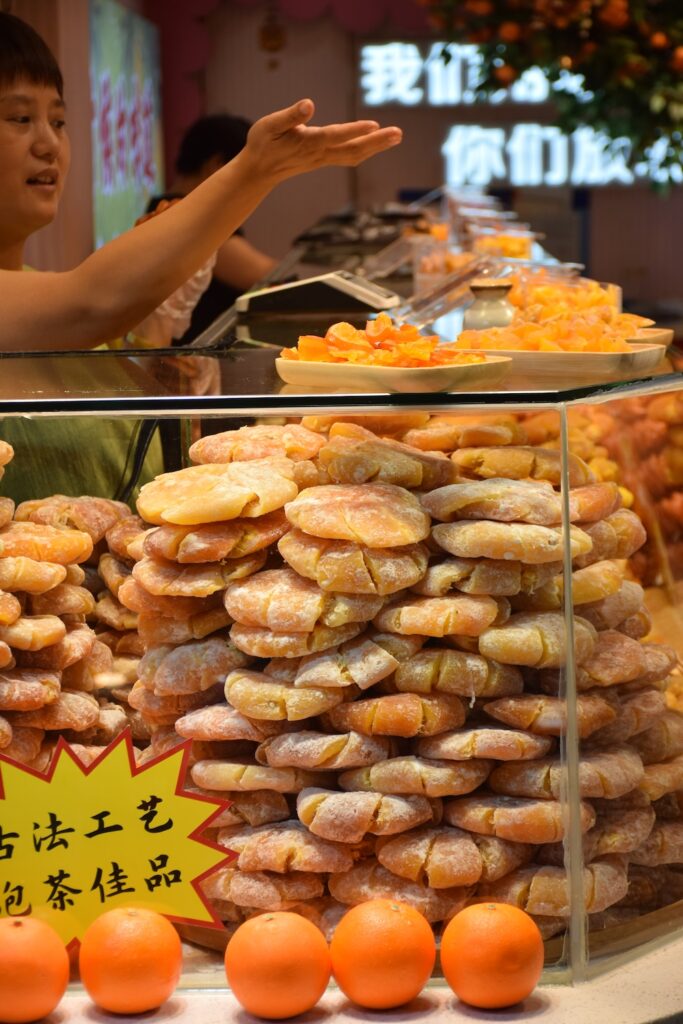
Zhujiajiao Ancient Town

How Long Do You Need?

We’d recommend allowing a full day.

Although you could see the highlights in a few hours, having the whole day meant we could explore at a relaxed pace, stop for food, browse the shops and simply enjoy wandering without worrying about catching the next train.

Best Time to Visit Zhujiajiao

We visited in September, and although it was still hot, the canals and narrow streets made for an enjoyable day out.

If possible, arrive earlier in the morning before the busiest part of the day, particularly if you’re visiting during weekends or Chinese holidays.

Practical Tips

Wear comfortable shoes

You’ll spend most of the day walking across stone streets and bridges.

Bring Alipay or WeChat Pay

Most shops and food stalls accepted mobile payments, just like the rest of China. Read our full guide on Best Apps for Visiting China.

Visit independently

There’s no need to book an organised tour. The metro is inexpensive, reliable and makes visiting Zhujiajiao very straightforward.

Final Thoughts

Zhujiajiao was one of our favourite day trips from Shanghai.

The contrast between Shanghai’s futuristic skyline and Zhujiajiao’s peaceful canals made the experience feel even more special. We loved spending the day wandering without an itinerary, crossing old stone bridges, browsing local shops and enjoying a slower pace before returning to the city in the evening.

If you’re spending more than two or three days in Shanghai, we’d highly recommend setting aside a day to visit.
August 1, 2026 0 comments
FacebookTwitterPinterestLinkedinRedditStumbleuponWhatsappTelegramThreadsOpenAIChatGPTEmail
China

Shanghai Travel Guide: What to Do, Where to Stay & Practical Tips

by Livia August 1, 2026
written by Livia

After spending time in Chengdu and Chongqing, Shanghai felt very different. We arrived by plane from Chongqing and, after weeks of exploring cities that felt unmistakably Chinese, Shanghai’s international skyline, European architecture and polished shopping streets made it feel much more familiar. It ended up being our least memorable stop in China, but we also think that’s because we visited it last.

If we were planning the trip again, we’d probably start in Shanghai. It’s easy to navigate, has more English speakers than many other Chinese cities, and offers a gentler introduction to travelling in China before heading further inland. While it wasn’t our favourite city, it’s still well worth visiting for its fascinating blend of historic neighbourhoods, The Bund, colonial architecture and futuristic skyline.

Nanjing Road Shanghai
The Bund Shanghai
Tianzifang shopping

Where to Stay in Shanghai

We stayed at Qianjing Xiaozhu Boutique Hotel Shanghai (City center & the Bund, Shanghai), located just a short walk from Nanjing Road and The Bund.

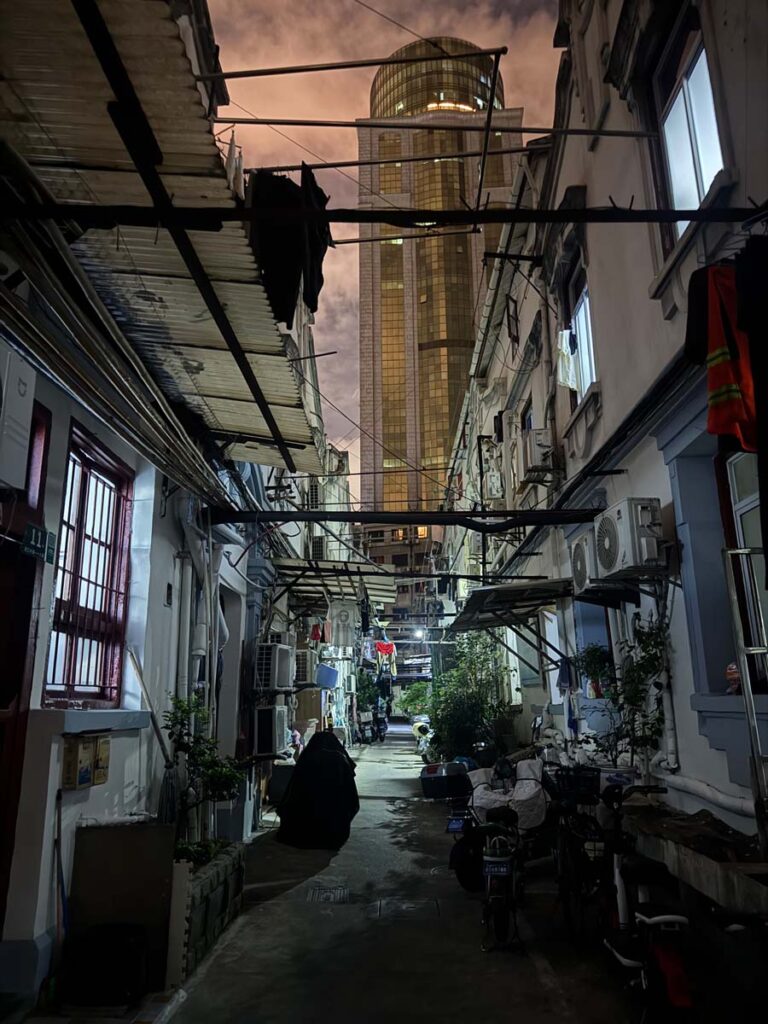
Finding it wasn’t straightforward. From the street, you enter through an unassuming doorway into a maze of narrow residential lanes that you could easily walk straight past without noticing. Surrounded by modern office towers and hotels, it felt like stumbling across a small pocket of old Shanghai that had somehow remained untouched.

The hotel itself blends into the neighbourhood and has even been used as a filming location for a Chinese drama. Walking back each evening through the quiet alleys, with laundry hanging overhead and locals going about their daily lives, felt completely different to the busy streets just outside.

The room was clean and comfortable, and despite being in the city centre, it was surprisingly peaceful at night. It wasn’t the most luxurious hotel we stayed in during our time in China, and it was actually the most expensive, but staying in a neighbourhood like this made it a memorable experience.

back alley hotel, but totally worth it
The alley to the hotel

Things to do in Shanghai

Shanghai is a city of contrasts. One minute you’re surrounded by futuristic skyscrapers, the next you’re wandering through leafy streets, historic neighbourhoods or converted warehouses filled with art galleries. While many visitors come for the famous skyline, we found some of our favourite moments were simply exploring the city’s different districts and seeing how each one had its own character.

Walk Along Nanjing Road Pedestrian Street

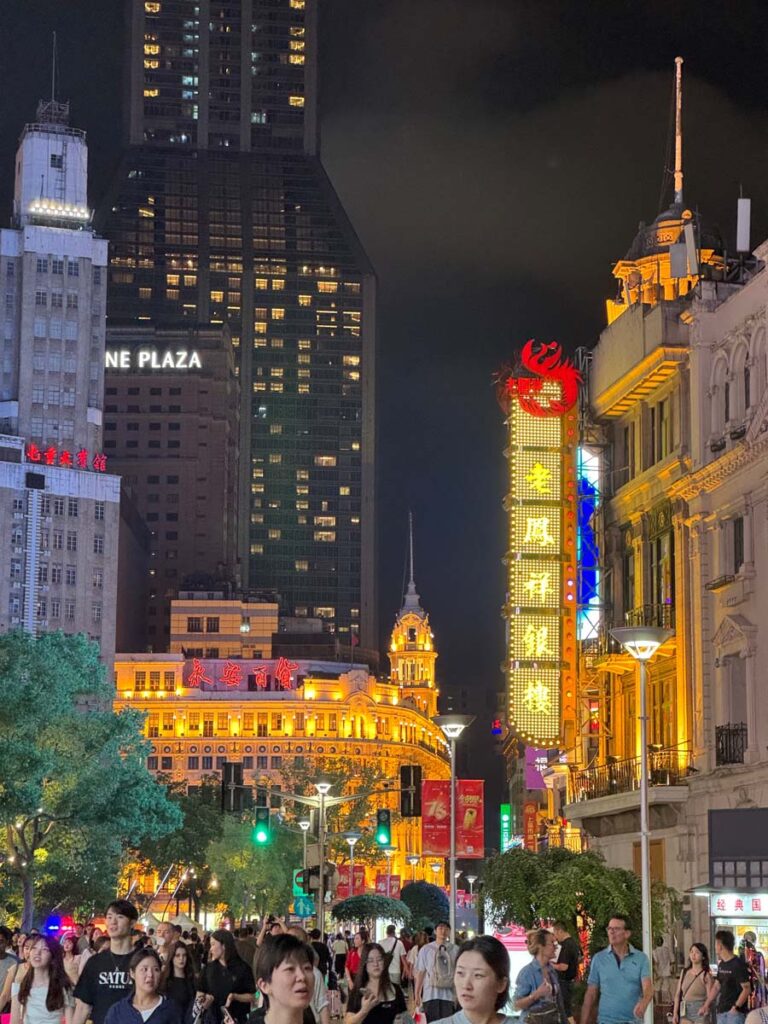
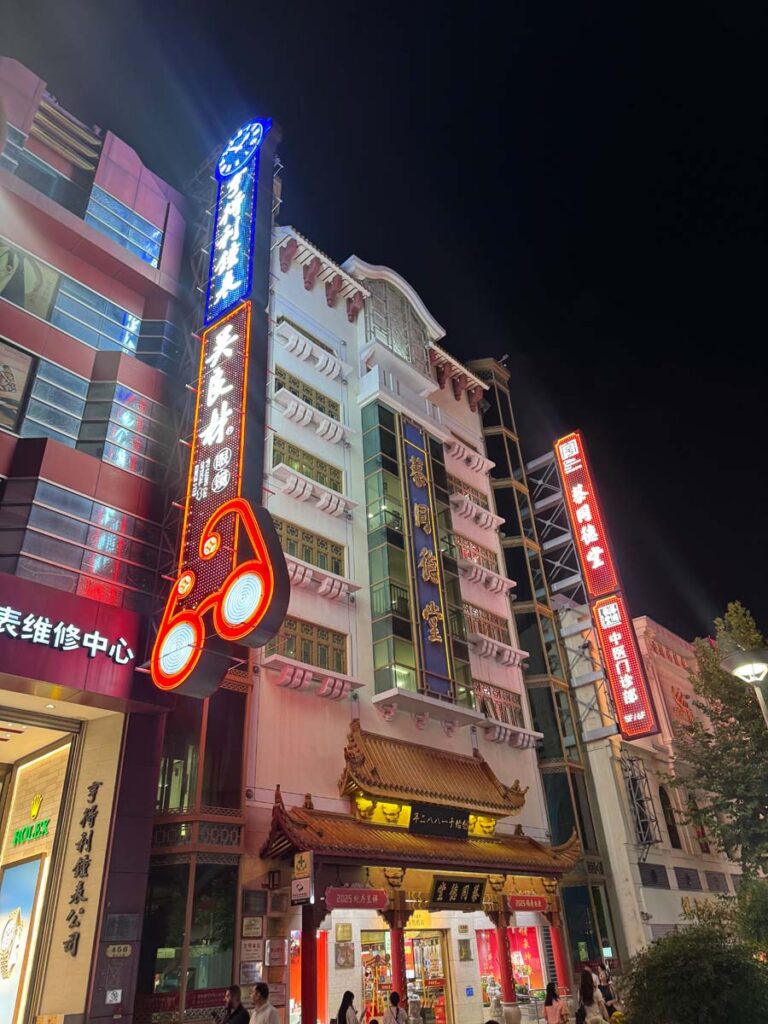
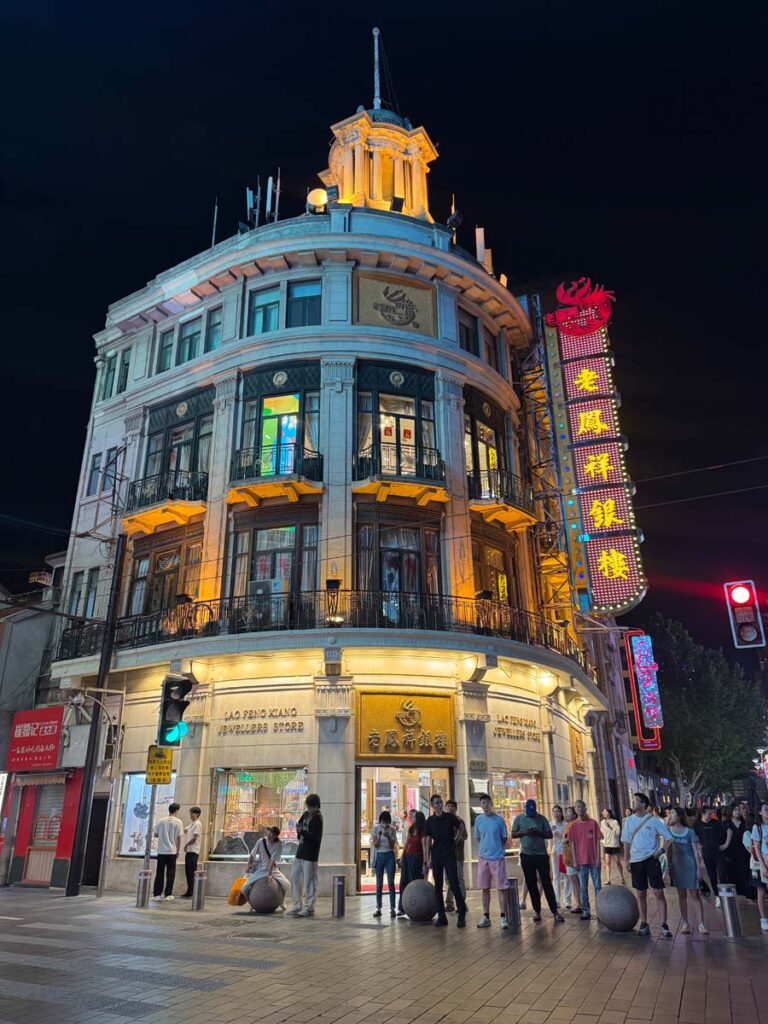
No visit to Shanghai is complete without walking along Nanjing Road Pedestrian Street, one of the busiest shopping streets in the world. Stretching for several kilometres, it’s lined with department stores, international brands, restaurants and huge digital billboards. During the day it’s busy, but after dark the neon lights give the whole street a completely different atmosphere.

Even if shopping isn’t your thing, it’s worth walking through to experience the energy of the city before continuing towards The Bund.

Nanjing Road Pedestrian Street

Walk Along The Bund

No visit to Shanghai is complete without a walk along The Bund. Stretching along the Huangpu River, it’s the city’s most famous waterfront, where grand colonial-era buildings face the futuristic skyline of Pudong on the opposite bank.

We visited on a Thursday evening, and while it was certainly busy, it never felt overwhelming. It was still easy to stroll along the promenade, stop for photos and enjoy the views without feeling constantly surrounded by crowds. Based on our experience, we’d avoid visiting on a Friday or Saturday evening, when it’s likely to be considerably busier.

As the sun goes down, the skyline gradually lights up, transforming the riverfront into one of Shanghai’s most iconic views. Watching the illuminated skyscrapers reflect across the Huangpu River is an experience that’s well worth including in your itinerary.

The Bund
The Bund
many people at The Bund
Crowds on a weekday

Wander Through the French Concession

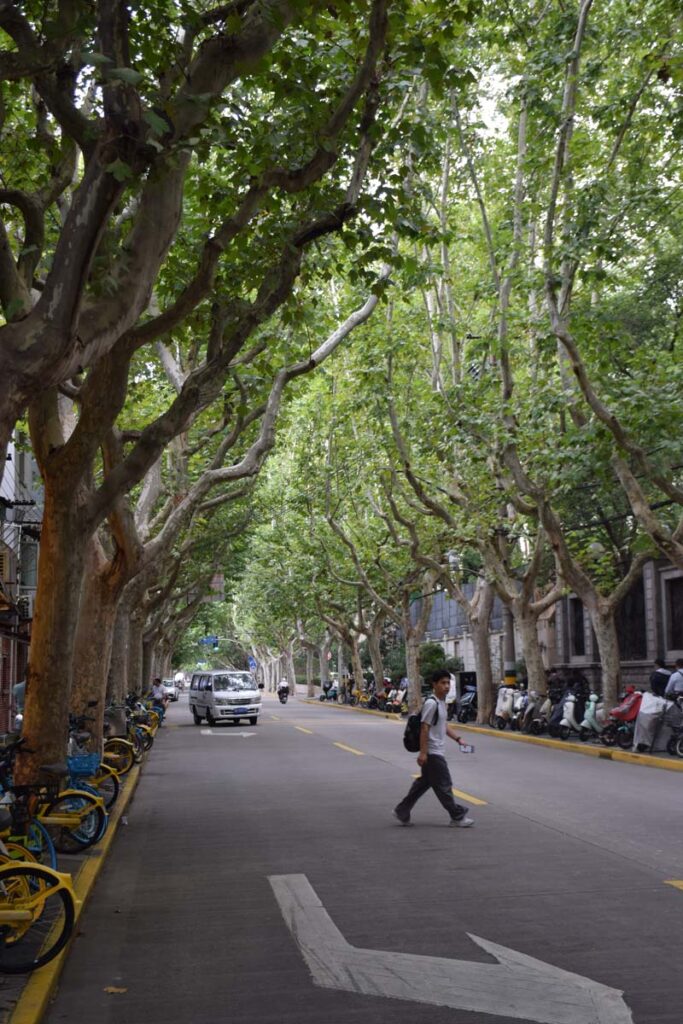
The French Concession couldn’t feel more different from central Shanghai. Wide tree-lined avenues replace busy shopping streets, while independent cafés, boutiques and beautiful historic buildings give the area a much more relaxed atmosphere.

It’s the perfect neighbourhood to slow down, grab a coffee and spend a few hours wandering without any particular destination in mind. If you’re looking for a break from Shanghai’s skyscrapers and busy shopping streets, this is a great place to do it.

French Concession Shanghai
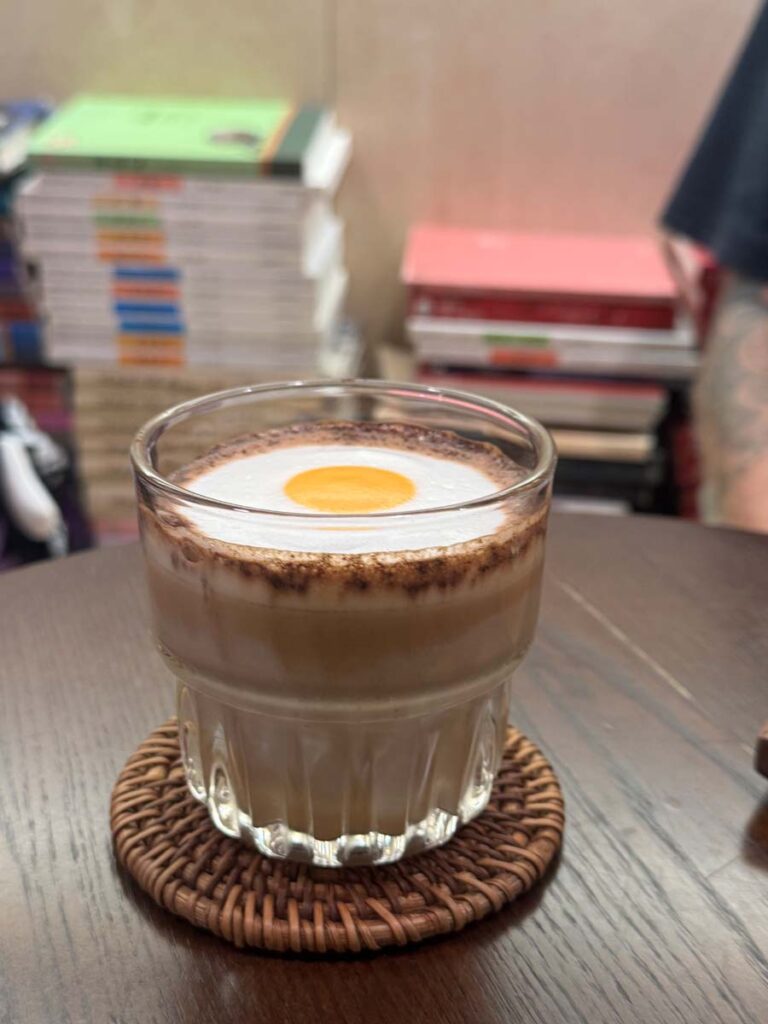
Coffee in French Concession Shanghai
tree lined streets in French Concession Shanghai

Explore Tianzifang

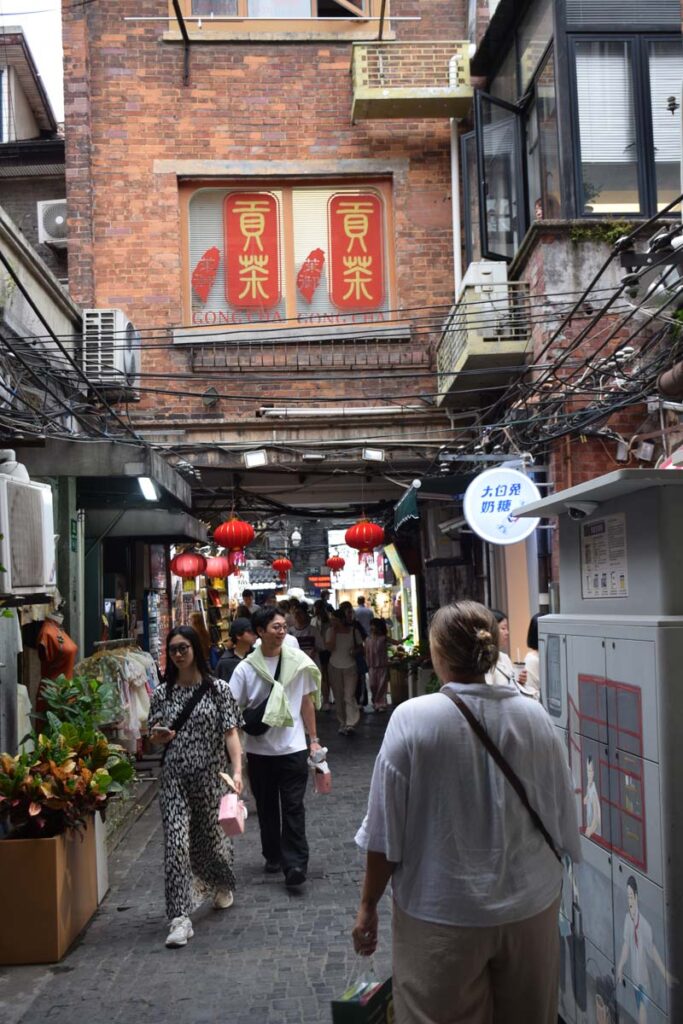
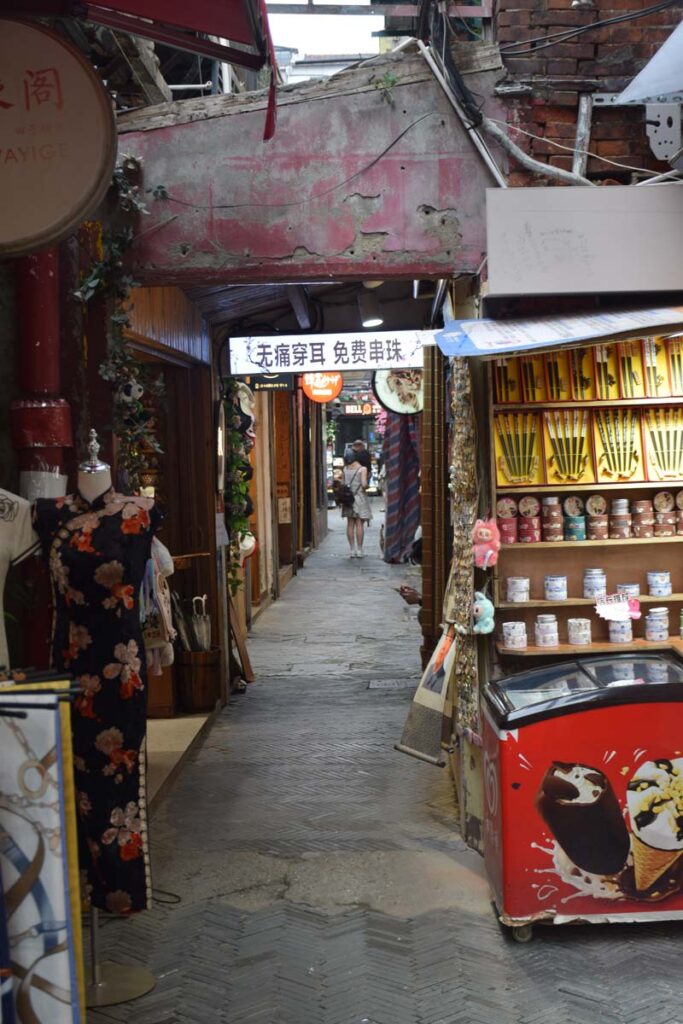
Hidden within a maze of narrow alleyways, Tianzifang is packed with small boutiques, cafés, art studios and independent shops. Although it’s popular with visitors, it still feels intimate thanks to the network of tiny lanes connecting everything together.

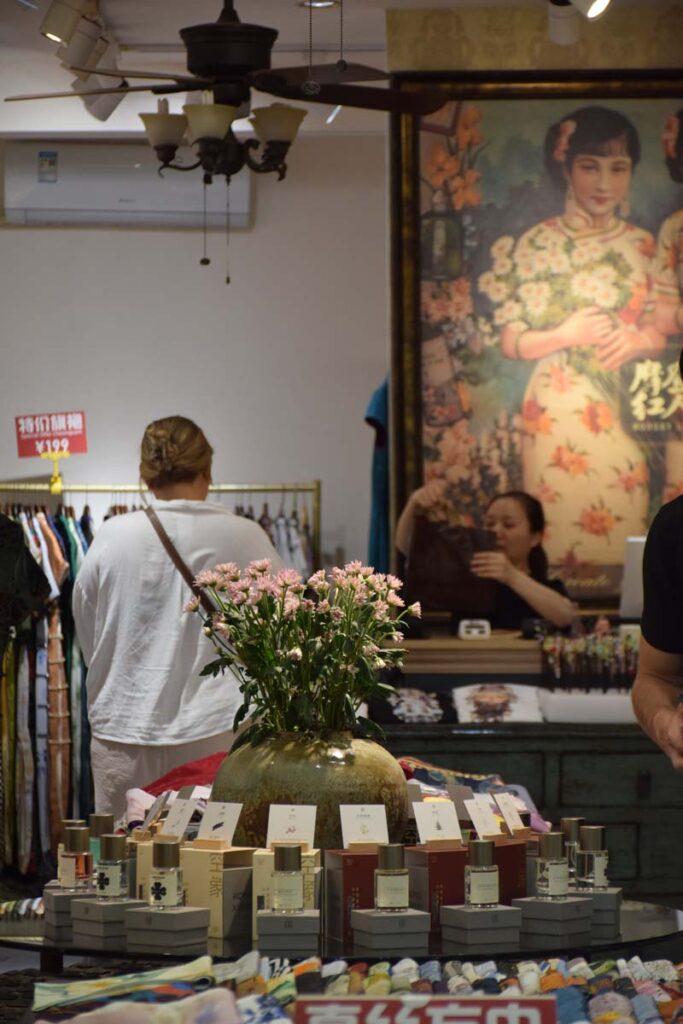
We ended up spending much longer here than we’d planned, browsing the shops and picking up gifts to take home for family. It was one of the best places we found in Shanghai for souvenirs, with plenty of locally made crafts, artwork and unique items that felt a little different from the usual tourist souvenirs.

It’s an easy place to lose track of time, whether you’re browsing the shops, stopping for a coffee or simply wandering through the narrow alleyways to see what you’ll discover next.

Tianzifang shopping
Tianzifang shopping
Tianzifang shopping

Visit Xintiandi

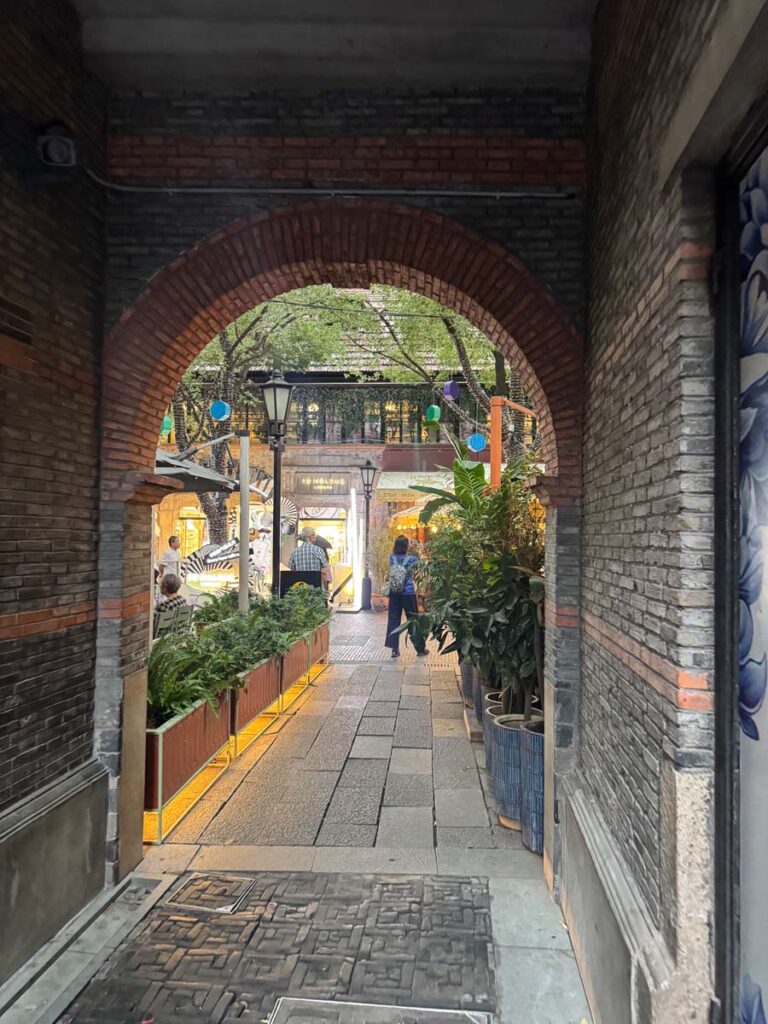
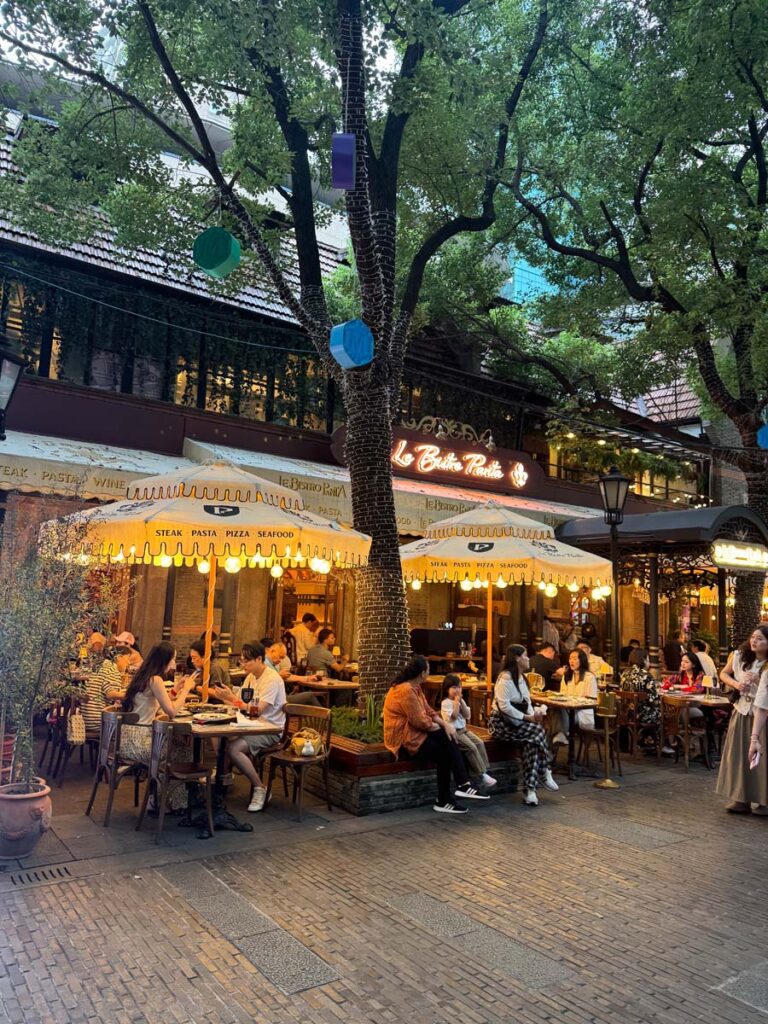
Xintiandi blends historic architecture with modern Shanghai. The restored stone-gate buildings now house stylish restaurants, cafés, bars and designer shops, creating one of the city’s more upmarket neighbourhoods.

It’s a pleasant area to wander during the afternoon or evening, particularly if you’re looking for somewhere to sit outside with a coffee or enjoy dinner after a day of sightseeing.

Xintiandi
Xintiandi
Xintiandi

Discover M50 Art District (50 Moganshan Road)

If you’re looking for something different, head to M50 Art District. Set inside former industrial warehouses, the area has been transformed into one of Shanghai’s leading creative spaces, with contemporary galleries, street art and artist studios spread throughout the complex.

It’s more than just an art district, though. Between the galleries you’ll find some excellent cafés, independent boutiques and several specialist tea shops where you can browse and sample a huge range of Chinese teas. We also stumbled across NOD Café, tucked away on the second floor overlooking Suzhou Creek, which was a great spot to stop for a coffee, enjoy the riverside views and soak up the creative, artistic atmosphere before continuing to explore.

Whether you’re interested in contemporary exhibitions or simply want to experience a quieter, more creative side of Shanghai, M50 is well worth adding to your itinerary.

M50 Art District
M50 Art District
M50 Art District
Cafe Nod

Visit Mengqing Garden (1000 Trees)

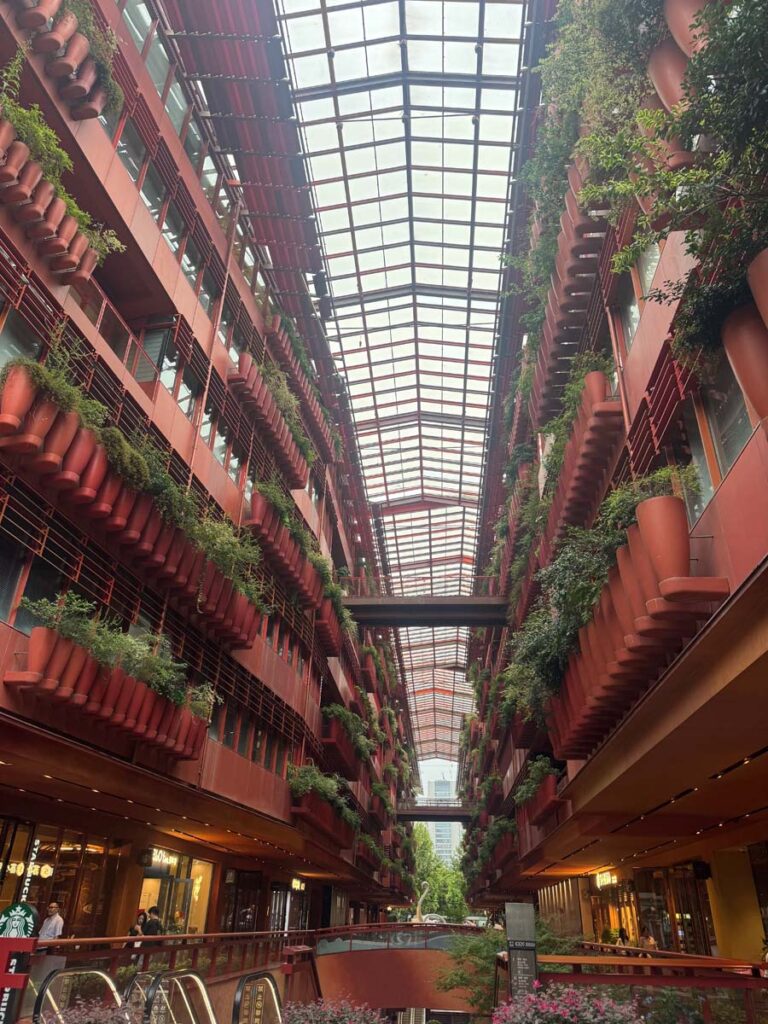
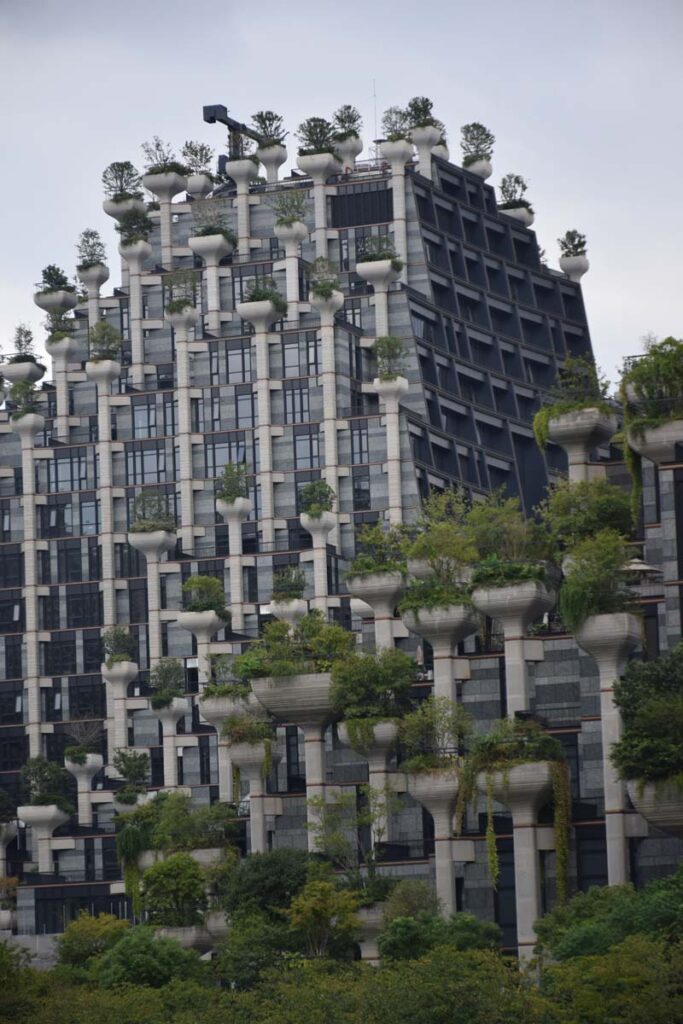
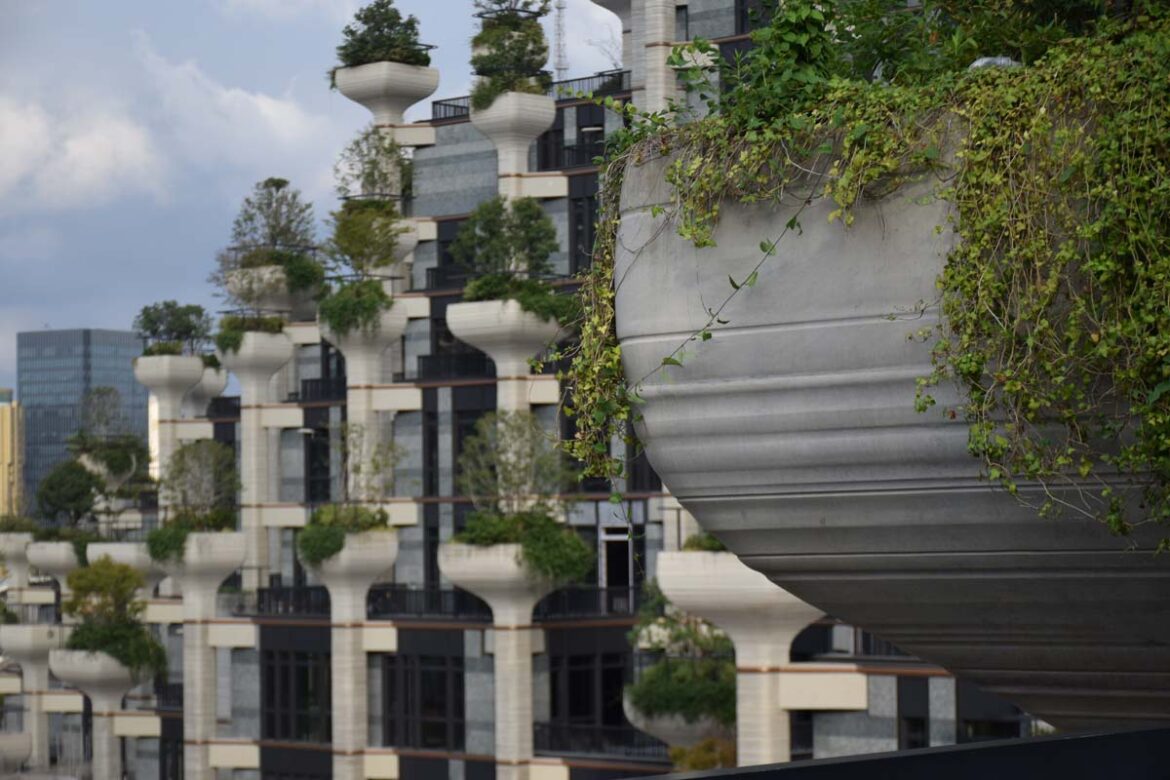
One of the more unusual places we visited was Mengqing Garden and the neighbouring 1000 Trees development along Suzhou Creek. The combination of riverside paths, green spaces and striking architecture makes it a pleasant area to wander, especially if you want a break from the busy city centre.

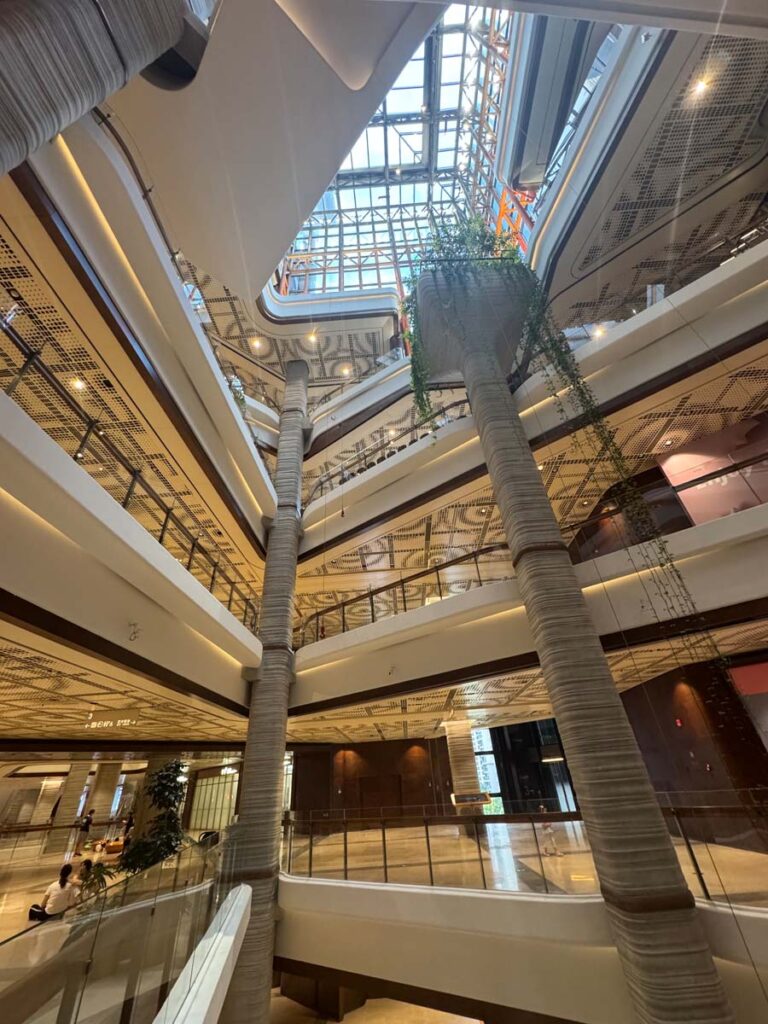
Don’t just admire 1000 Trees from the outside. Head inside the shopping centre, where you’ll find cafés, restaurants and shops spread across several levels. It’s also worth making your way up to the rooftop terraces, which offer great views over Suzhou Creek and the surrounding skyline while giving you a closer look at the building’s unique tree-covered design.

1000 Trees
1000 Trees
1000 Trees

Take a Day Trip to Zhujiajiao Ancient Town

If you have the time, a day trip to Zhujiajiao Ancient Town is well worth adding to your itinerary. Often called one of Shanghai’s water towns, it’s a world away from the city’s skyscrapers, with canals, stone bridges and narrow streets lined with traditional buildings.

We spent the day wandering the old town, crossing its historic bridges and enjoying the slower pace before returning to the city in the evening. It made a great contrast to the rest of our time in Shanghai and was one of our favourite days of the trip. We’d recommend allowing a full day so you can explore at a relaxed pace rather than rushing back to the city.

How to get to Zhujiajiao Ancient Town

Zhujiajiao is easy to visit independently using Shanghai’s metro system. From central Shanghai, the journey takes just over an hour. Take Metro Line 2 to Hongqiao Railway Station, then change to Line 17 and get off at Zhujiajiao Station.

From the station, you can either walk for around 25 to 30 minutes to the entrance of the ancient town or catch a local bus. We chose to walk there, which was straightforward and gave us a chance to see a little more of the area, before taking the bus back to the metro station at the end of the day. We found it an easy day trip to do without joining an organised tour.

Zhujiajiao Ancient Town

Where to eat in Shanghai

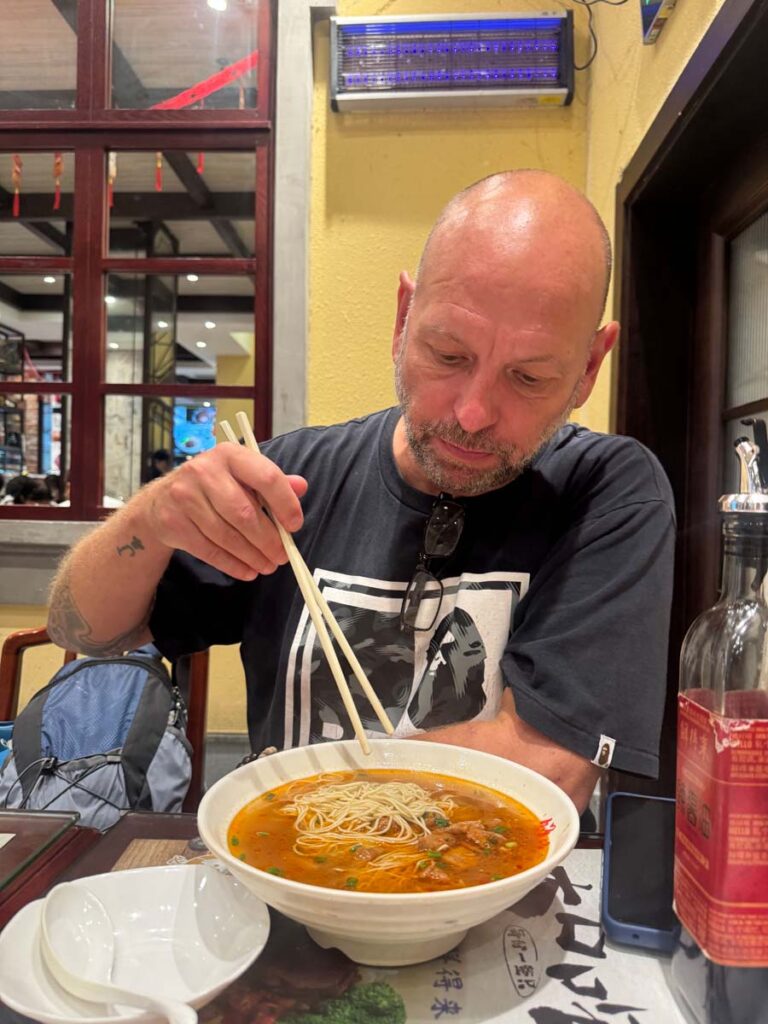
After the bold, spicy flavours of Sichuan cuisine in Chengdu and Chongqing, Shanghai’s food felt noticeably different. The local cuisine is generally milder and slightly sweeter, with an emphasis on fresh ingredients, seafood, braised dishes and delicate flavours rather than chilli and Sichuan pepper. You’ll also find plenty of dumpling shops, noodle restaurants and bakeries, alongside modern cafés and international restaurants.

One thing we particularly enjoyed was the variety of street food. Whether we were exploring Nanjing Road, wandering through neighbourhoods or browsing markets, there always seemed to be stalls selling dumplings, pancakes, skewers, buns and freshly cooked snacks. It’s a great city to graze your way through rather than sticking to three big meals a day.

Shanghai has no shortage of places to eat, from tiny noodle shops to modern restaurants and international cuisine. While the streets around Nanjing Road are packed with dining options, we actually found ourselves returning to the quieter area around Jiujiang Road, where we were staying. Just a few minutes from the crowds, the neighbourhood was full of small local restaurants and cafés that felt much more relaxed. It was here that we discovered some of our favourite meals, simply by wandering the streets and seeing where the locals were eating.

Food in Shanghai
Food in Shanghai
Food in Shanghai

Shucaiji Pan-Fried Vegetable Rice 舒蔡记生煎菜饭

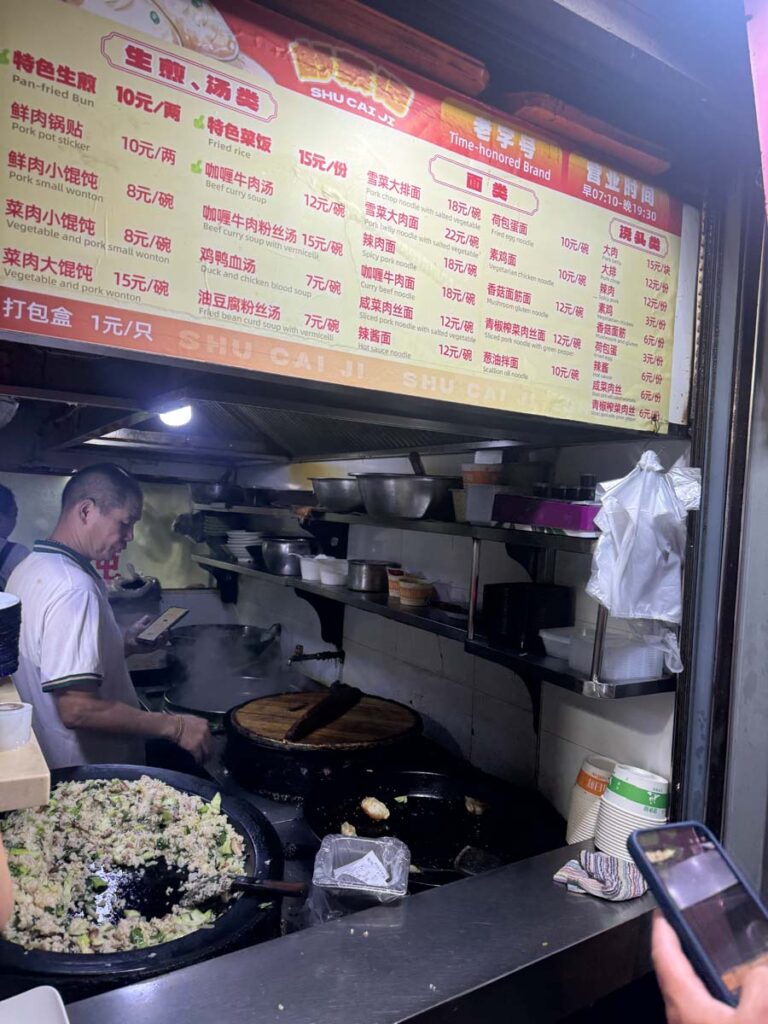
Located just outside our hotel, this tiny local restaurant quickly became one of our regular stops. Their pan-fried dumplings (shengjian bao) were excellent, with a crispy base and juicy filling, and the scallion oil noodles were simple but full of flavour. It’s the kind of place you could easily walk past, but it’s well worth stopping if you’re nearby.

Xiandelai 鲜得来

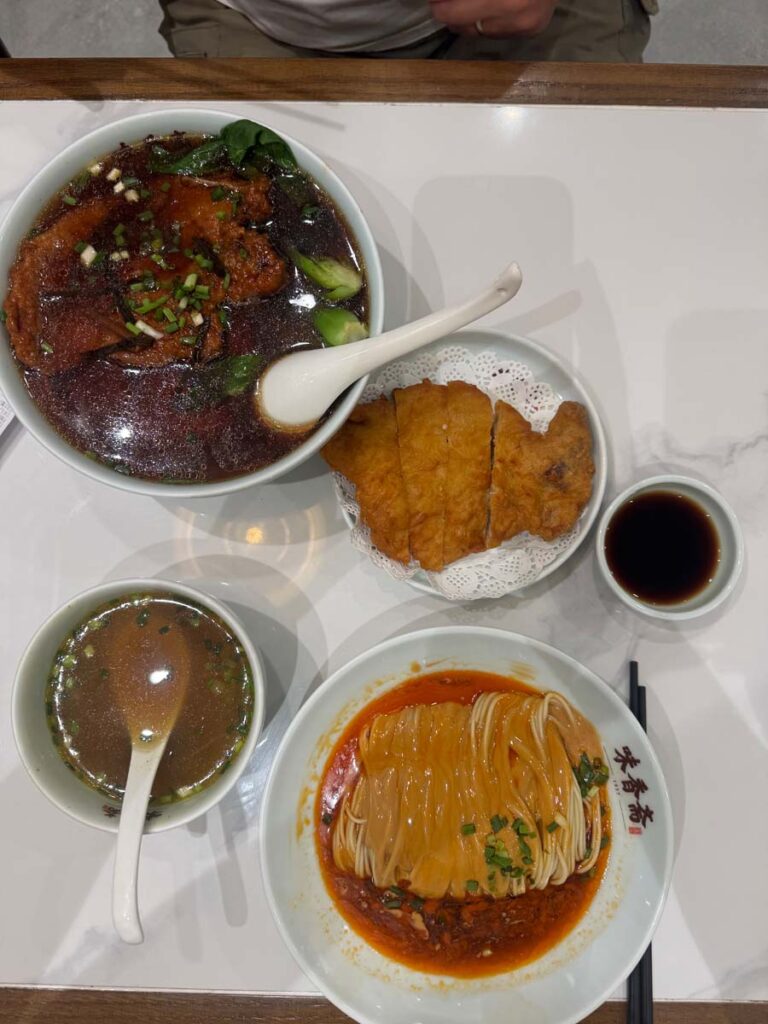
Founded in 1921, Xiandelai is one of Shanghai’s best-known traditional restaurants and is famous for its fried pork chop (排骨), a local speciality that’s been enjoyed for over a century. Alongside the restaurant, there’s a takeaway counter selling a wide range of traditional Benbang dishes, including braised meats, smoked fish and soy-braised duck.

We enjoyed it so much that we came back a second time to try more of the menu. If you only have time to try one traditional Shanghai restaurant, Xiandelai is an excellent choice.

Hu Ji a Zhong Feature Fried Dumpling 胡记阿忠特色锅贴

Another small local restaurant specialising in potstickers (guotie). The dumplings are cooked until perfectly crisp on the bottom while staying juicy inside, making this a great place for a quick and inexpensive dinner. There was a queue when we arrived, but it moved quickly and was well worth the short wait

Zheying Restaurant 浙影餐厅

We stumbled across this restaurant near our hotel and ended up having one of our favourite dinners in Shanghai. It had a relaxed local atmosphere, friendly patrons and every dish we ordered was delicious.

Moo Moo By Moo Cake

If you’re looking for breakfast or a coffee break, Moo Moo by Moo Cake was a great bakery. Their fresh pastries, especially the morning buns, were the perfect way to start the day before heading out to explore the city.

Food in Shanghai
Xiandelai 鲜得来
Food in Shanghai
Hu Ji a Zhong Feature Fried Dumpling 胡记阿忠特色锅贴
Food in Shanghai
Shucaiji Pan-Fried Vegetable Rice 舒蔡记生煎菜饭

How many days in Shanghai

We spent 4 nights in Shanghai. While there was still plenty we didn’t have time to see, we felt we’d experienced the city’s different sides, from the busy shopping streets and historic neighbourhoods to the quieter cafés, art districts and a day trip beyond the city. Looking back, we would probably have spent one less night here and added an extra night to Chengdu, simply because that city suited our travel style better.

2 Days

Two days is enough to experience many of Shanghai’s main highlights. You can explore Nanjing Road, wander along The Bund, and spend time discovering neighbourhoods such as the French Concession, Xintiandi or Tianzifang.

3 Days

With three days, you can explore at a more relaxed pace and venture beyond the main tourist sights. Visit the M50 Art District (50 Moganshan Road), stroll through Mengqing Garden (1000 Trees), enjoy more of Shanghai’s cafés and restaurants, or simply spend time wandering the city’s different neighbourhoods.

4+ Days

If you have four or more days, it’s worth taking at least one day trip outside the city. We visited Zhujiajiao Ancient Town, which offered a completely different atmosphere from central Shanghai. There are also plenty of other day trips we would have loved to do but simply didn’t have enough time for, including Suzhou, Hangzhou and several other nearby water towns. Having extra time also means you can explore more neighbourhoods, try different restaurants and enjoy Shanghai at a slower pace.

Practical Tips for Visiting Shanghai

Language

Compared to Chengdu and Chongqing, we found Shanghai easier to navigate as English was more widely spoken, particularly around the main tourist areas, hotels and larger restaurants. That said, don’t expect everyone to speak English, so having a translation app and a few key phrases is still helpful.

Getting Around Shanghai

Metro

Shanghai has an excellent metro system and it’s by far the easiest way to get around the city. We mostly walked between attractions in the centre and used the metro for longer journeys. Trains were frequent, clean and easy to navigate, making public transport one of the highlights of travelling around Shanghai.

As with the other cities we visited in China, we simply added a Shanghai Public Transport Card to Apple Wallet, which made travelling incredibly easy. We could tap in and out without needing to buy individual tickets.

Walking

Although Shanghai is huge, many of the main attractions around The Bund, East Nanjing Road, People’s Square and the French Concession are surprisingly walkable. We covered most of the city centre on foot, using the metro only when travelling between different neighbourhoods.

Best Time to Visit Shanghai

Spring (March to May) and autumn (September to November) are generally considered the best times to visit Shanghai, with milder temperatures and lower humidity.

We visited in September, and it was still very hot and humid, especially during the middle of the day, but the warm evenings were perfect for walking along The Bund and exploring the city’s different neighbourhoods.

Internet, Payments and Apps

Like the rest of China, you’ll need a few apps before you arrive. Alipay and WeChat Pay are accepted almost everywhere, while Trip.com made booking trains and attractions straightforward. We also recommend arranging an eSIM or VPN before you travel so you can access Google services and other websites that are blocked in China.

For a full breakdown of the apps we used, how to set them up before you arrive, and everything you need to know about internet access, mobile payments and getting around China, read our Complete Guide to the Essential Apps for Travelling in China.

Final Thoughts on Visiting Shanghai

Shanghai was a fascinating place to end our journey through China. From the futuristic skyline and historic waterfront to creative neighbourhoods and peaceful water towns, it offered a completely different experience to Chengdu and Chongqing.

Although it wasn’t our favourite city of the trip, that’s largely because we visited it last. After spending time in inland China, Shanghai felt more familiar and international. Looking back, we think it would actually make the perfect introduction to China before venturing further afield.

Whether you’re visiting for a couple of days or using it as a base for day trips like Zhujiajiao, Shanghai has plenty to offer. Wander beyond the main sights, explore its different neighbourhoods, and don’t be afraid to duck into the small local restaurants. Some of our favourite memories came from the places we found simply by walking without a plan, proving that Shanghai rewards curiosity just as much as careful planning.

Friends and Food in Shanghai
Shanghai
the Bund

Save the pin

August 1, 2026 0 comments
FacebookTwitterPinterestLinkedinRedditStumbleuponWhatsappTelegramThreadsOpenAIChatGPTEmail
China

Chongqing Travel Guide: What to See, Where to Stay & Our Honest Tips

by Livia July 22, 2026
written by Livia

We arrived in Chongqing by high-speed train from Chengdu, and the difference was immediate. Chengdu had felt relaxed and approachable, while Chongqing greeted us with towering skyscrapers, dramatic bridges and some of the most unusual architecture we’d ever seen. It felt bigger, busier and, at first, much more intimidating.

Like many people, we’d seen countless videos of Chongqing on social media before our trip. We wondered whether the city could really live up to the hype.

Spoiler Alert: It absolutely did!

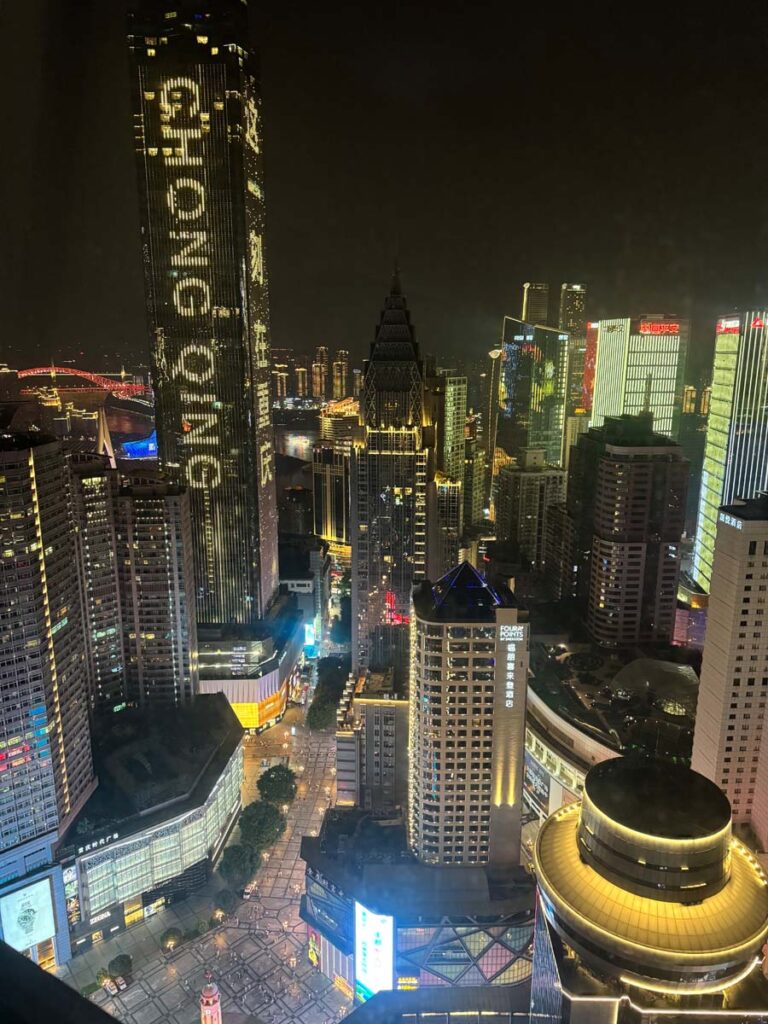
Views over Chongqing
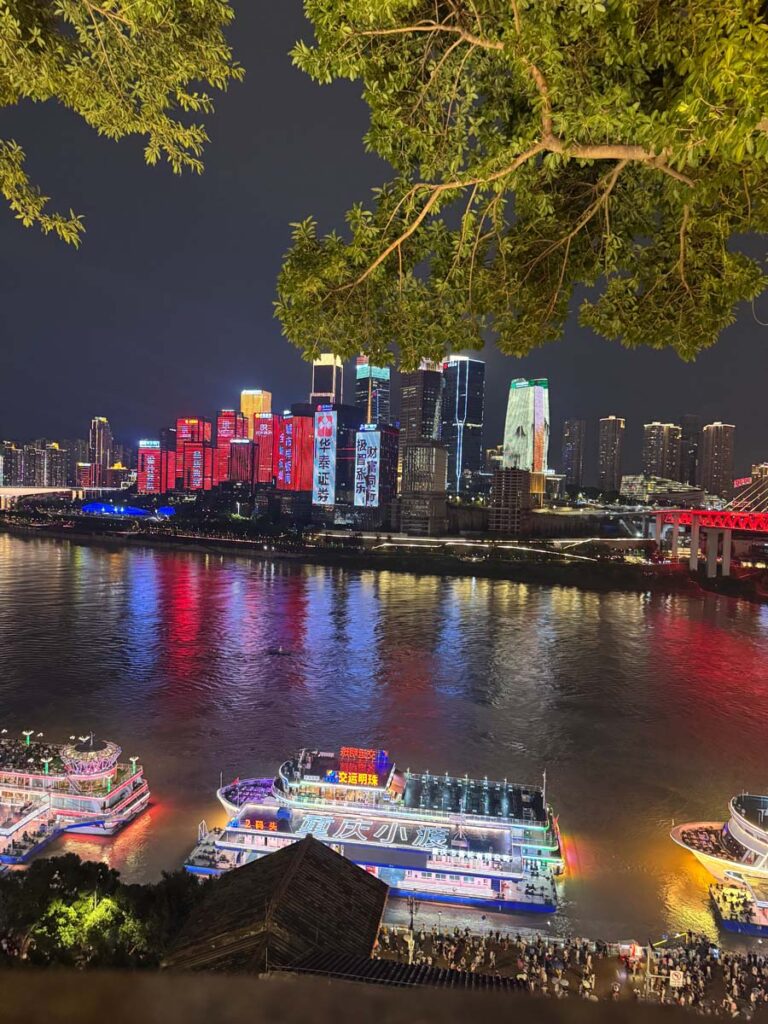
Chongqing by night

Why visit Chongqing

Chongqing is quite unlike anywhere else we’ve visited. Towering skyscrapers, layered roads, neon lights and incredible food combine to create one of the most fascinating cities in China. While the skyline is spectacular, what really makes Chongqing special is exploring everything in between.

Once the sun goes down, the city transforms. Neon lights reflect off the rivers, bridges light up across the skyline and the whole place feels like something from a futuristic film. But Chongqing is much more than just a city to photograph.

If you love unusual architecture, incredible food and cities that challenge your sense of direction, Chongqing should be high on your list. You’ll also find peaceful parks, historic streets, scenic viewpoints and some of the best hot pot we’ve ever eaten.

What makes Chongqing so extraordinary is its geography. Built where the Yangtze and Jialing Rivers meet, the city rises sharply from the water instead of spreading neatly around it. Hills, bridges, cliffs and steep streets shape everything, creating a place that feels stacked rather than simply built.

That vertical layout makes Chongqing unlike anywhere else we’ve been. Roads pass above and below each other, buildings open onto different streets at different floors, and metro lines burst out of apartment blocks. A short route on the map can turn into staircases, lifts, flyovers and sudden viewpoints, with the city constantly shifting around you.

It’s confusing, exhausting and completely brilliant. Even with navigation apps, we often found ourselves stopping to work out whether we needed to go left, right, up or down. Chongqing isn’t just big; it’s layered, chaotic and alive in a way that makes simply walking through it feel like an adventure.

Where to stay in Chongqing

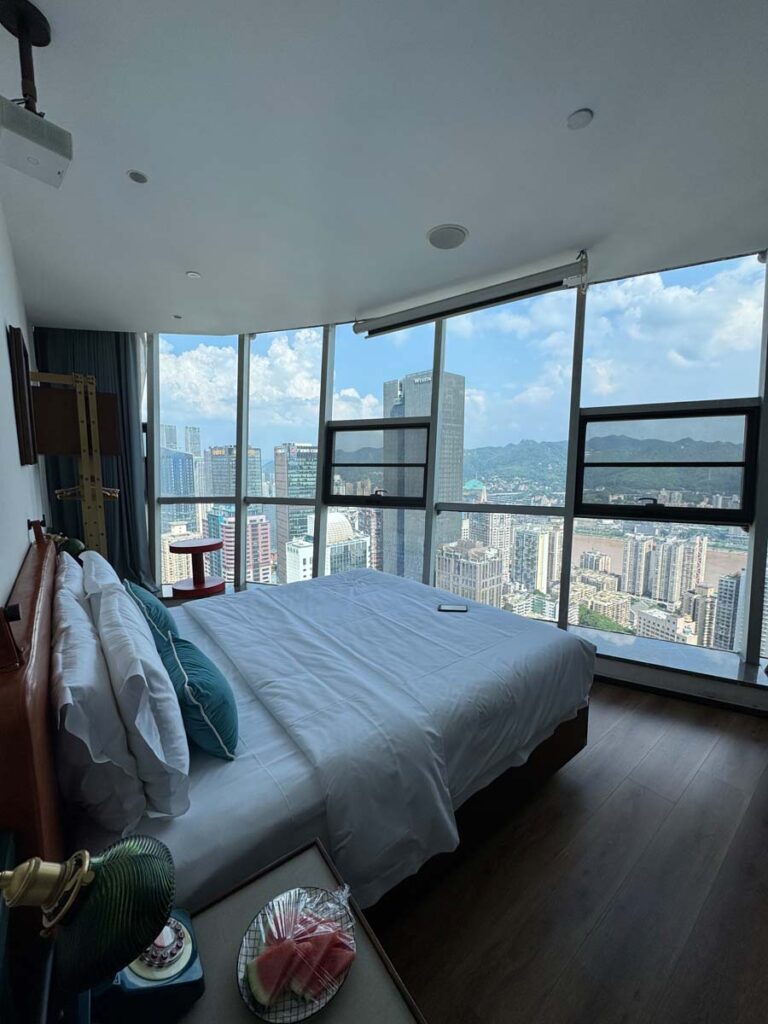
We stayed at Chongqing Jiefangbei Hongya Cave Houju High-altitude River-view Hotel, on the 46th floor of a high-rise in the heart of Jiefangbei, Chongqing’s city centre.

Staying in Jiefangbei turned out to be the perfect base. Hongyadong, Bayi Road Food Street, Nengren Temple and several metro stations were all within walking distance, making it easy to explore the city.

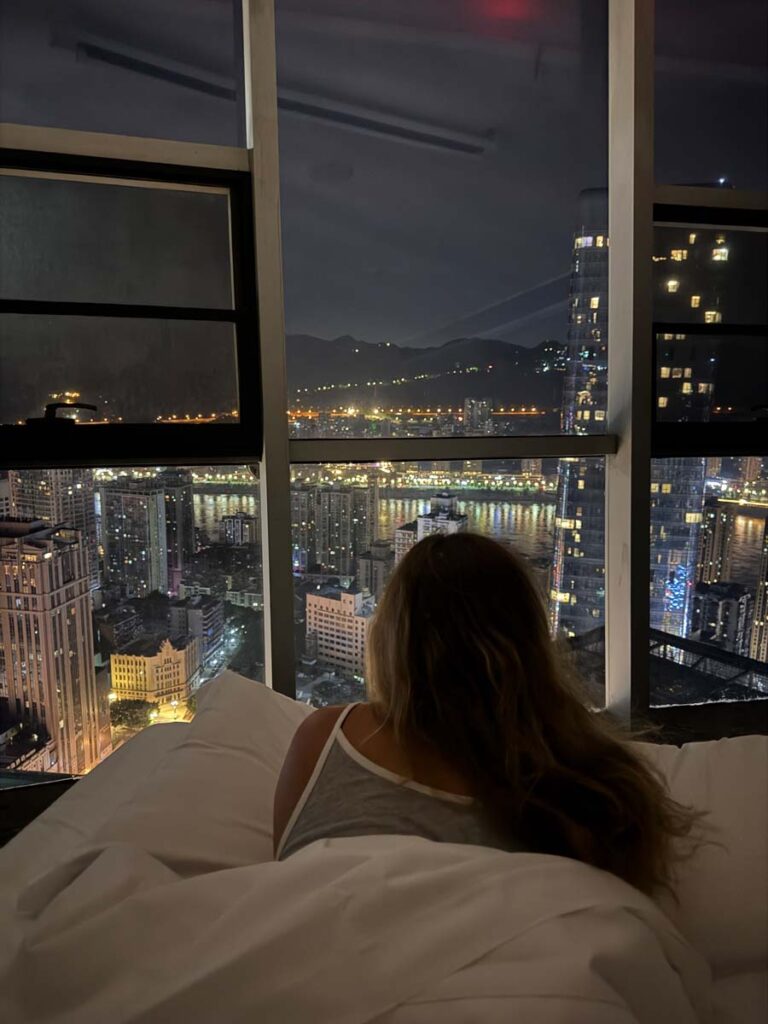
The hotel itself offered excellent value for money. Our room overlooked the city skyline, and waking up to panoramic views from the 46th floor was a real highlight of our stay. The room was modern, comfortable and quiet despite being in one of Chongqing’s busiest districts.

We’d happily stay here again and wouldn’t hesitate to recommend it if it’s your first visit to Chongqing.

Chongqing Jiefangbei Hongya Cave Houju High-altitude River-view Hotel
Views from Chongqing Jiefangbei Hongya Cave Houju High-altitude River-view Hotel

Things to Do in Chongqing

Explore Jiefangbei Pedestrian Street

This is the heart of modern Chongqing and the area where we based ourselves. Expect huge shopping malls, neon lights, street food and plenty of people. It’s a great place to get your bearings and a good starting point for exploring the city.

Visit Nengren Temple & Try a Fortune Coffee

Just next to our hotel, Nengren Temple is a small Buddhist temple tucked between Chongqing’s towering skyscrapers. It’s easy to miss, but definitely worth a stop if you’re exploring the Jiefangbei area.

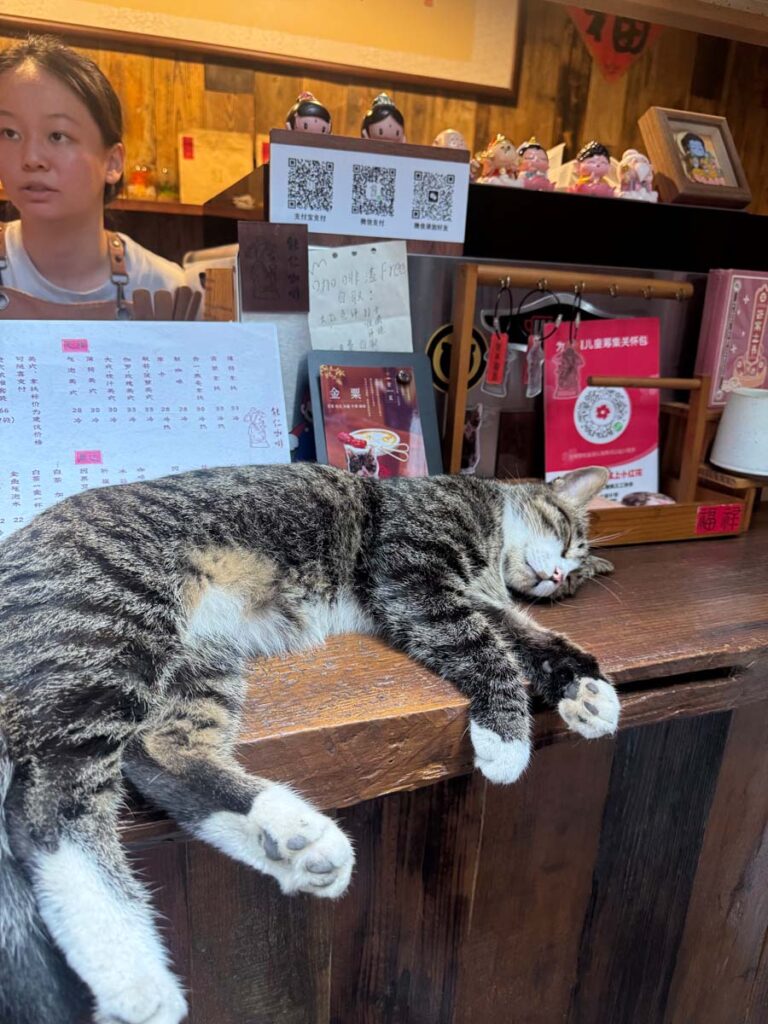
Before entering the temple, stop at Nengren Coffee. Rather than simply choosing a drink from the menu, you’re invited to draw a traditional fortune stick first, and your fortune determines which coffee you receive. The beans are blessed by the monks, making it a unique coffee experience. We were also greeted by the temple’s resident cat, who seemed perfectly at home sleeping on the counter.

After our coffee, we explored the peaceful temple grounds. It’s very small and only takes around 15 minutes to wander through, but it provides a lovely contrast to the busy streets outside and is a reminder that Chongqing isn’t just about skyscrapers and neon lights.

Nengren Temple & Fortune Coffee

Wander Around Daijia Alley

Located just above Hongyadong, Daijia Alley is a lively hillside neighbourhood filled with cafés, restaurants and small shops. As you wander through the streets, you’ll come across several viewpoints overlooking the Jialing River and Hongyadong, offering a different perspective of one of Chongqing’s most famous landmarks.

Visit Hongyadong (Our Honest Thoughts)

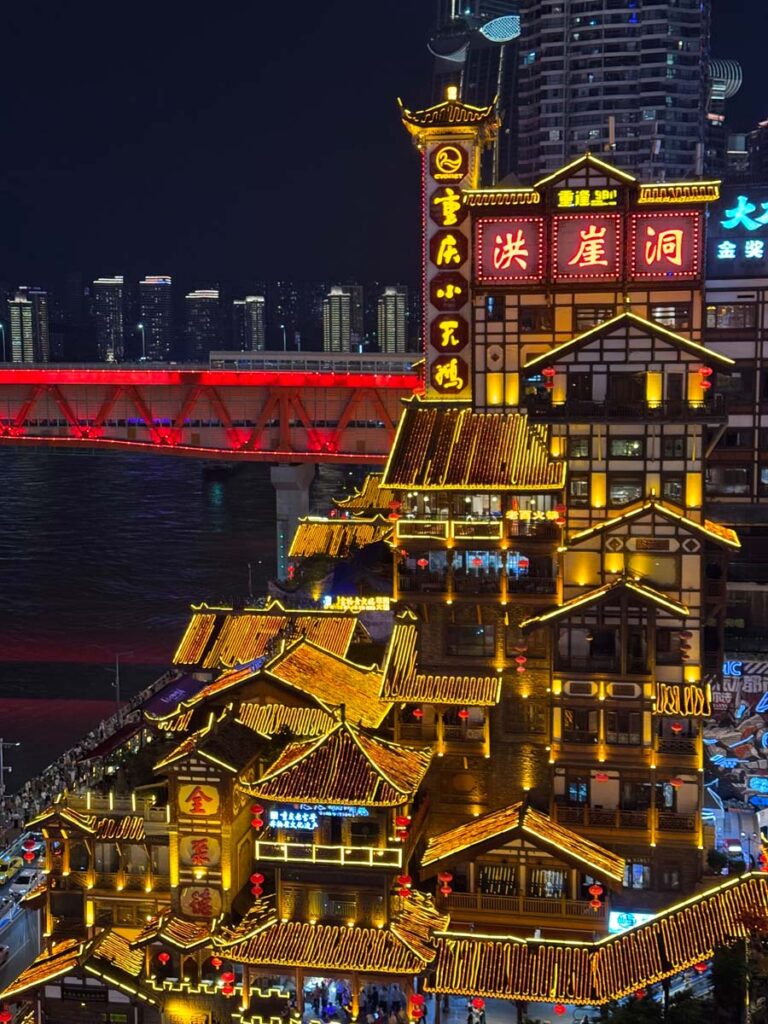
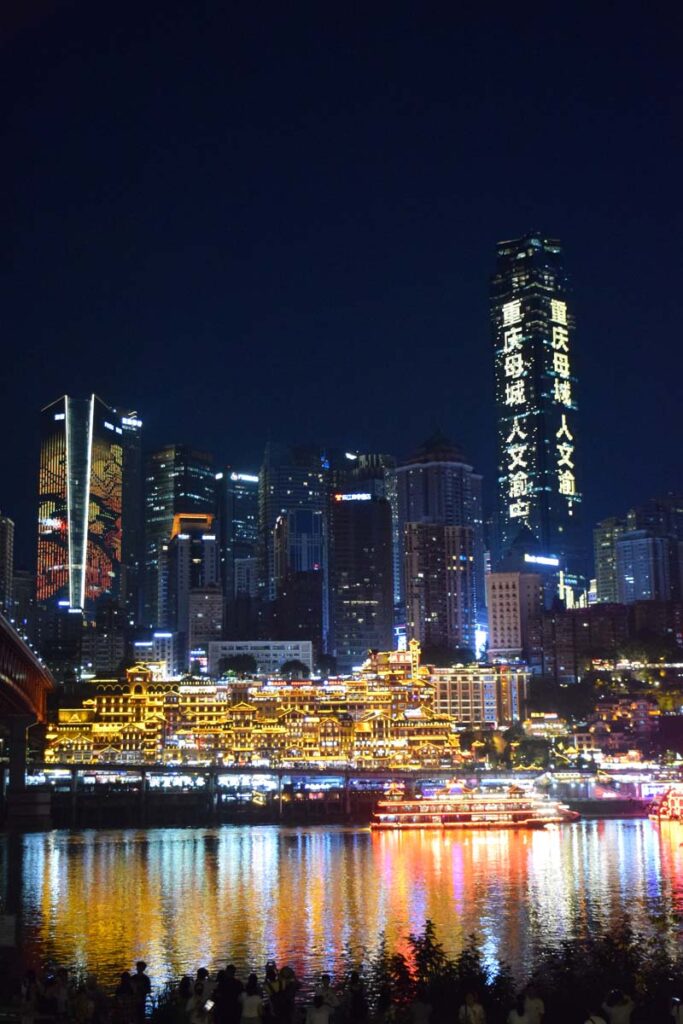
Hongyadong is Chongqing’s most famous landmark, and it’s especially impressive once the lights come on after dark. Unsurprisingly, it’s also one of the busiest places in the city.

Rather than joining the crowds directly in front of the complex, we chose to admire it from two different viewpoints. The first was from Daijia Alley, which gives you a side view over Hongyadong and was noticeably less crowded than the main entrance. Later, we crossed the river to the large viewing area by the waterfront. There was plenty of space, benches to sit on and a much more relaxed atmosphere, so we could simply enjoy the skyline without squeezing through crowds or waiting for a photo.

If you love being in the middle of the action, you’ll probably enjoy exploring Hongyadong itself. But if you’re anything like us and prefer to take it all in from a quieter spot, we’d recommend one of these viewpoints instead.

Hongyadong in Chongqing
Hongyadong in Chongqing from the otherside of the river

Visit Kuixinglou Square

This is one of the best places to experience Chongqing’s incredible elevation changes. You arrive feeling like you’re standing at street level, but after walking across the square, you suddenly find yourself on the 22nd floor of the building opposite. It’s one of those places that perfectly explains why Chongqing is often called China’s “8D city”.

Watch the Metro Pass Through a Building at Liziba

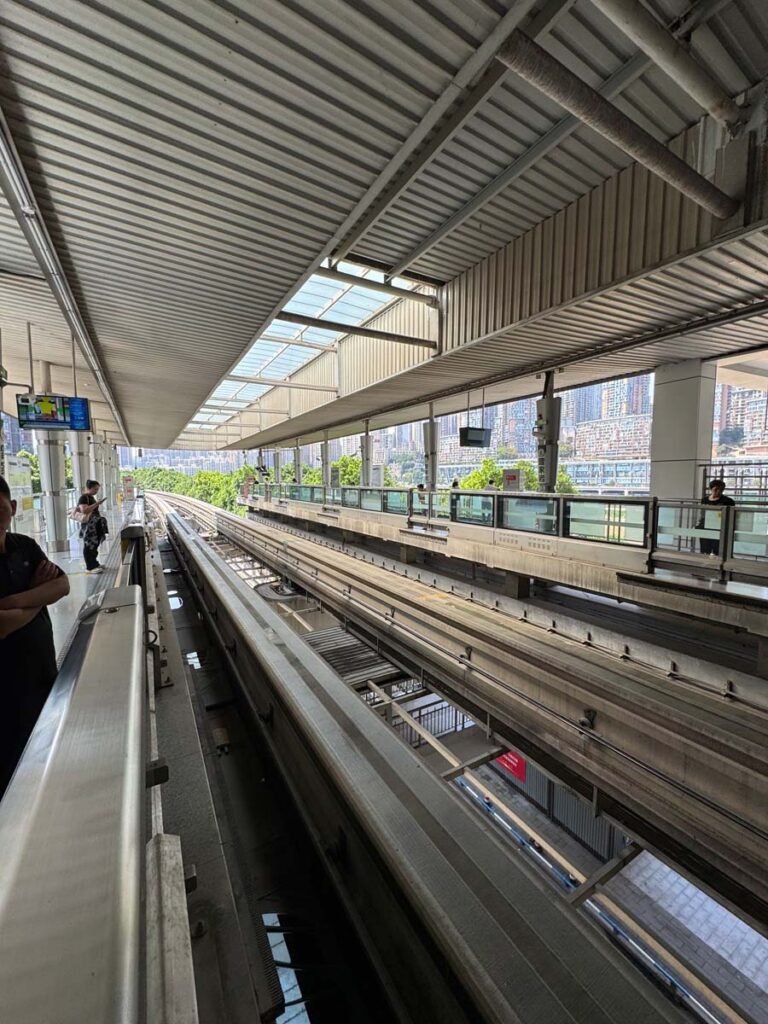
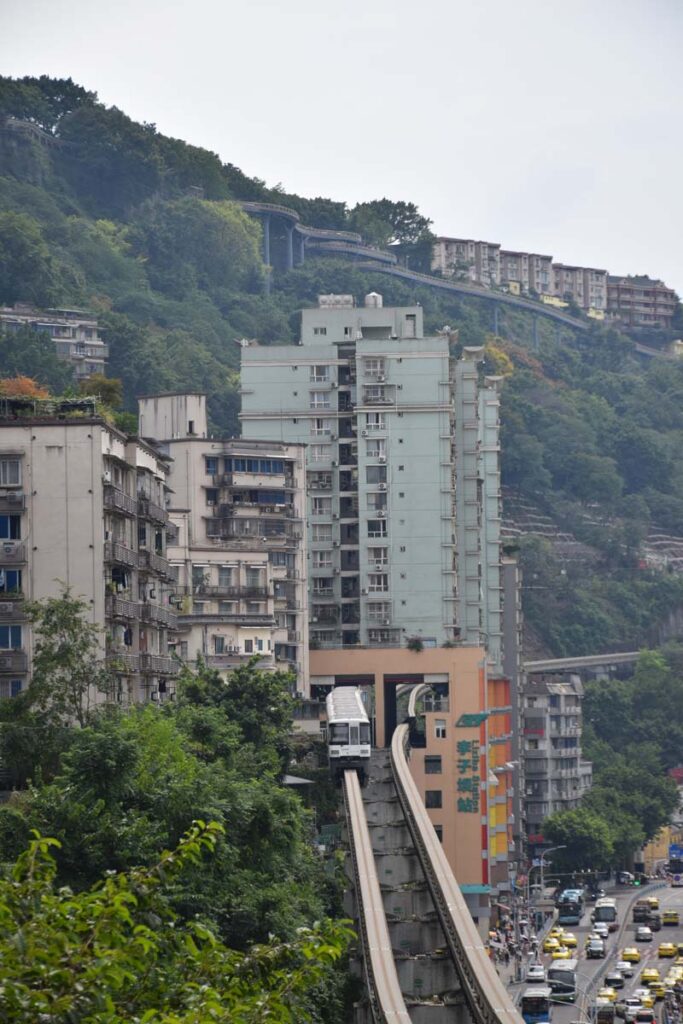
Liziba is another of Chongqing’s famous sights, where the metro appears to pass straight through the middle of an apartment building. It’s another one of those places you’ve probably seen countless times on social media.

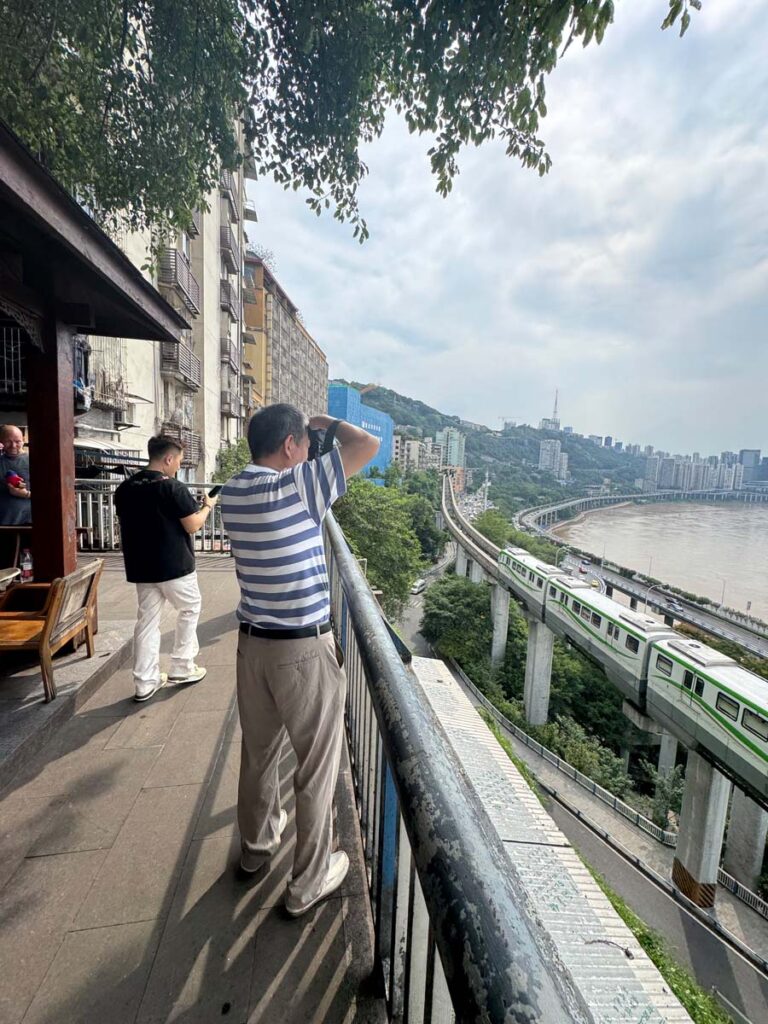
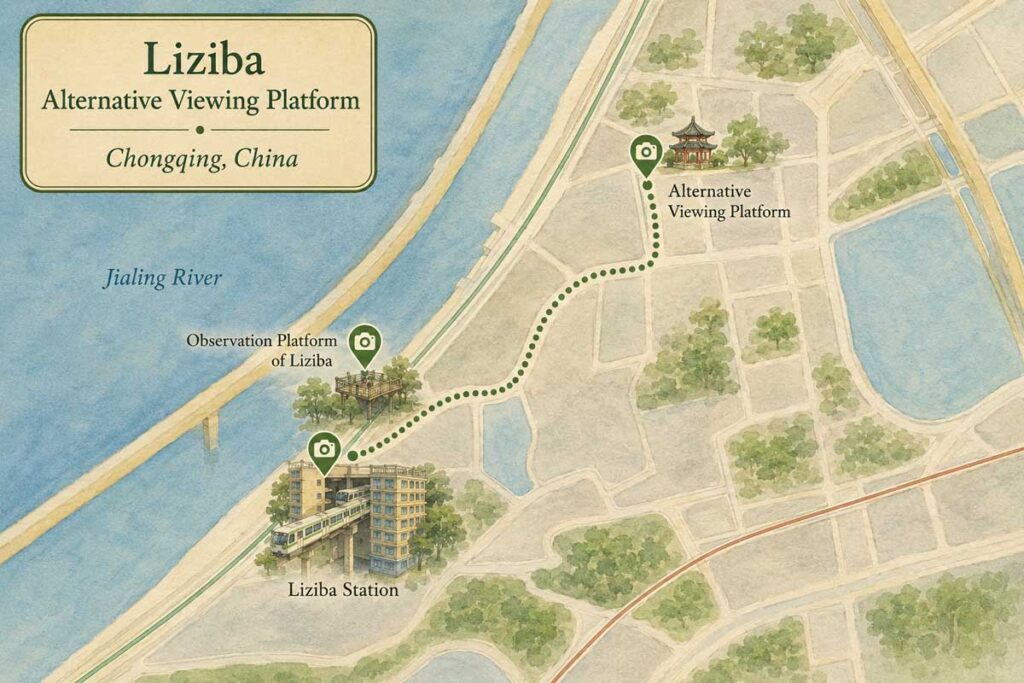
The official viewing platform was packed when we visited, so instead we headed to a quieter viewpoint in a nearby residential neighbourhood, about a 10 minute walk up the hill from the back of the metro station. There were only a handful of other people there, and we actually preferred it. We still had a great view of the train passing through the building, but without having to fight through the crowds.

For a quieter angle, walk towards Datianwan Primary School / 大田湾小学 and look for Lansheng Pavilion / 揽胜亭, a small viewpoint around 10–12 minutes from Liziba Station. It gives you a wider view of the train curving through the hillside, rather than just the classic “train through the building” shot.

Directions:

  1. Take Chongqing Rail Transit Line 2 to Liziba Station.
  2. Use Exit 2.
  3. Walk about 600m uphill towards Datianwan Primary School (大田湾小学)
  4. Near the school area follow the road down between the apartment blocks to the Lansheng Pavillion
  5. Be respectful — it’s near a school/residential area, so don’t block paths or film people.
Liziba Station
Liziba Station at view
Liziba Station alt view
Lansheng Pavilion alternative view point

If you’re planning to visit Liziba and don’t like crowds, we’d definitely recommend looking for one of the nearby viewpoints rather than heading straight to the main platform.

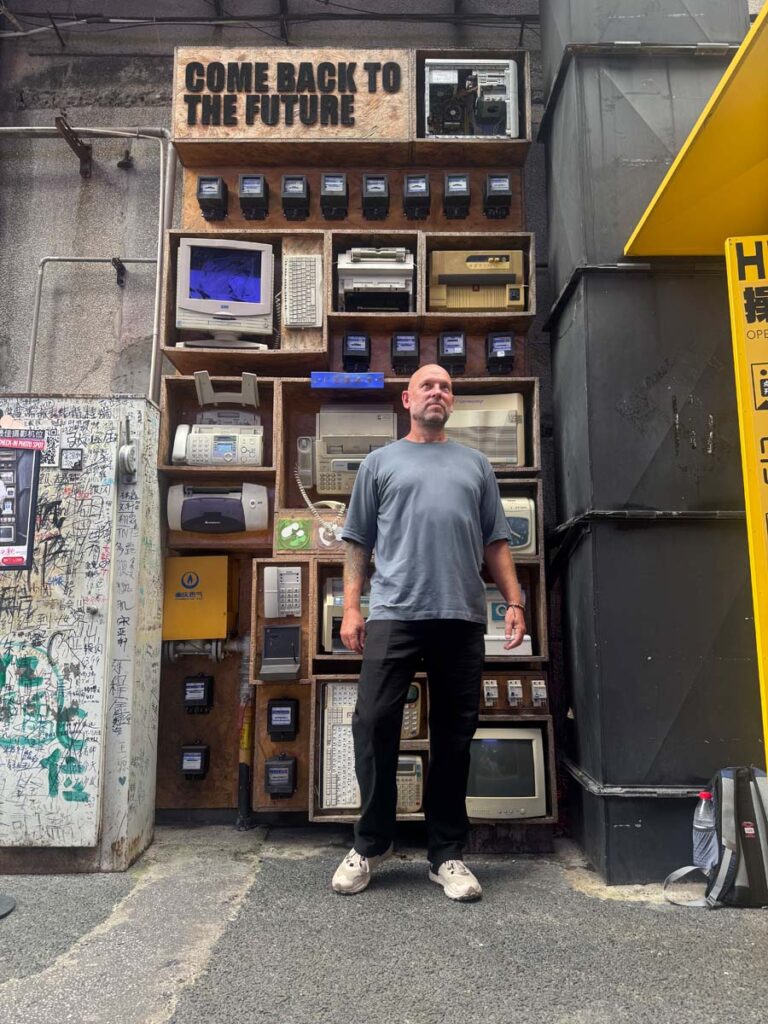
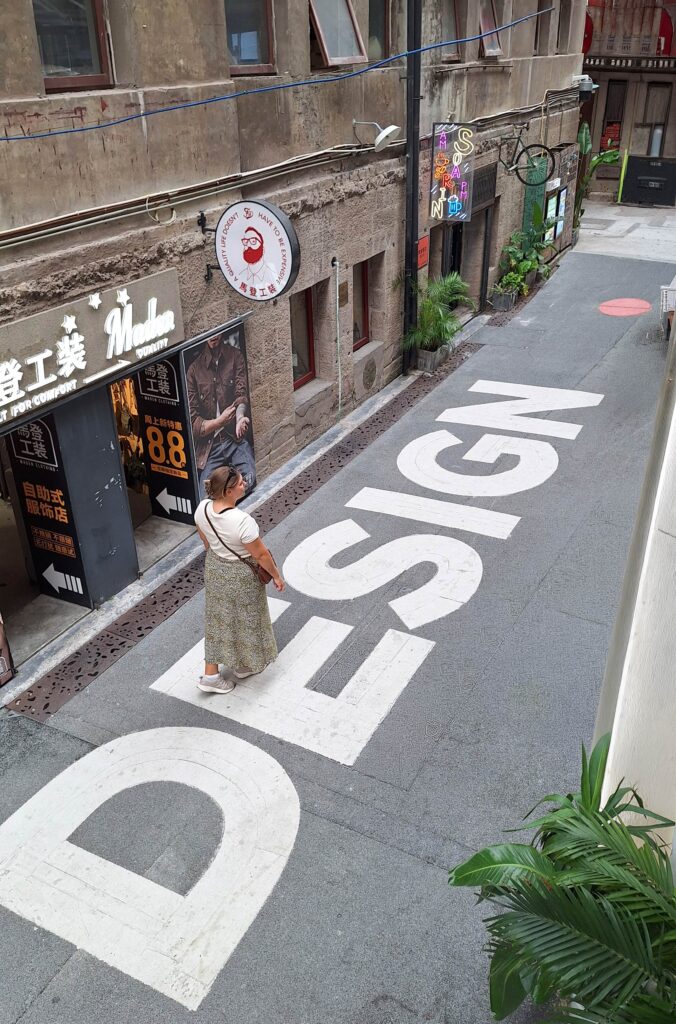
From Liziba, we walked to Testbed 2 before continuing on to Eling Park. It made for a nice route, taking us from one of Chongqing’s most famous sights to a quieter creative district before ending the afternoon surrounded by greenery.

Visit the Chongqing Testbed 2 (TESTBED2) Art District

If you’re walking from Liziba to Eling Park, you’ll pass Testbed 2, a former industrial site that’s been transformed into a creative district with galleries, cafés, exhibitions and colourful street art.

We stopped for a wander, it wasn’t one of our favourite places in Chongqing. It felt a little too curated and touristy for our tastes, lacking the authentic creative atmosphere we’d hoped for. That said, it’s an easy stop along the route and worth a quick look before continuing to Eling Park.

TESTBED2
TESTBED2

Relax in Eling Park

After tackling countless hills and staircases on our walk from Liziba, Eling Park was a welcome place to relax and escape the bustle of the city. One of the city’s oldest and greenest parks, it’s the perfect place to slow down and experience a different side of the city.

We spent a couple of hours wandering through the leafy gardens, watching locals playing mahjong, friends chatting and groups of young adults dressed in elaborate traditional Chinese outfits having professional photos taken. It felt like a place where people came to enjoy the afternoon rather than simply tick off another attraction.

There are several teahouses dotted throughout the park, and we stopped at Goose Ling Leisure Tea Center for a fancy pot of tea and desserts. It had a wonderfully traditional atmosphere and was the perfect place to sit back, relax and soak up the surroundings before continuing our walk through the park.

If you’re looking for a break from Chongqing’s fast pace, Eling Park is one of the best places to experience local life.

Goose Ling Leisure Tea Center
Eling Park
Eling Park

Watch Sunset from Liangjiang Pavilion

If you’re visiting Eling Park, stay until sunset and climb the tower for panoramic views across Chongqing. Watching the city gradually light up as the sun set over Chongqing was a great way to end the day.

Sunset from Liangjiang Pavilion

Visit Laojundong Taoist Temple

Perched high on the hillside, reaching the temple involves plenty of uphill walking, and once inside you’ll continue climbing staircases that wind their way through the temple complex. It might leave you a little out of breath, but the views over Chongqing are more than worth the effort.

Despite being relatively close to the city centre, it felt peaceful and far removed from the crowds below. We loved wandering through the temple grounds, exploring the different halls and terraces, and taking in the panoramic views over the skyline. If you’re looking to experience a quieter, more traditional side of Chongqing, this is a place we wouldn’t miss.

Laojundong Taoist Temple
Views of Chongqing from Laojundong Taoist Temple

Explore Huangjueya Old Street

Just a short distance from Laojundong Taoist Temple, Huangjueya Old Street has a completely different feel to central Chongqing. Although it’s still a popular area, it was much quieter than places like Hongyadong and Jiefangbei. Traditional buildings sit alongside cafés, coffee shops and plenty of greenery, making it an enjoyable place to spend a slower afternoon.

We wandered through the streets, stopped for coffee and simply enjoyed exploring without any real plan. If you’re looking for a break from Chongqing’s busiest attractions, it’s well worth making the trip.

Tea shops at Huangjueya Old Street

Experience Chongqing After Dark

If there’s one thing you shouldn’t miss, it’s seeing Chongqing after sunset. The neon skyline, illuminated bridges and reflections on the rivers completely transform the city. This is when Chongqing really earns its “cyberpunk” reputation.

Wander the Multi-level Streets

One of the best things to do in Chongqing isn’t a specific attraction at all. Spend time simply walking. You’ll constantly discover roads above roads, staircases disappearing between buildings, hidden viewpoints and entrances on completely different levels. Getting slightly lost is part of the experience.

Where to eat in Chongqing

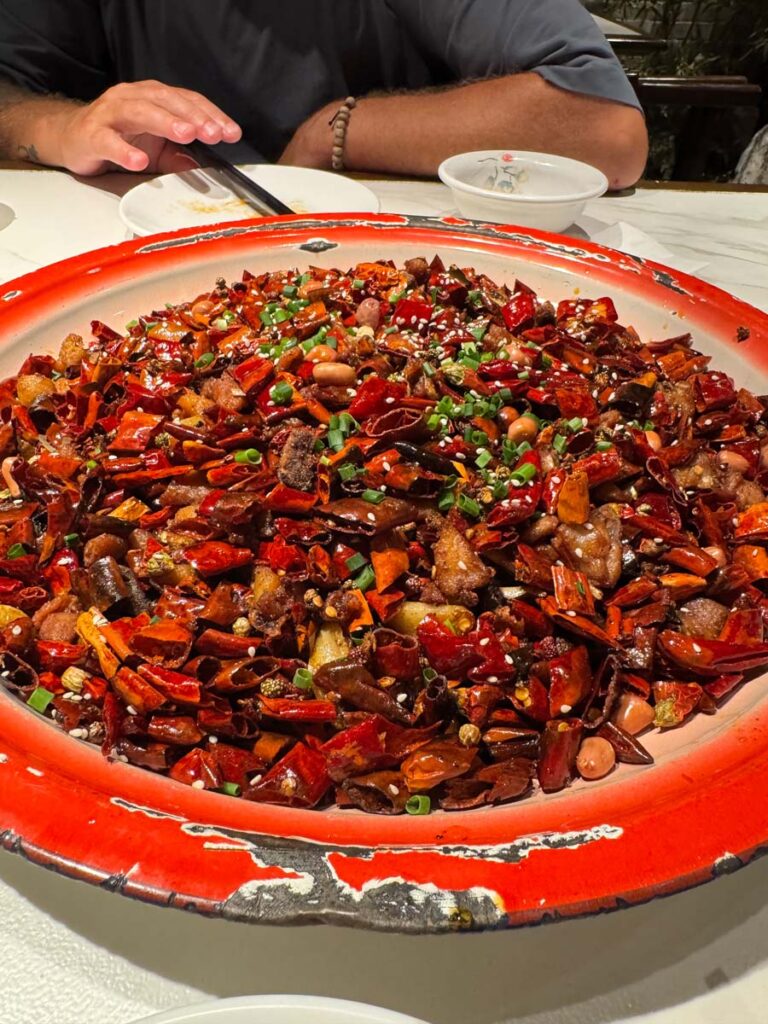
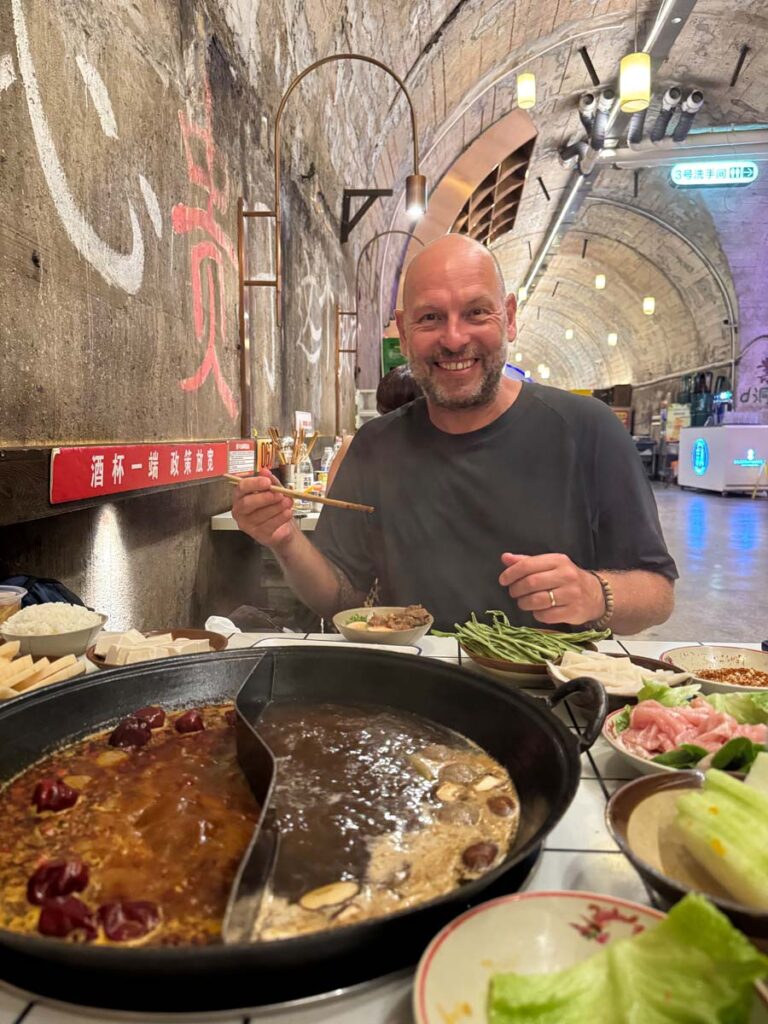
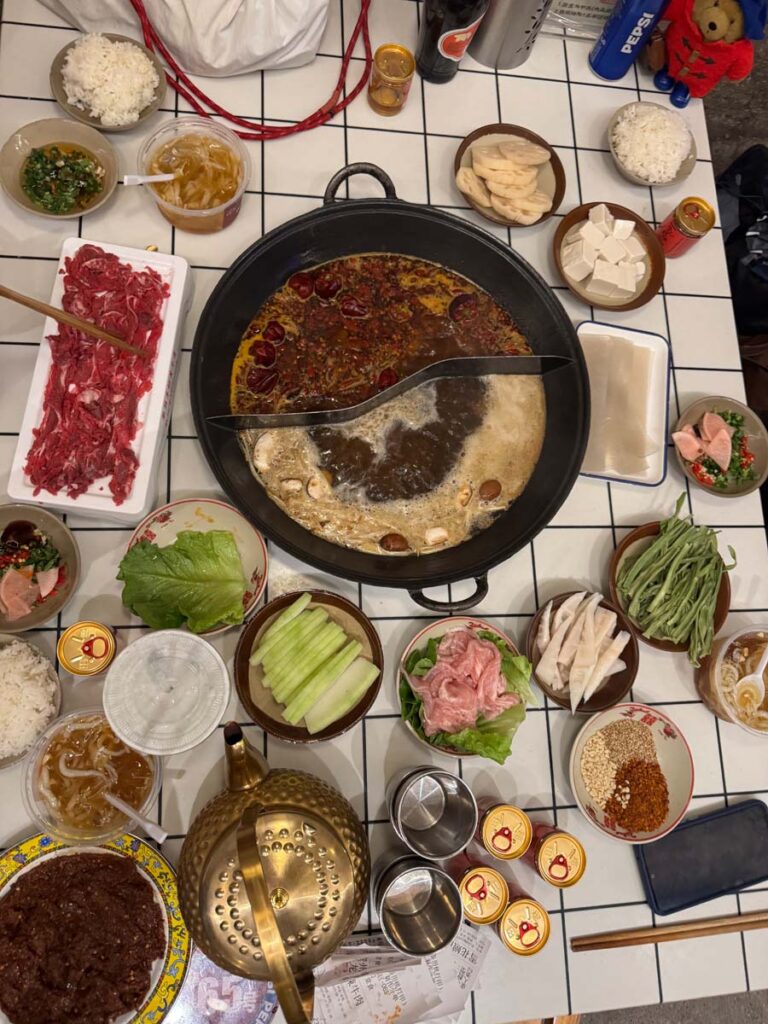
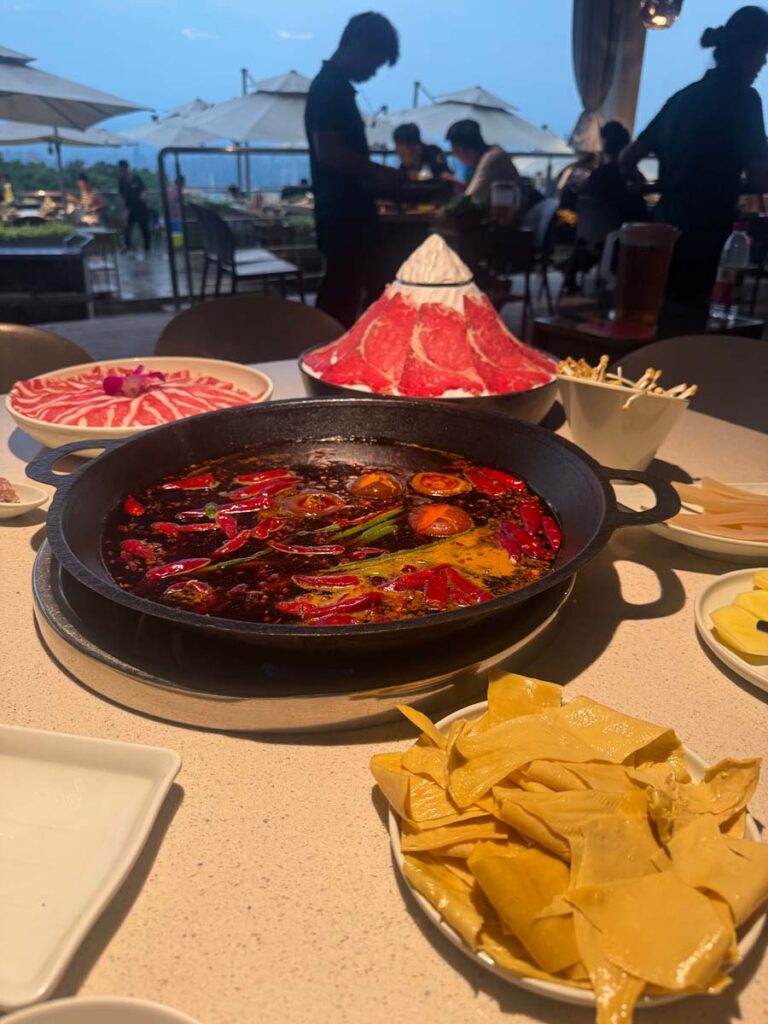
Chongqing is famous for one thing above all else: hot pot. Rich, spicy and packed with dried chillies and Sichuan peppercorns, it’s one of the city’s signature dishes and something every visitor should try. If you’re not used to spicy food, don’t worry. Most restaurants also offer a yin-yang pot, combining the traditional spicy broth with a milder option.

Beyond hot pot, you’ll find everything from street food stalls and noodle shops to barbecue restaurants and late-night eateries. Here are a few places we think are worth adding to your itinerary.

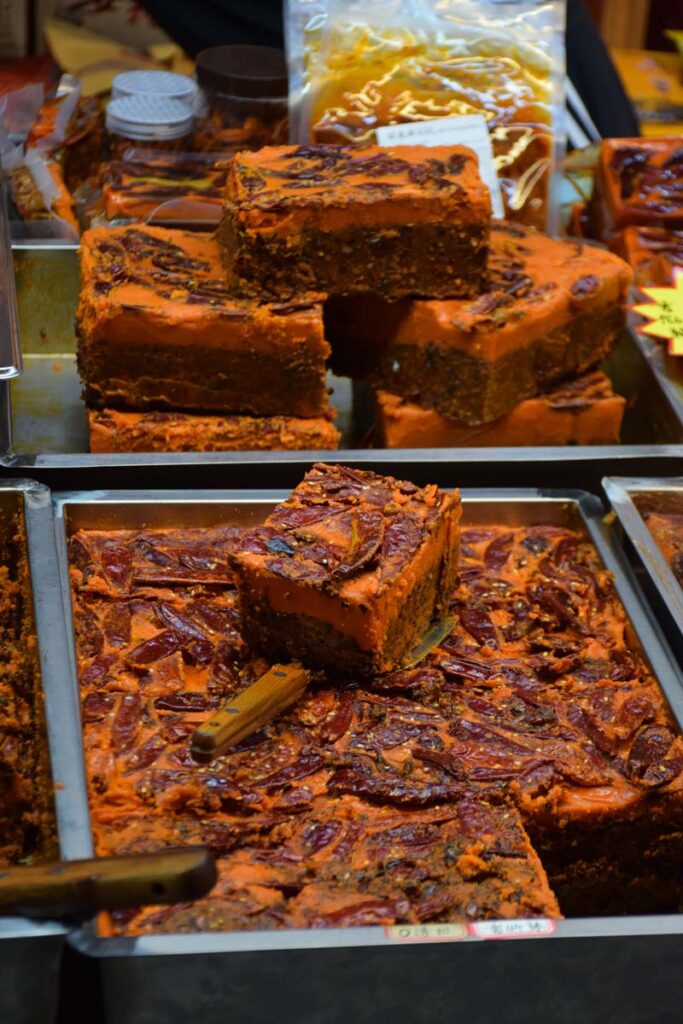
Hot Pot mix for sale
Traditional Chongqing fried chicken with a ton of chillies

Eat Hot Pot in a Former Air Raid Shelter

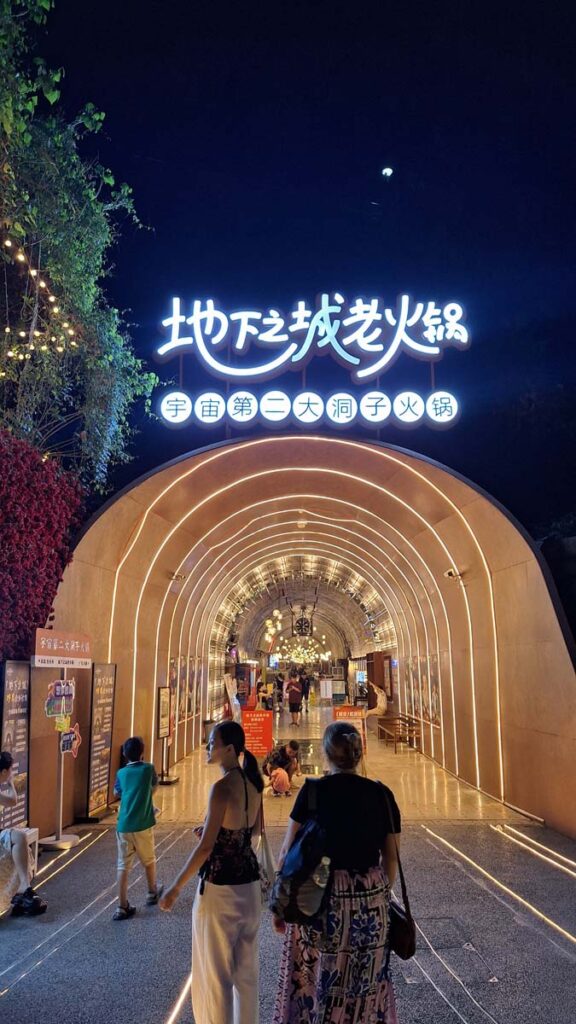
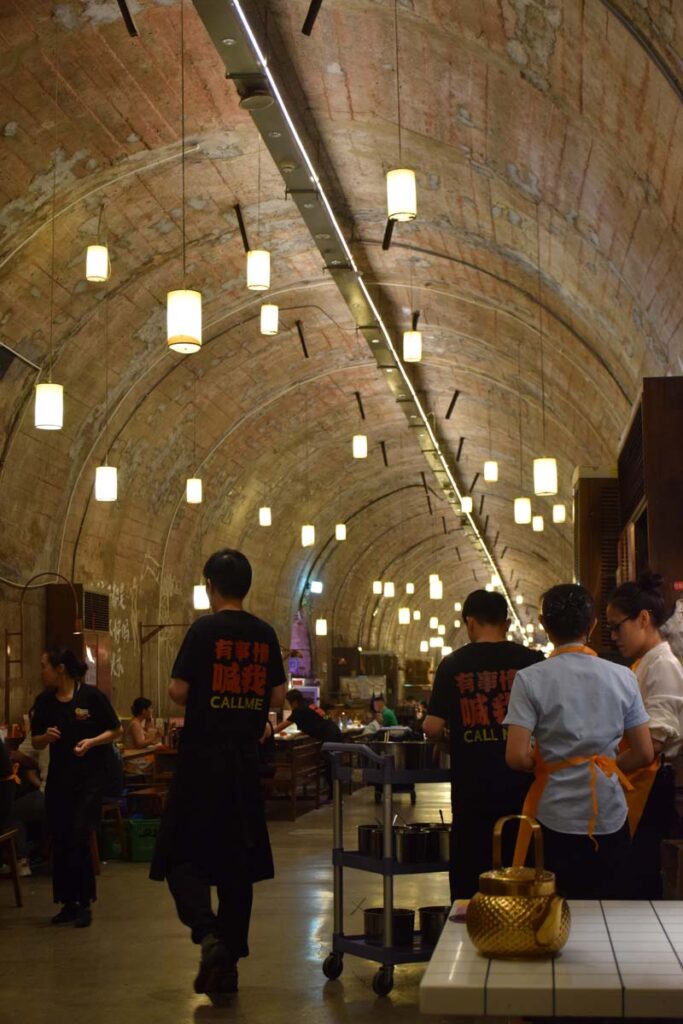
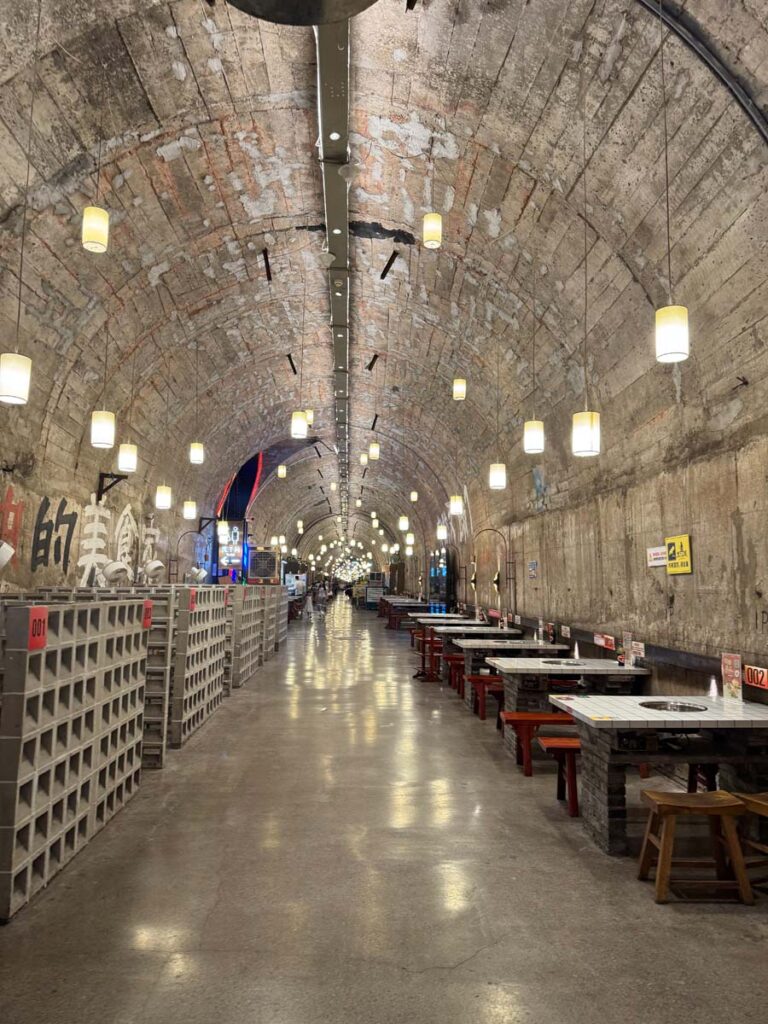
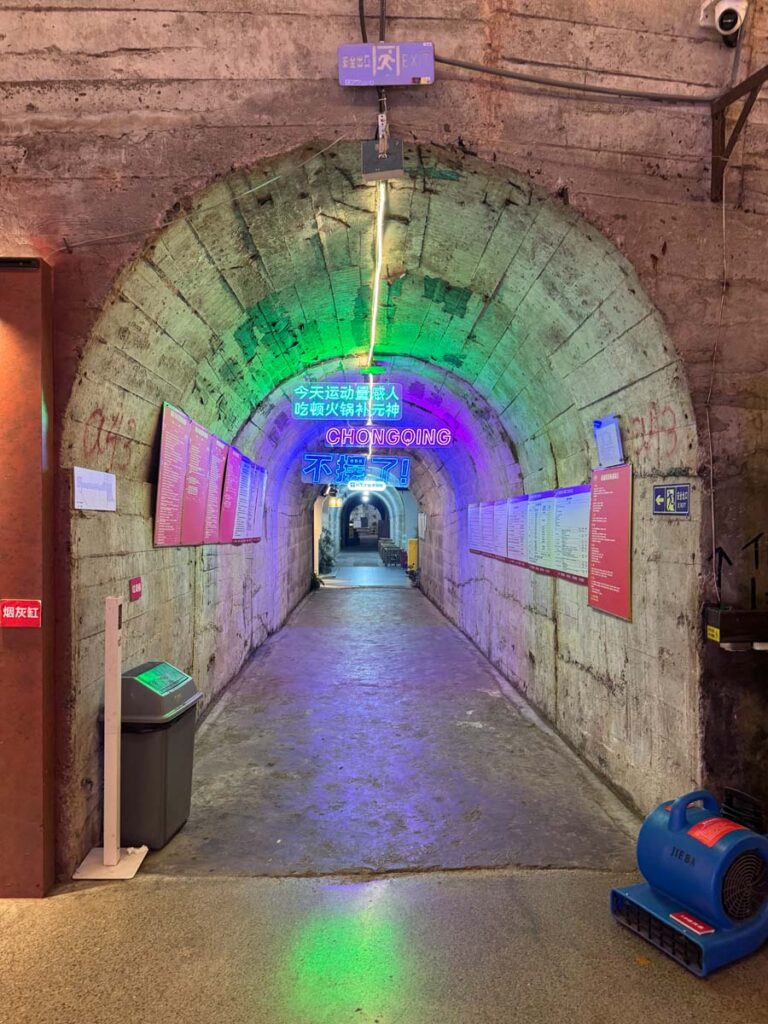
Chongqing is famous for its Bomb Shelter hot pot restaurants, and this is one of the most unique places to try the city’s signature dish. Underground Zhicheng Old Hot Pot is set inside a former World War II air raid shelter, where diners eat beneath vaulted concrete tunnels that were built to protect the city’s residents.

The setting is unlike any typical restaurant anywhere. Long bunker corridors lead to different dining areas, while the exposed concrete walls have been left largely untouched. It’s busy, full of locals and a fascinating place to experience Chongqing’s hot pot culture.

If you’re deciding between a standard hot pot restaurant and an air raid shelter, we’d recommend trying the latter. It’s a dining experience that’s absolutely unique to Chongqing.

How to Get to Underground Zhicheng Old Hot Pot by Metro

The nearest metro station to Underground Zhicheng Old Hot Pot is Hongtudi Station / 红土地站, served by Chongqing Metro Line 6 and Line 10.

Take the metro to Hongtudi Station, then use Exit 1A. From there, walk along Wuhong Road / 五红路 towards Longtou Temple Park / 龙头寺公园. The hot pot restaurant is inside the underground shelter complex near the south side of Longtou Temple Park, around a 5–10 minute walk from the station.

Chongqing Bomb Shelter Hot Pot

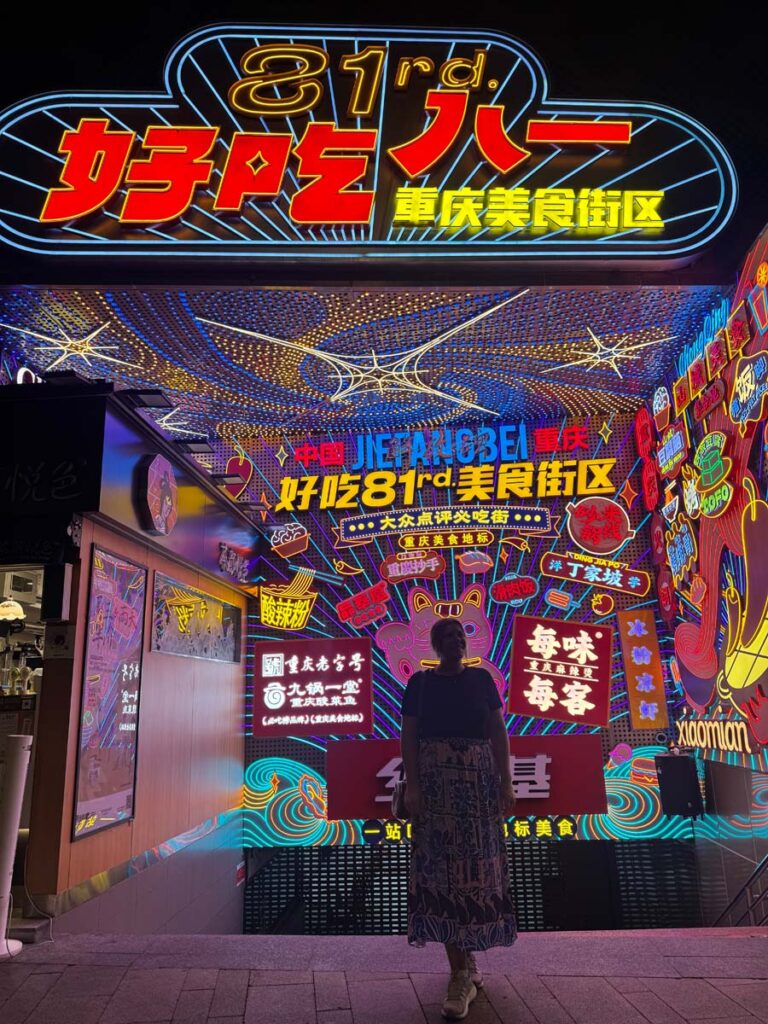
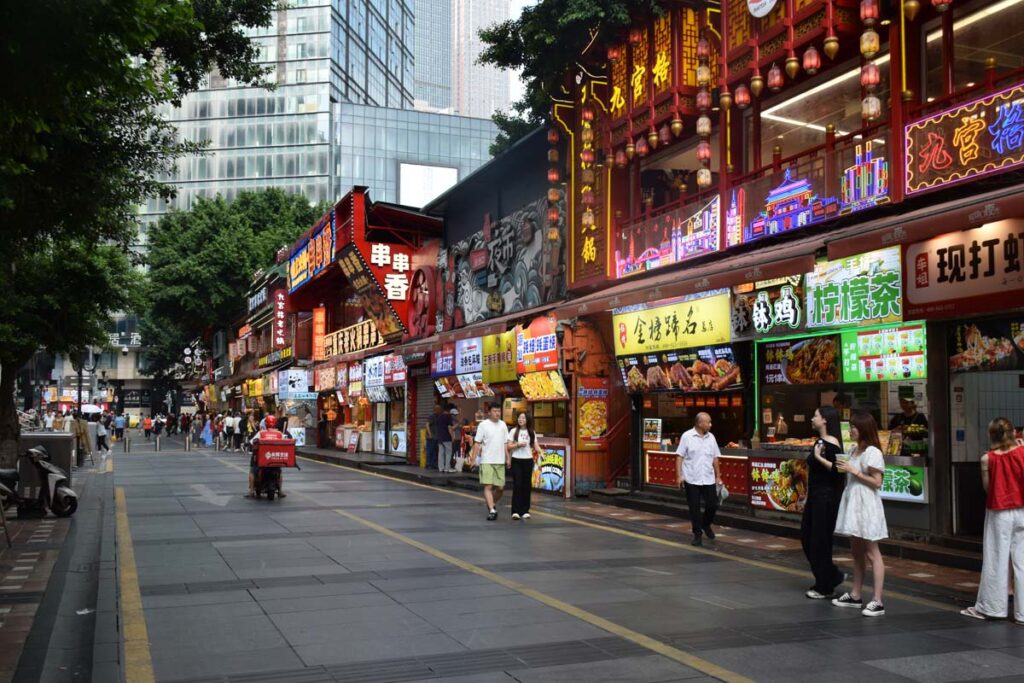
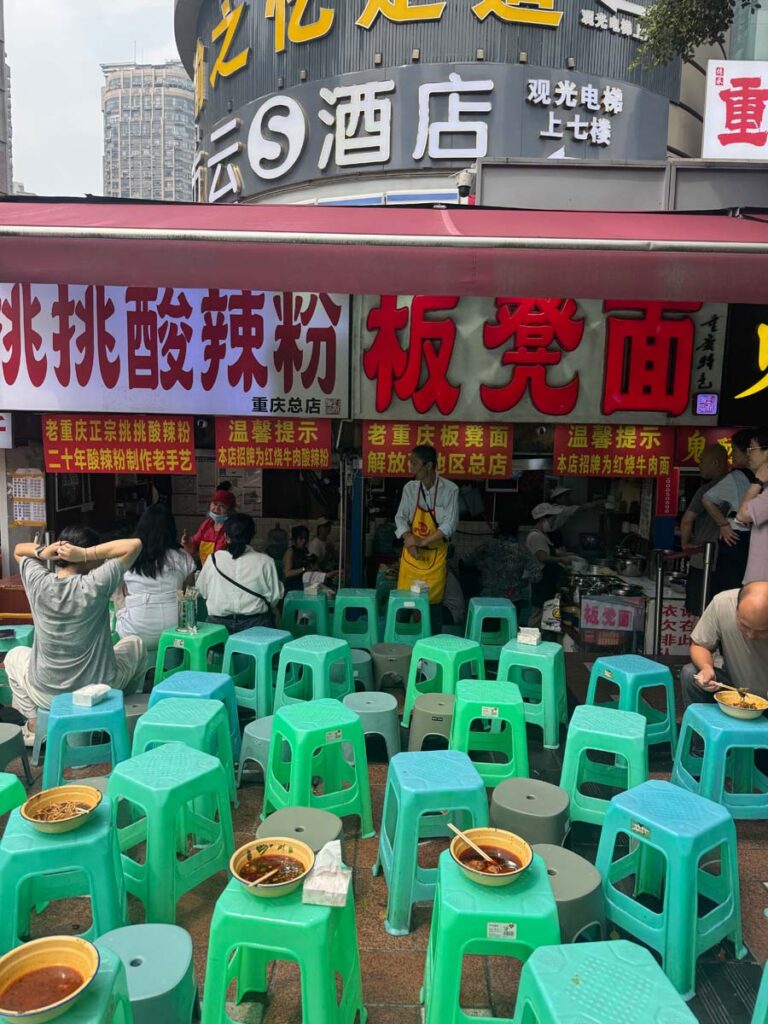
Bayi Road Food Street

Just a short walk from our hotel, Bayi Road Food Street is packed with food stalls, noodle shops and traditional restaurants serving everything from grilled skewers and dumplings to spicy Sichuan dishes.

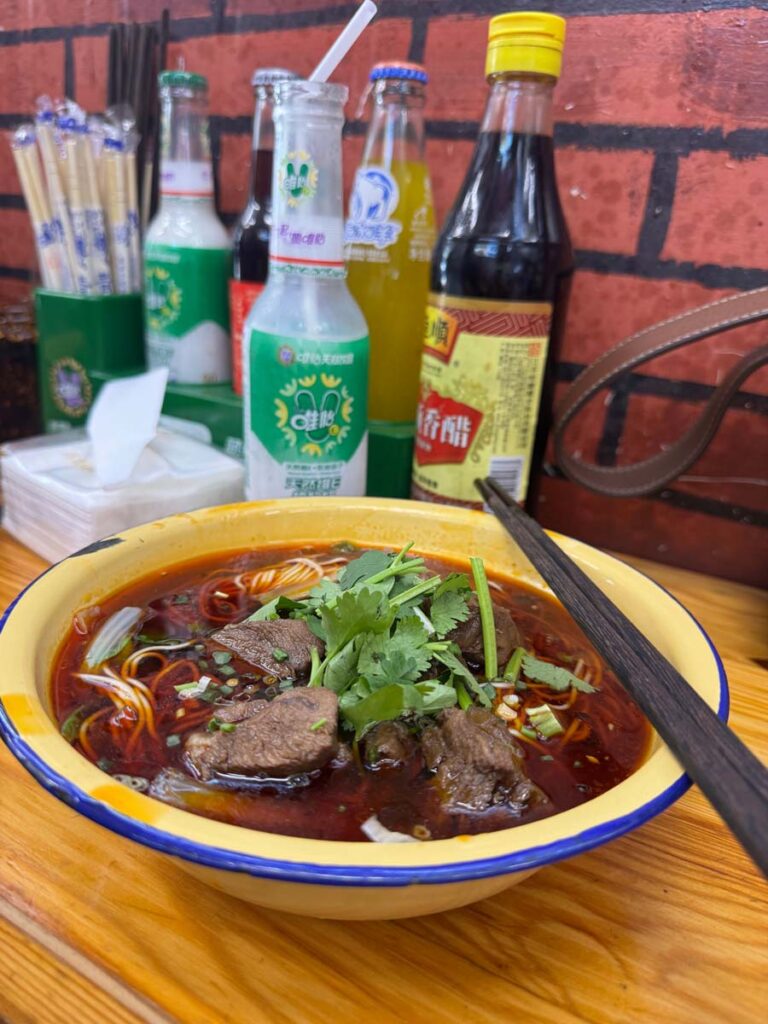
We found ourselves returning several times during our stay, whether it was for a quick bowl of beef noodles, street food or dinner. Even if you don’t have a particular restaurant in mind, it’s a great area to wander and choose somewhere that catches your eye.

Bayi Road Food Street

Hesi Chongqing Noodles

If you’re looking for a quick, affordable meal, Hesi Chongqing Noodles is a great choice. Just a short walk from Bayi Road Food Street, it’s a popular local spot serving traditional Chongqing xiaomian (small noodles).

We stopped here for lunch and it was one of those simple restaurants that does one thing really well. If you’re keen to try a classic bowl of Chongqing noodles without spending much, this is an easy place to start. 

Chongqing Noodles
Chongqing Noodles

Go Nanshan Night View Hot Pot Park

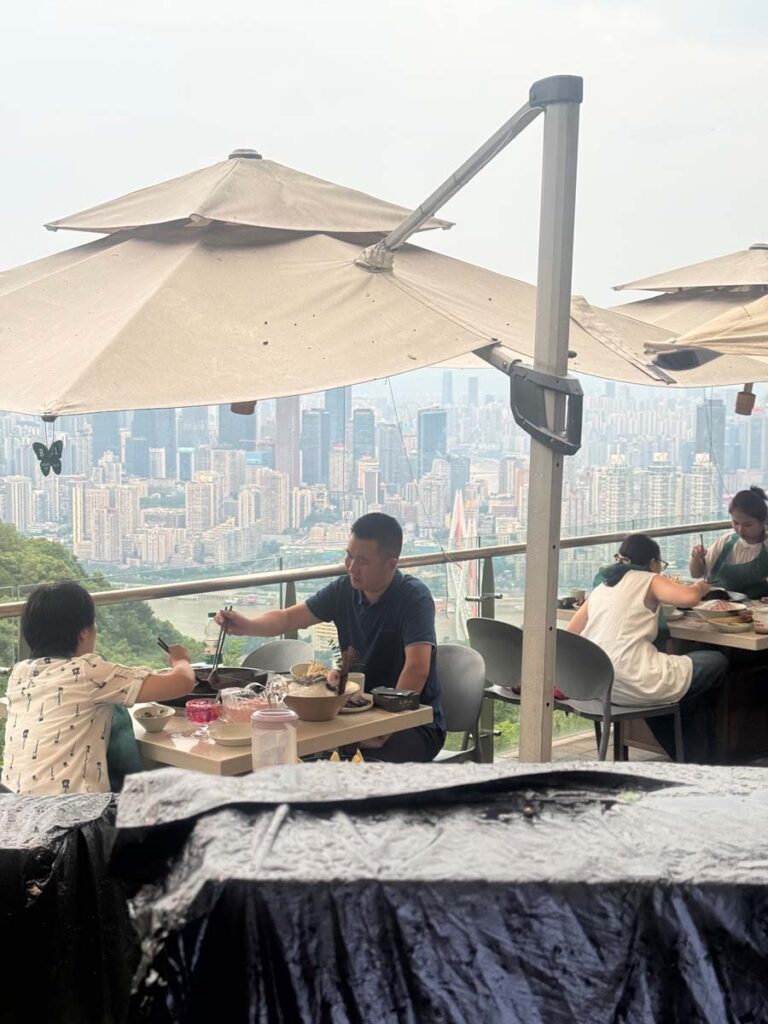
After exploring Huangjueya, we took a local bus further into the Nanshan hills and walked uphill for around five to ten minutes to Go Nanshan Night View Hot Pot Park. The restaurant is built across several terraces on the hillside, with outdoor tables overlooking Chongqing’s skyline.

We arrived while it was still light and stayed as the city lit up below us. Despite the impressive setting, it didn’t feel particularly touristy when we visited, and most of the other diners appeared to be local families and groups of friends. The hot pot was excellent, and watching the lights come on across Chongqing made it a memorable way to end the evening.

Chinese name: 去南山夜景火锅公园
Address: 南山街道真武山88号, Nan’an District

Go Nanshan Night View Hot Pot Park

Sanmao Impression Café

If you’re exploring Huangjueya Old Street, Sanmao Impression Café is a great place to stop for a coffee and a break. Located beside Sanmao’s Former Residence, the modern café has floor-to-ceiling windows, several levels of seating and a large outdoor terrace surrounded by trees. We sat outside with a coffee before continuing our walk through the Nanshan hills, and it was the perfect place to slow down for a while.

Impression Café

How to Get to Chongqing

Chongqing is well connected by both high-speed rail and air, making it an easy city to include in a China itinerary.

We travelled to Chongqing by high-speed train from Chengdu, a journey that took around two hours. The trains are fast, comfortable and run frequently throughout the day, making this one of the easiest routes in China.

We flew out of Chongqing Jiangbei International Airport (CKG) going to Shanghai, which is well connected to destinations across China and internationally. The airport is easy to reach by metro, taxi or ride-hailing apps such as Didi.

One thing to be aware of is China’s power bank regulations. On domestic flights, airport security may confiscate power banks that don’t display a valid CCC (China Compulsory Certification) mark, even if they’re perfectly legal in your home country. We nearly lost both of ours before our flight to Shanghai and thought we’d have to leave them behind. Fortunately, a member of staff took pity on us and offered to arrange shipping to our hotel instead. She organised everything, we transferred a small fee to the courier, and two days later both power banks arrived safely at our hotel in Shanghai.

In our case, this wasn’t an official airport service. However, some airports in China now do offer power bank shipping, so if you find yourself in the same situation, it’s definitely worth asking before handing yours over.

How Many Days Do You Need in Chongqing?

2 Days

Two days is enough to experience some of Chongqing’s main highlights, but it will feel quite busy. You could explore the streets around Jiefangbei, visit a temple, ride the metro, eat hot pot and street food, and see the city from one or two viewpoints, but you’ll need to keep the pace moving.

3 Days

We spent 3 nights in Chongqing, which felt like a good amount of time for a first visit. It gave us enough space to explore the bustling streets around Jiefangbei, visit temples, wander through Huangjueya Old Street, ride the metro, eat plenty of hot pot and street food, and see the city from several viewpoints without feeling like we were racing through it.

4+ Days

If you have four days or more, we’d recommend using at least one of them for a day trip outside the city. Wulong Karst National Geology Park is one of the most popular excursions from Chongqing, known for its dramatic limestone landscapes, natural bridges and filming locations from Transformers: Age of Extinction. It’s somewhere we would have loved to visit ourselves but simply didn’t have enough time.

Getting Around Chongqing

Despite its size, we found Chongqing surprisingly easy to get around. Between the metro, buses and Didi, we never had any trouble reaching the places we wanted to visit.
If you’re travelling in China for the first time, it’s worth setting up your essential apps before you arrive. We’ve covered the ones we actually used in our best apps for visiting China guide, including Alipay, Didi, maps, translation and transport tools.

Metro and bus

Chongqing has an extensive metro network that connects many of the city’s main attractions. We used it throughout our stay and found it to be clean, efficient and easy to navigate, even as first-time visitors.

We also caught local buses several times, particularly when exploring the Nanshan area. Some places simply aren’t served by the metro, and the buses were just as easy to use.

We set up a Chongqing Transport Card in Alipay, which allowed us to pay for both buses and the metro by simply scanning our phone.

Didi

For longer journeys or when we wanted the easiest option, we used Didi, China’s equivalent of Uber. It was affordable, reliable and easy to book through the Alipay app. We found it especially useful late in the evening or when travelling to places outside the city centre.

Walking

Although many of Chongqing’s attractions are within walking distance of each other, don’t expect a flat city. Chongqing is built across steep hills, and even short walks can involve hundreds of steps, long escalators and surprisingly steep climbs. By the end of the day, your legs will certainly know they’ve had a workout.

Navigation can also be confusing at first. The city is built on multiple levels, so your map might tell you your destination is only 50 metres away, while in reality it’s several storeys above or below you. Give yourself a little extra time when walking, especially if it’s your first visit.
Sam on Chongqing Metro
A lot of stairs
Many pretty metro stations

Best Time to Visit Chongqing

We visited Chongqing in September and found it very hot and humid. The combination of high humidity and the city’s steep hills made exploring on foot more challenging than we expected. We often found ourselves stopping to catch our breath after climbing some of the city’s endless staircases.

If you’re planning to spend a lot of time walking, spring (March to May) and autumn (October to November) generally offer the most comfortable temperatures. That said, Chongqing is a year-round destination. Summer brings lush greenery and dramatic thunderstorms, while winter is known for the low cloud and mist that earned the city its nickname, “The City of Fog.”

Practical Tips for Visiting Chongqing

  • Don’t underestimate the hills. We regularly found ourselves stopping halfway up staircases to catch our breath, especially in the September heat and humidity.
  • Allow extra time to get around. Distances on the map can be deceptive. Your destination might be directly above or below you, rather than across the street.
  • Use the metro or buses when you can. It often saves time compared with walking, especially if you’re moving between different levels of the city.
  • Choose your hotel location carefully. Staying near Jiefangbei made it easy for us to walk to many attractions and restaurants while still having good metro connections.

Internet, Payments and Apps

Most businesses in Chongqing are cashless, so it’s worth setting up Alipay and WeChat before you arrive. We used it throughout our stay for public transport, Didi rides and paying in restaurants and cafés.

You’ll also need an eSIM or VPN if you want to access Google services and other blocked websites. We cover everything you need to know, including the apps we used every day, in our Complete Guide to the Best Apps for Travelling in China.

Final Thoughts on Visiting Chongqing

We only spent three nights in Chongqing, but it was enough to understand why so many people rave about it. There were still plenty of places we didn’t have time to visit, especially Wulong Karst National Geology Park, which gives us a good excuse to return. If you’re looking for a city that’s completely different from anywhere else in China, Chongqing deserves a place on your itinerary.

July 22, 2026 0 comments
FacebookTwitterPinterestLinkedinRedditStumbleuponWhatsappTelegramThreadsOpenAIChatGPTEmail
Walking Around Shiomi Nawate
Japan

Matsue Travel Guide: Castle, Samurai Streets and Lake Shinji

by Sam July 20, 2026
written by Sam

Matsue was one of the easiest cities to enjoy on our 23 day slow train route through western Japan. After smaller stops like Masuda and Izumo, Matsue felt a little more substantial, but still calm, historic and very manageable.

We stayed two nights, which gave us enough time to visit Matsue Castle, walk through the old samurai district, stop at a fox shrine, eat cold soba, find GREAT coffee, enjoy a great lunchtime BBQ deal and watch the sunset over Lake Shinji.

It’s also close enough to Izumo Taisha that you can visit the shrine from Matsue, especially if you’d rather base yourself in a larger city with more food and hotel options.

Why Visit Matsue?

Matsue is well worth visiting if you like historic cities with a slower pace. It has one of Japan’s few remaining original castles, a moat, old streets, awesome samurai history, lakeside views and a quieter atmosphere than the more famous historic cities.

It doesn’t feel like tourist-heavy Japan. Instead, Matsue gives you castles, shrines, tea, soba, water views and old neighbourhoods without the rush.

For us, it was one of the many enjoyable stops on the San-In Line.

Where to Stay in Matsue

We stayed at Matsue New Urban Hotel, which worked well for our two-night stay. The hotel was walking distance from Matsue-Shinjiko-Onsen Station and also close enough to walk to Matsue Castle, which made the location much better than we first expected.

It wasn’t near to the JR Matsue Station, so when we left the city we needed to take a bus back to the main station. Even so, we were glad we stayed in this area because it felt more appealing for actually enjoying Matsue.

The hotel also had a tattoo-friendly onsen, which was a big plus for us.

A small bonus of staying near Matsue-Shinjiko-Onsen Station is the public foot spa just outside the station. Bring a small towel if you want to soak your feet after a day of exploring.

Visiting Izumo Taisha from Matsue

Matsue is close enough to Izumo Taisha to use as a base. You can catch the electric train from Matsue-Shinjiko-Onsen Station towards Izumo and continue to Izumotaisha-mae Station with a change along the way.

The train ride itself is part of the experience. When we travelled this route, it felt slow, local and scenic, especially where the line runs near the lake.

One important thing to know: IC cards were not accepted on this train when we travelled, so buy a paper ticket before boarding.

If you’re planning this trip yourself, we’ve written a separate guide covering exactly how to get to Izumo Taisha from Matsue, Izumoshi Station and even Hiroshima, including bus and train options. You can read our full Izumo Taisha transport guide here.

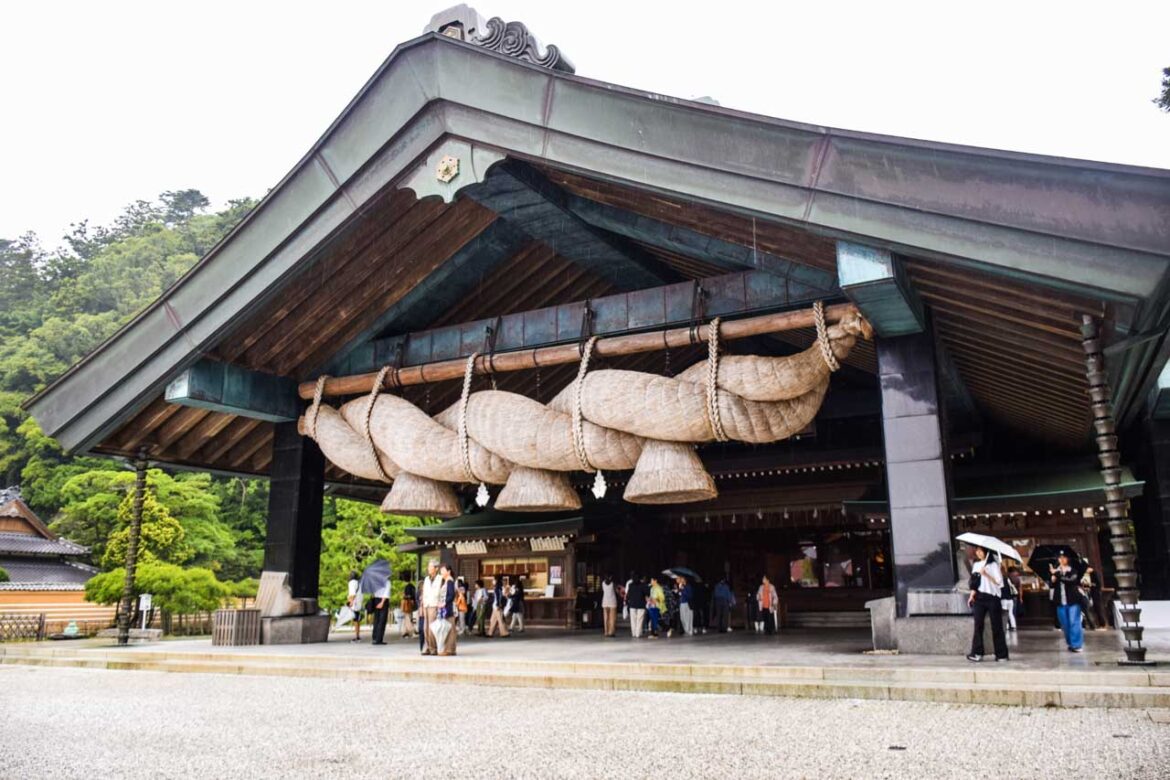
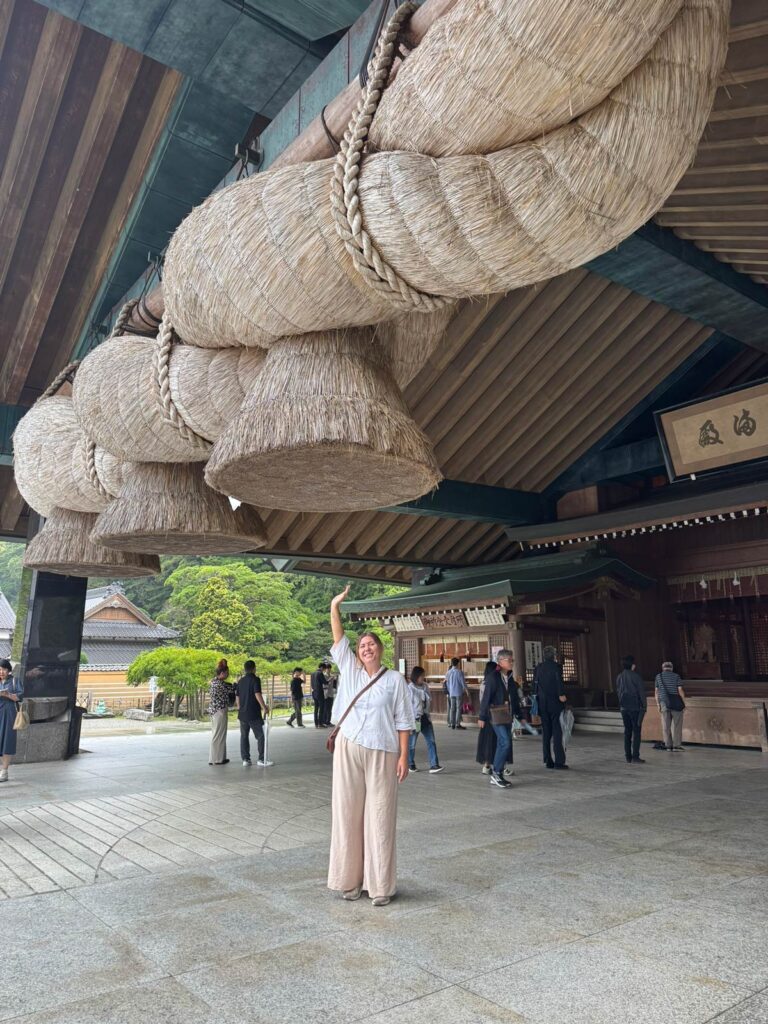
The massive shimenawa at Izumo Taisha

Things to Do in Matsue

Visit Matsue Castle

Matsue Castle is the city’s main historic sight and one of Japan’s few remaining original castles. It’s surrounded by a moat and sits in a lovely area for walking, with old streets and water views nearby.

The castle has a darker, more solid look than some reconstructed castles, which gives it real presence. The detail inside is wonderful, Each floor with it’s solid wooden beams, impecible joinery and and the views keep getting better as you go up. Even if you don’t go inside (shich you absolutely should as you just paid to get in the grounds), the surrounding grounds are worth your time.

Matsue Castle
Matsue Castle
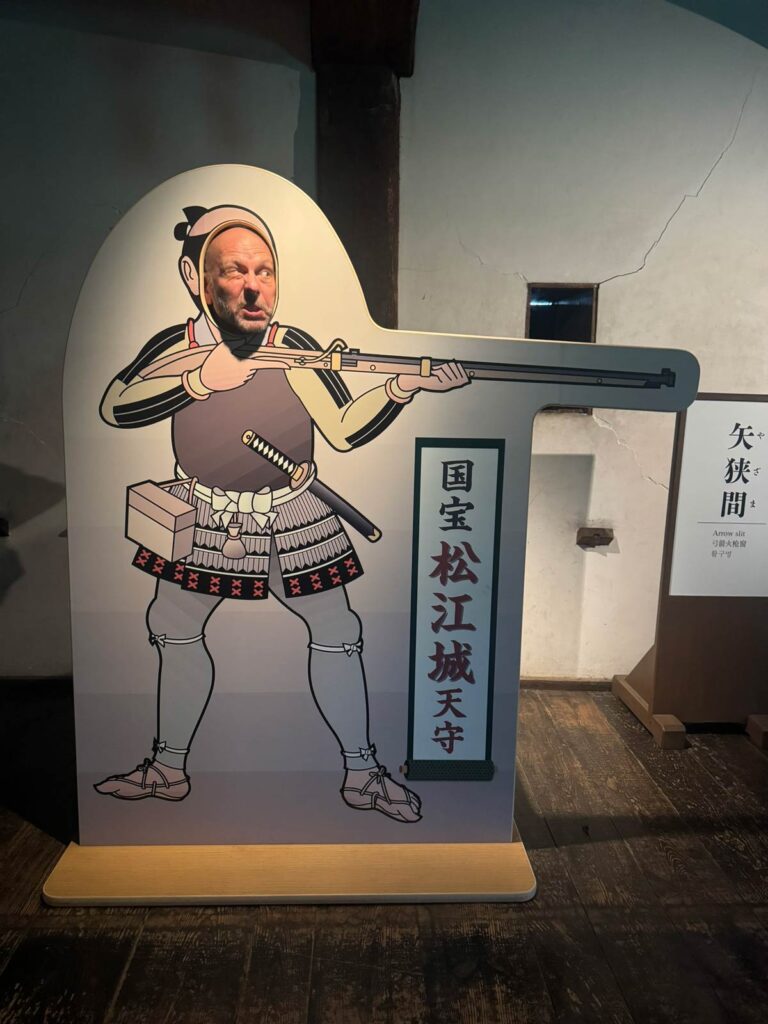
Sam defending Matsue Castle lol
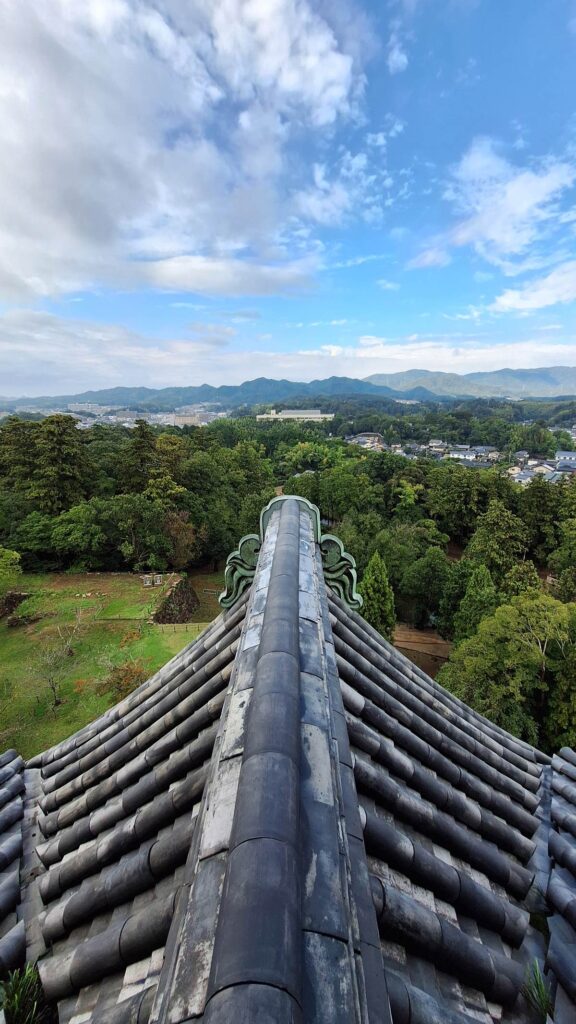
View from the top of Matsue Castle

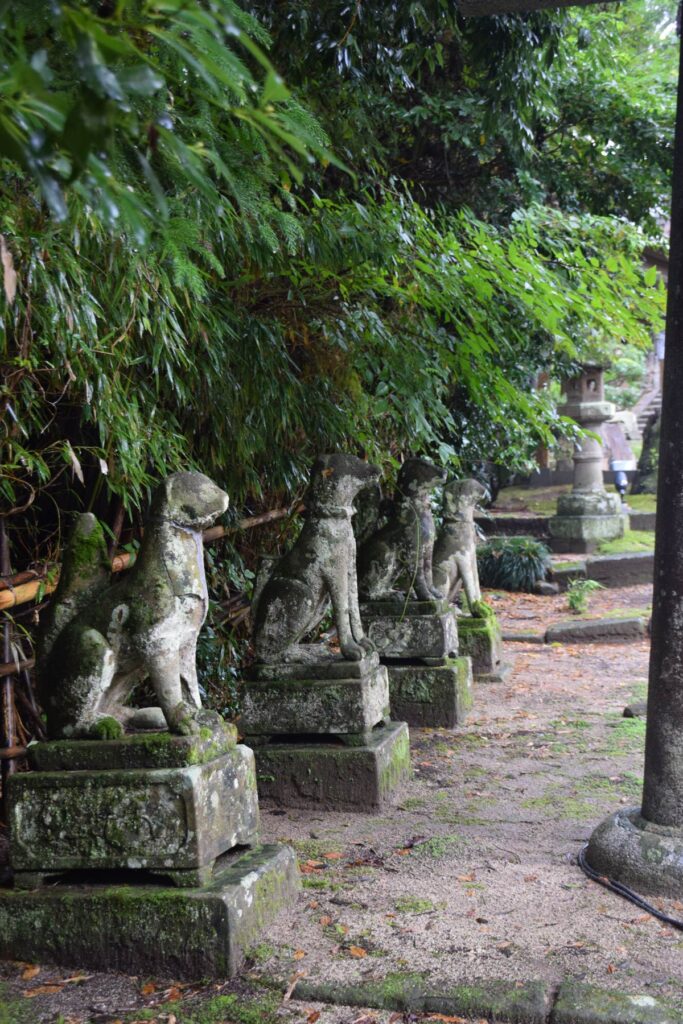
Stop at Jozan Inari Shrine

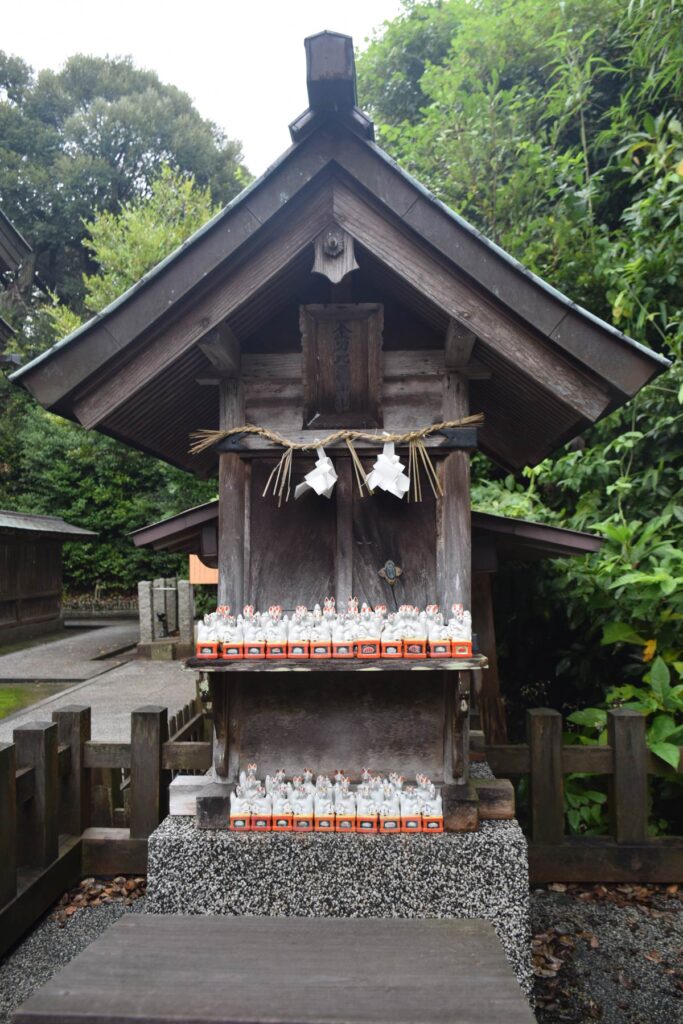
Jozan Inari Shrine is close to Matsue Castle , just head down the path at the rear of the castle and follow the road round. It’s known for its fox statues. It’s a quiet, atmospheric shrine and a good short stop while exploring the castle area. We were the only people there when we visited.

We always enjoy smaller shrines like this because they add texture to a city. Matsue has a nice mix of big sights and small details.

Jozan Inari Shrine
Jozan Inari Shrine
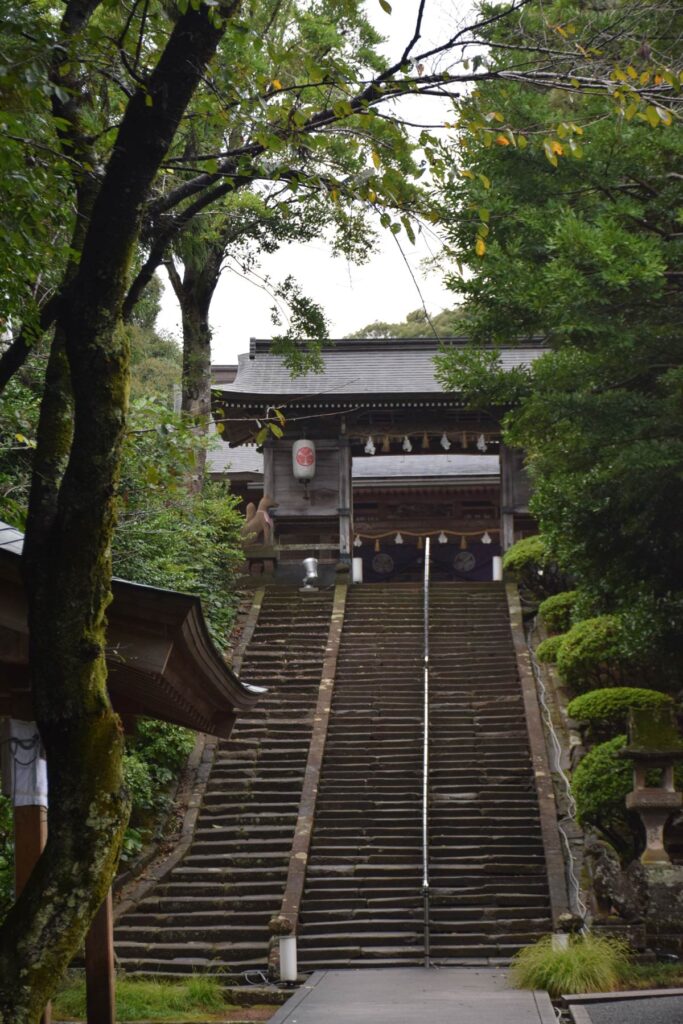
Entrance to Jozan Inari Shrine
Fox statues at Jozan Inari Shrine

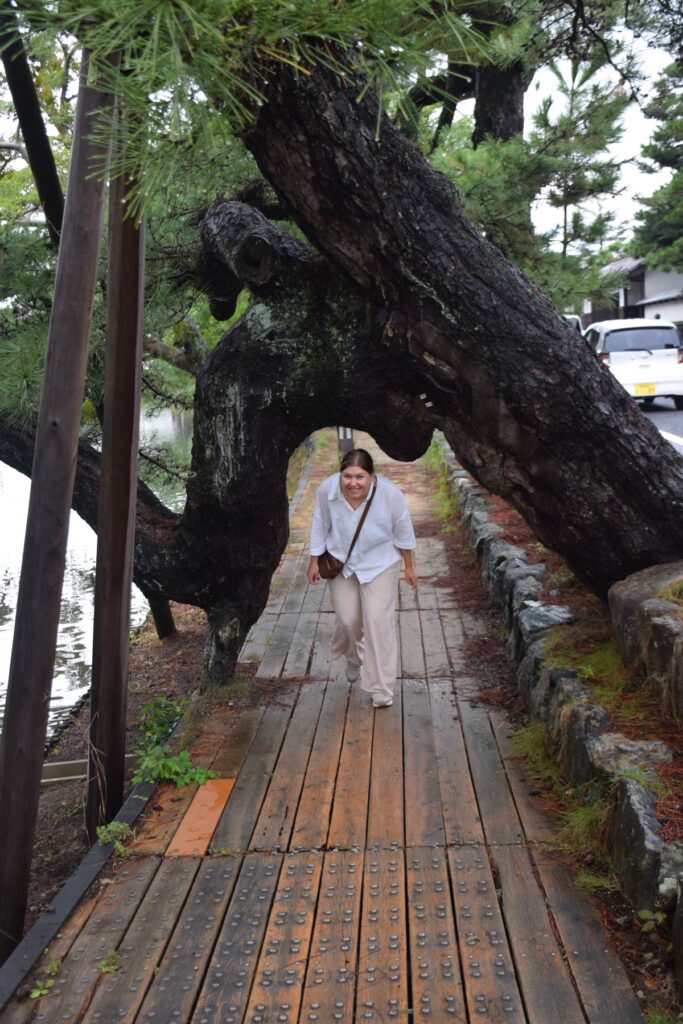
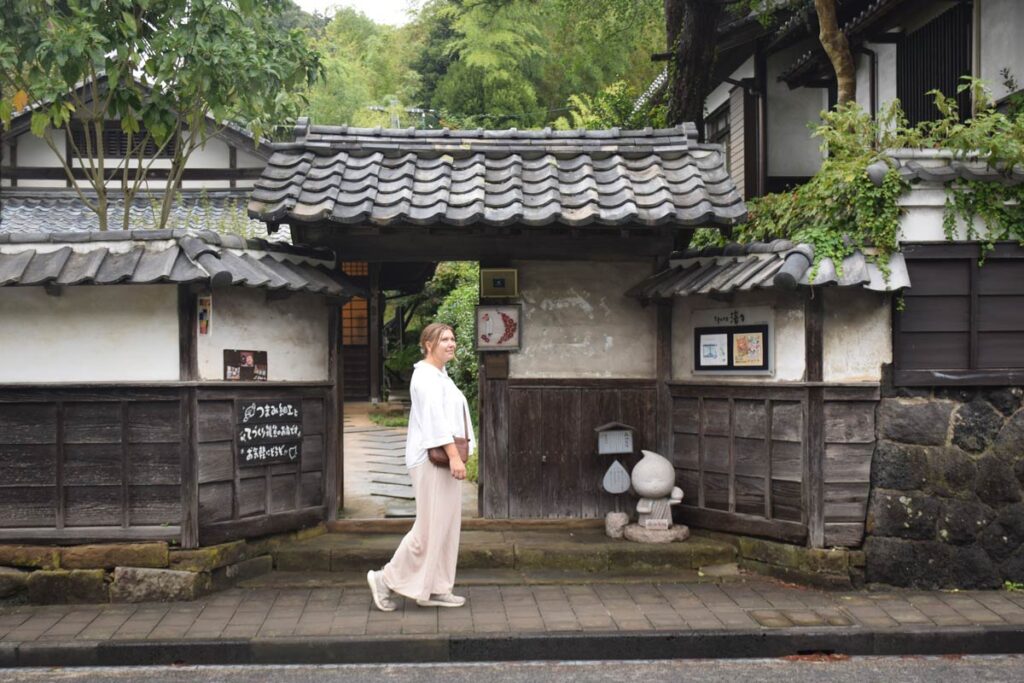
Walk Around Shiomi Nawate

Just outside the castle area, Shiomi Nawate is one of the prettiest streets in Matsue. It has old houses, canals, trees and a quiet historic feel.

This is where Matsue really started to click for us. It feels atmospheric without being overrun, and it pairs perfectly with the castle, former samurai residence and nearby tea shops.

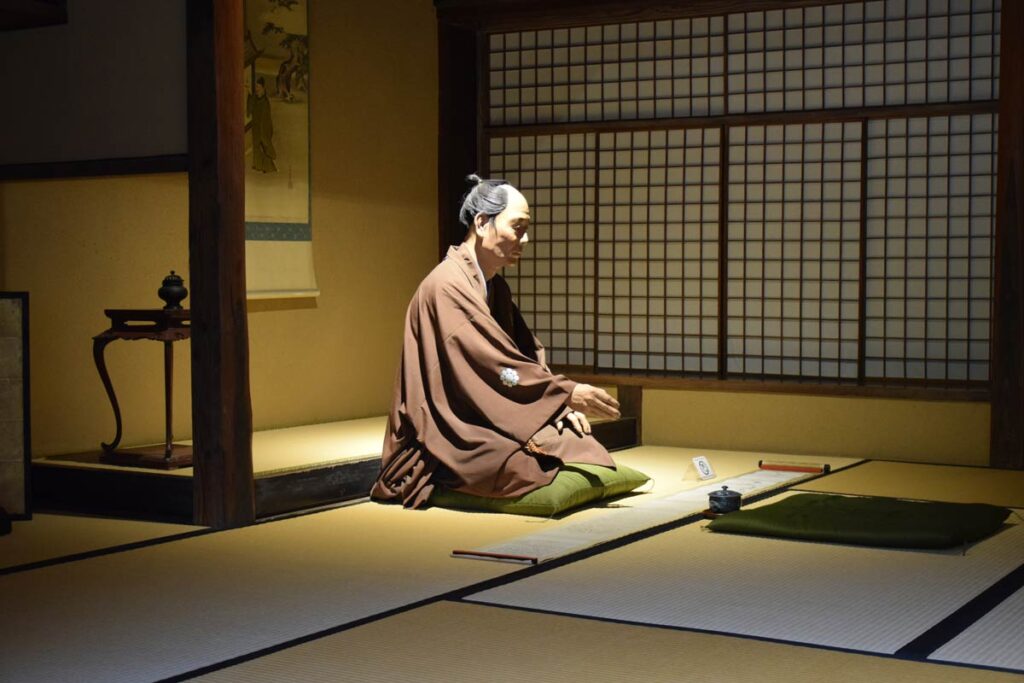
Visit the Former Samurai Residence

The Former Samurai Residence is just outside the castle area on Shiomi Nawate, it gives you a small but interesting look at Matsue’s samurai history. You can walk inside the house and learn all about Samurai history. The gardens are pretty and covered in gravel, so the samurai can hear the footsteps of course!

It’s an easy stop while walking around Shiomi Nawate, and it helps give more context to the old district around the castle.

Walking Around Shiomi Nawate
Inside the Former Samurai Residence
Walking Around Shiomi Nawate

Have Matcha by the River at Shiomi Cyaho

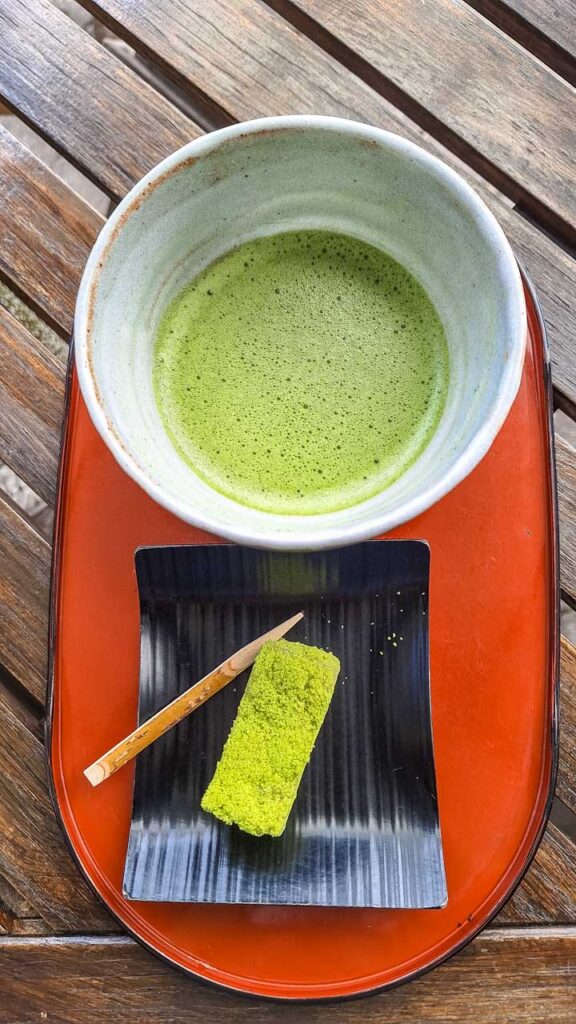
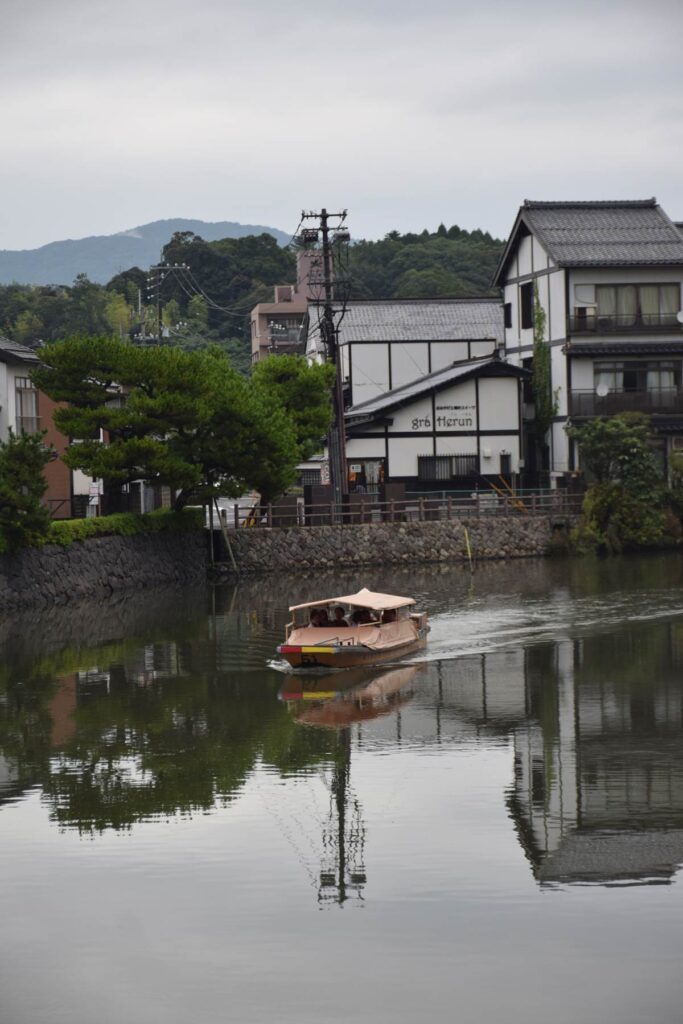
Near the castle area, Shiomi Cyaho is a lovely place to stop for matcha. It’s actually a souvinir shop, but you can go to the back and sit by the river, order matcha and matcha mochi, and watch the boats pass by.

It’s a simple moment, but exactly the kind of thing that makes Matsue feel special. Don’t fortget to wave at people passing by in the boats.

Matcha tea with Matcha Mochi
Boat trips on the Kyobashi River
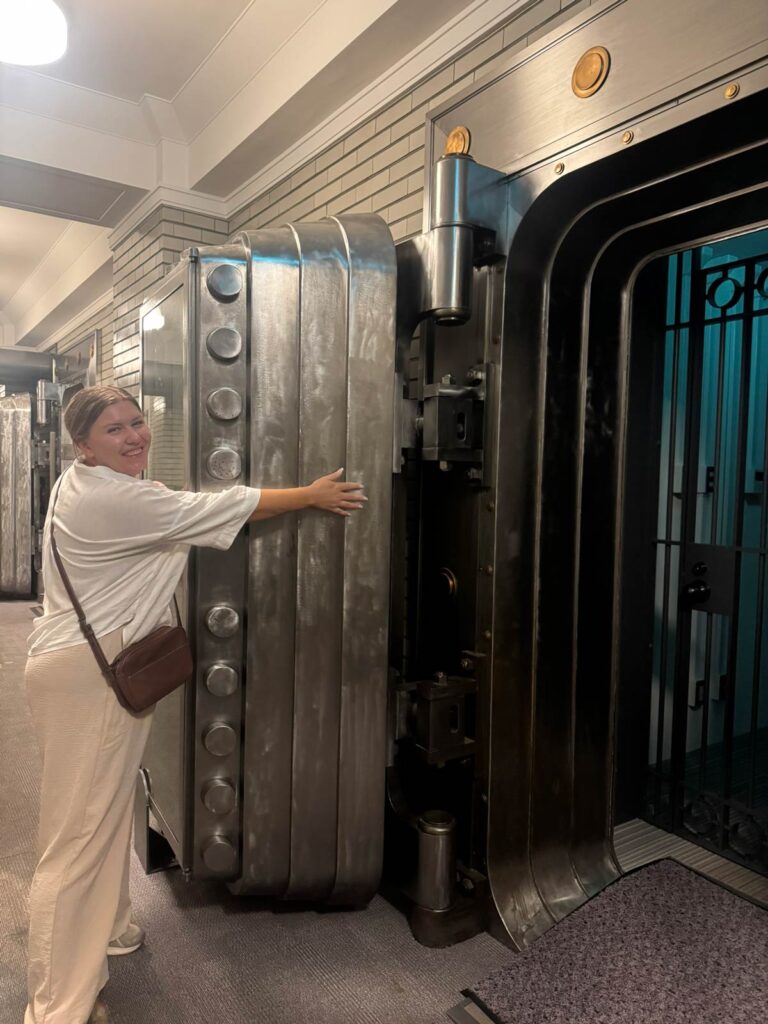
Basement Safe at the old bank Gogin Karakoro Museum

Visit Gogin Karakoro Museum

The Gogin Karakoro Museum is housed in an old bank, which already makes it more interesting than expected. Downstairs, you can visit the old vault, while upstairs there are handicrafts and local products.

It’s not a huge museum, but it’s a fun and slightly unusual stop between the castle area, coffee and lunch.

Watch Sunset at Shirakata Park

For sunset, head to Shirakata Park by Lake Shinji. Matsue is known for its lakeside views, and this is a peaceful place to slow down at the end of the day.

If the weather is clear, it’s a lovely way to finish your sightseeing before heading out for dinner.

Lakeside sundowners
Lakeside sundowners

Coffee and Food in Matsue

LITTLE COURT COFFEE

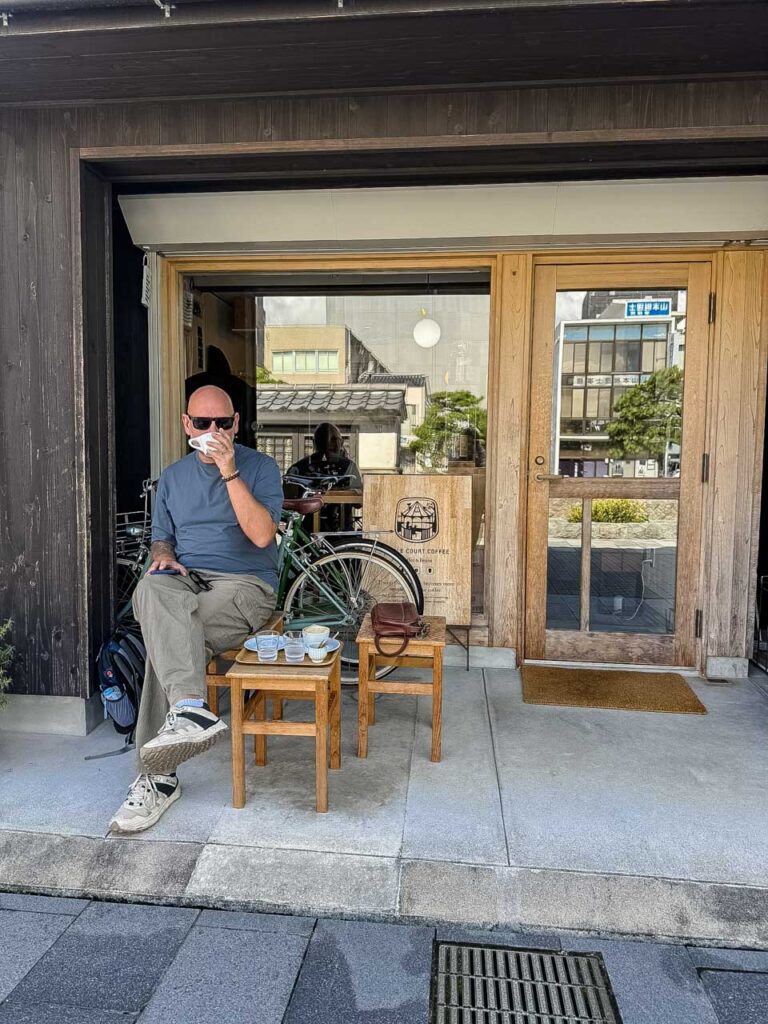
リトルコートコーヒー / LITTLE COURT COFFEE was our favourite coffee stops in Matsue. It’s next to the Kyobashi River, in a nice area for a slow wander.

If you like finding good coffee while travelling like we do, add this one to your map. They have an upstairs room with tatami mats or you can sit outside by the river.

Our favourite coffee in Matsue
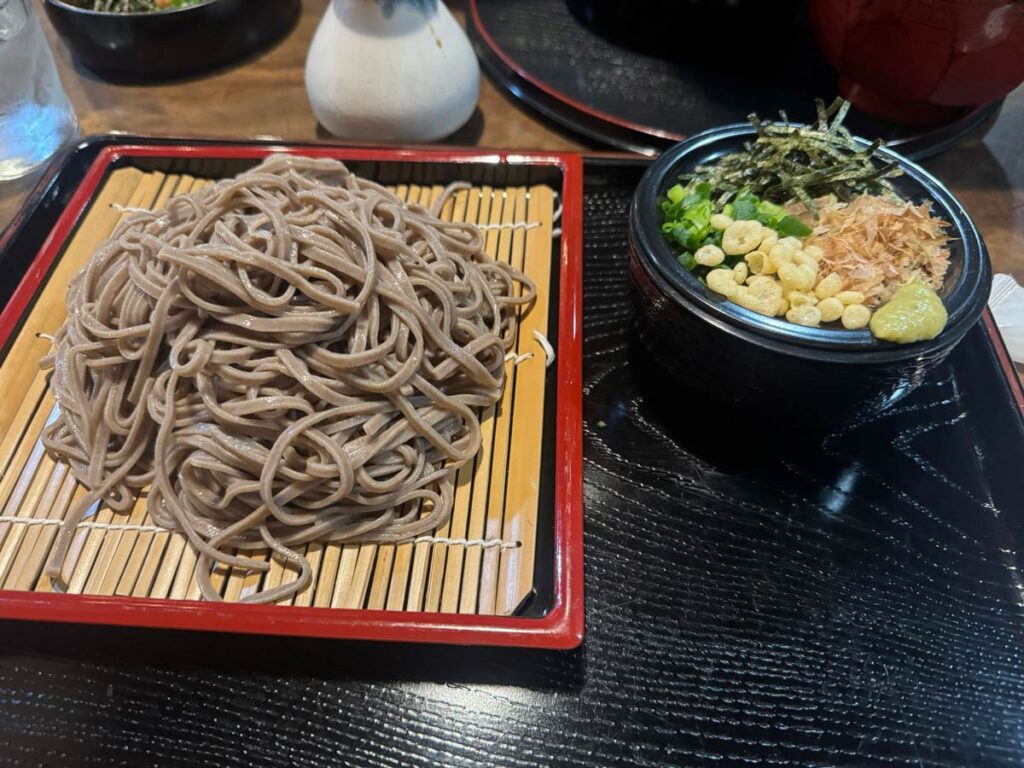
Cold Soba Noodles at Mingei Sabo Sasaki

Mingei Sabo Sasaki

One street down from the river is a walking street with shops, cafés and places to eat. On this street, Mingei Sabo Sasaki is a good place to try cold soba noodles. It’s hidden at the back of an antique shop and has lots of interesting knick knacks everywhere. The noodles are delicious and the service is very friendly.

Matsue and the wider region are known for soba, so this felt like the right place to lean into it.

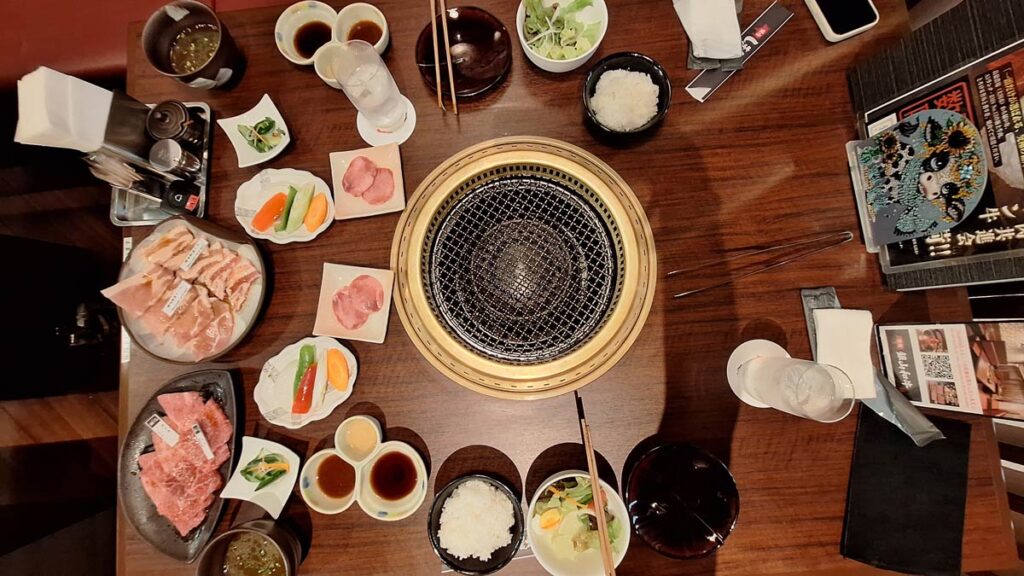
Yakiniku Ginzan Wagyu Karakoro Branch

Yakiniku Ginzan Wagyu Karakoro Branch was a great lunch stop. They had a good-value lunchtime set meal, and it was a fun way to enjoy Japanese BBQ without turning it into a big expensive dinner. Located in the food court behind the Gogin Karakoro Museum.

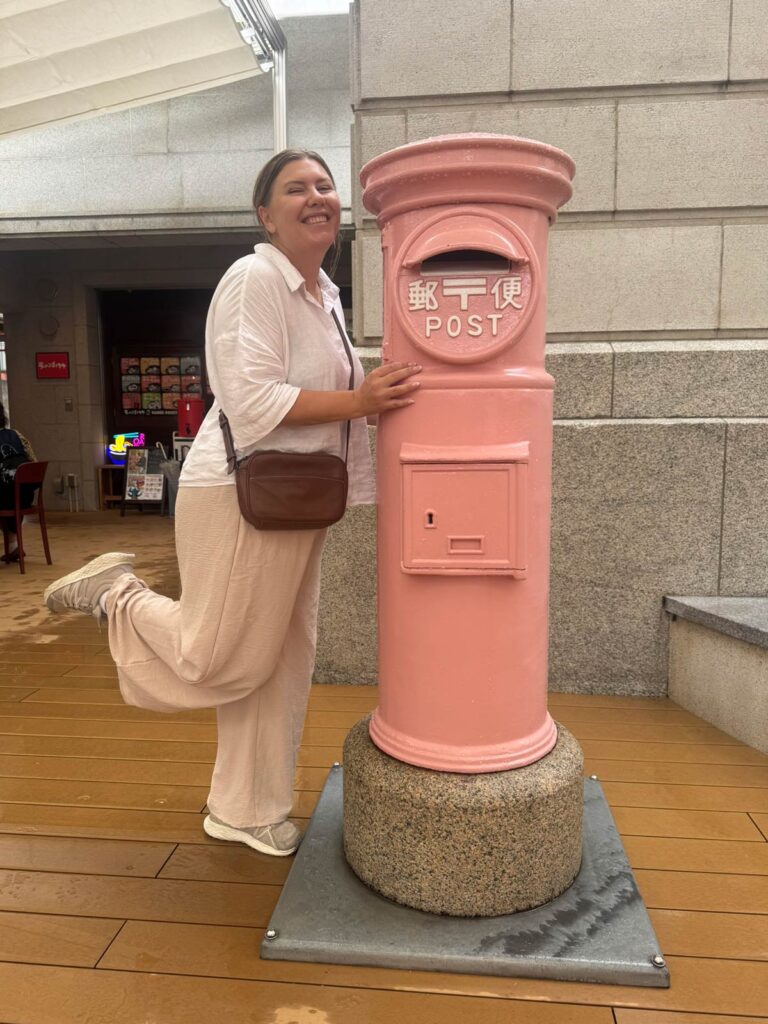
Outside, look for the Good Fortune Pink Postbox too. It’s silly, cheerful and very easy to photograph.

Set meal at Yakiniku Ginzan Wagyu Karakoro Branch

Oideyasu Ookiniya

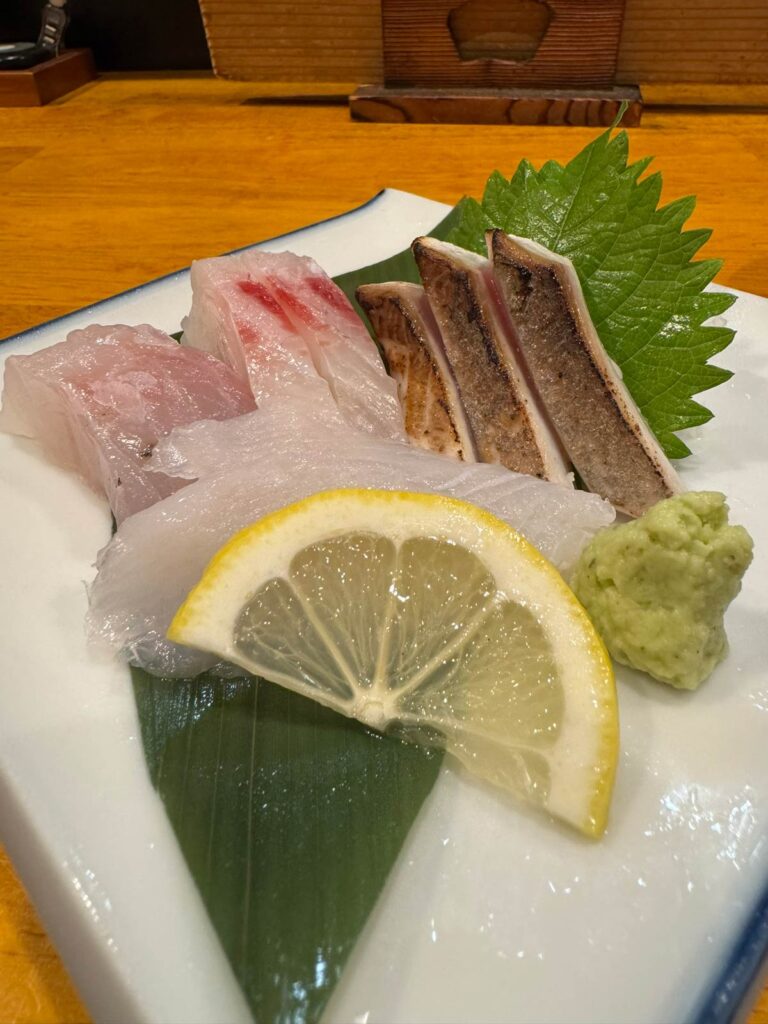
Oideyasu Ookiniya was a friendly izakaya where we sat at the bar and watched the chef cook. That kind of setup always makes a meal more memorable. The food was delicious, the chef always had a smile on his face and they had an unlimited drinks package which lasted for an hour, totally worth it!

It had the warm, local feeling we like in Japan: casual, welcoming and not overly polished with super firendly clientele.

Find the Good Fortune Pink Postbox
Sashimi at Oideyasu Ookiniya
Wagyu at Oideyasu Ookiniya
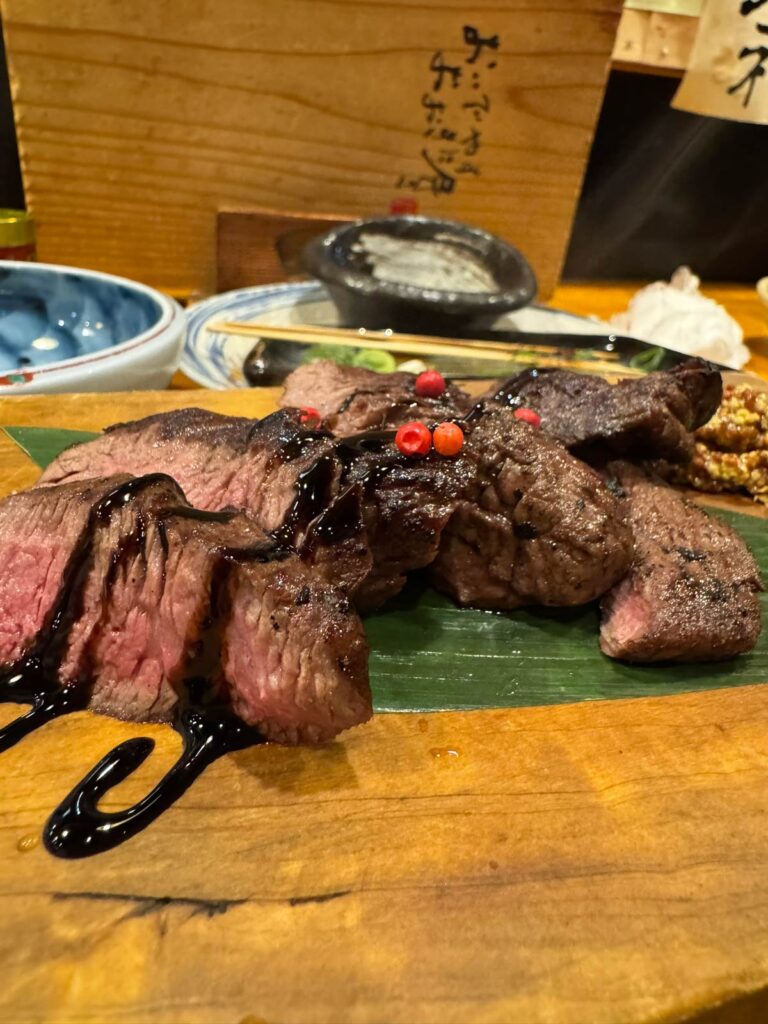
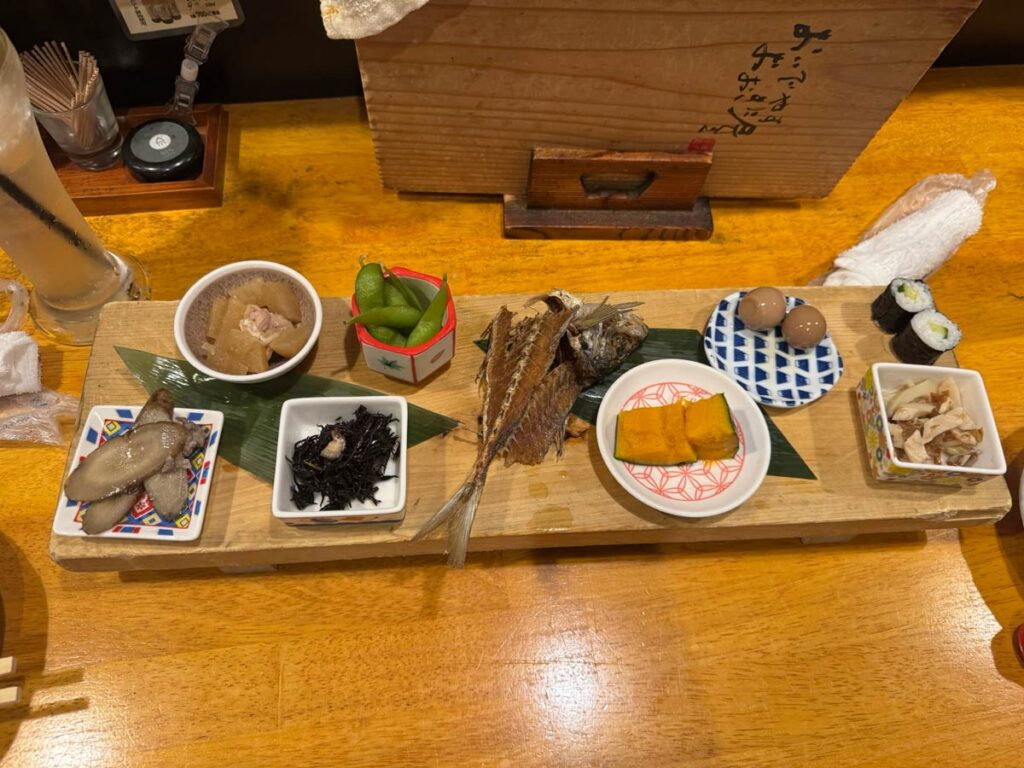
Appetizer at Oideyasu Ookiniya

How Long Do You Need in Matsue?

We stayed two nights in Matsue, and that felt just right.

With two nights, you can visit Matsue Castle, walk around Shiomi Nawate, see the former samurai residence, stop at Jozan Inari Shrine, have matcha by the river, visit the Gogin Karakoro Museum and enjoy sunset by Lake Shinji.

If you also want to visit Izumo Taisha from Matsue, two nights can still work, but three would give you a more relaxed pace.

Final Thoughts on Matsue

Matsue was one of the easiest stops to enjoy on our western Japan route. It had enough to do without feeling overwhelming, and the area around Matsue Castle, Shiomi Nawate and Lake Shinji gave the city a strong sense of place.

We liked staying near Matsue-Shinjiko-Onsen Station because it put us close to the lake, castle area, coffee shops and restaurants, even if it meant a bus ride back to JR Matsue Station when we left.

For us, Matsue was only a two-night stop, but it became one of the most enjoyable cities on our 23 day slow train route through western Japan.

Save the pin

July 20, 2026 0 comments
FacebookTwitterPinterestLinkedinRedditStumbleuponWhatsappTelegramThreadsOpenAIChatGPTEmail
The massive shimenawa at Izumo Taisha
Japan

How to Get to Izumo Taisha: Visit Japan’s Ancient Shrine Without the Crowds

by Sam July 20, 2026
written by Sam

Izumo Taisha Grand Shrine was one of the most important cultural stops on our 23 day slow regional train journey through western Japan. We only stayed one night in Izumo, but that was enough time to visit the shrine, wander the approach street and continue onwards to Matsue the next morning.

Izumo Taisha, also known as Izumo Ōyashiro, is one of Japan’s most important Shinto shrines. It is often considered one of the oldest shrines in Japan, and the official shrine access page lists its location in Izumo, Shimane Prefecture.

For us, the appeal was not just its history. It was also the atmosphere. Compared with the famous shrine and temple stops in Kyoto, Nara or Tokyo, Izumo Taisha felt calmer and far less crowded with international tourists. It still had plenty of Japanese visitors, but it never felt like the big tourist trail.

Even on a rainly day Izumo Taisha is extraordinarily beautiful

Why Visit Izumo Taisha?

Izumo Taisha is an incredible shrine and one of the most meaningful places we visited in Japan. The grounds are large, peaceful and atmospheric, with forested paths, smaller shrine buildings and the famous huge shimenawa sacred rope.

This is not a hidden place, but it does feel different from Japan’s more obvious tourist-heavy shrines. It has weight, history and space to breathe.

If you are travelling through western Japan, Shimane Prefecture, Matsue or Izumo, we think it is absolutely worth making time for.

5 ton shimenawa rope at Izumo Taisha
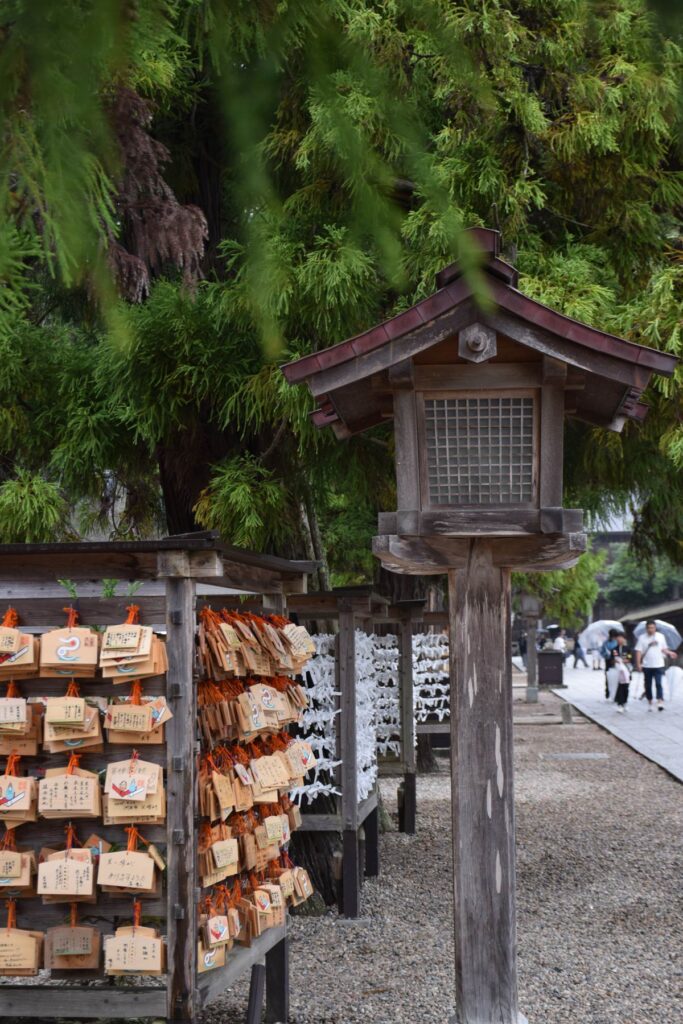
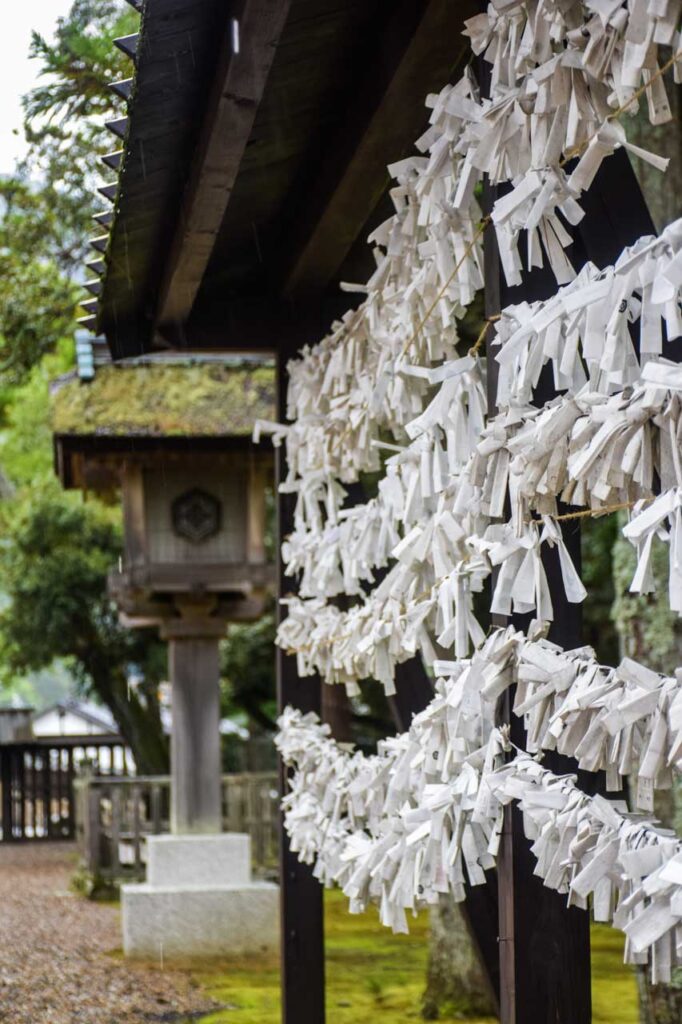
Wishes at Izumo Taisha
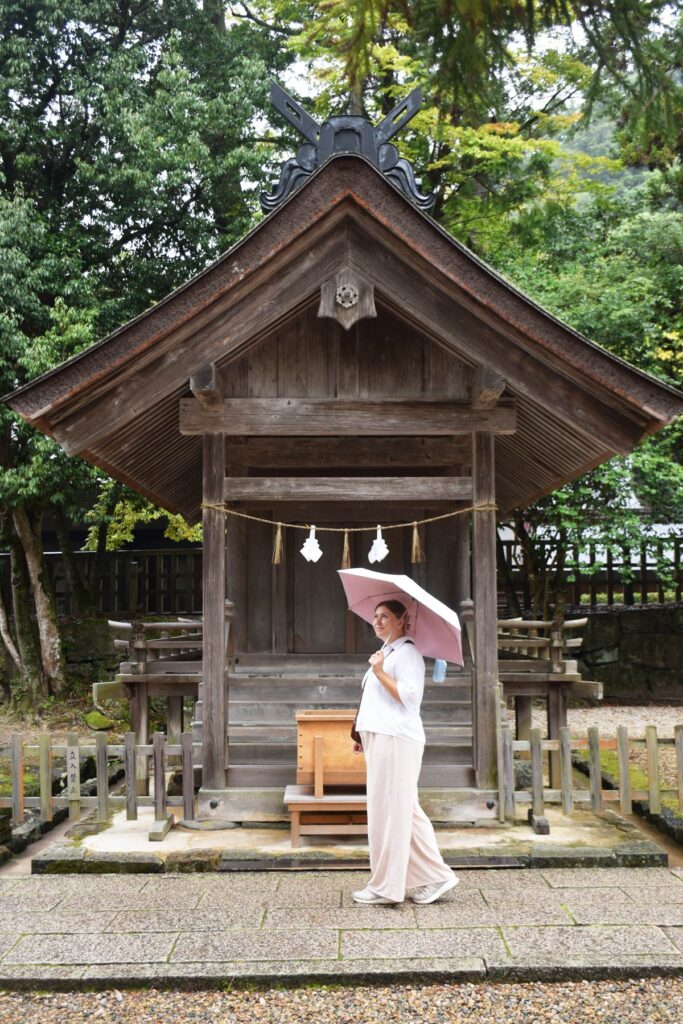
Shines large and small at Izumo Taisha

Where We Stayed in Izumo

We arrived at JR Izumoshi Station and stayed at Super Hotel Izumo Ekimae.

The hotel was very close to the south entrance of the station, which made it easy for a one-night stop. It also had a free two-hour drinks bar in the evening, including a surprisingly good range of sake, and a very good breakfast the next morning.

For visiting Izumo Taisha, staying near Izumoshi Station worked well because both the bus and train options are nearby.

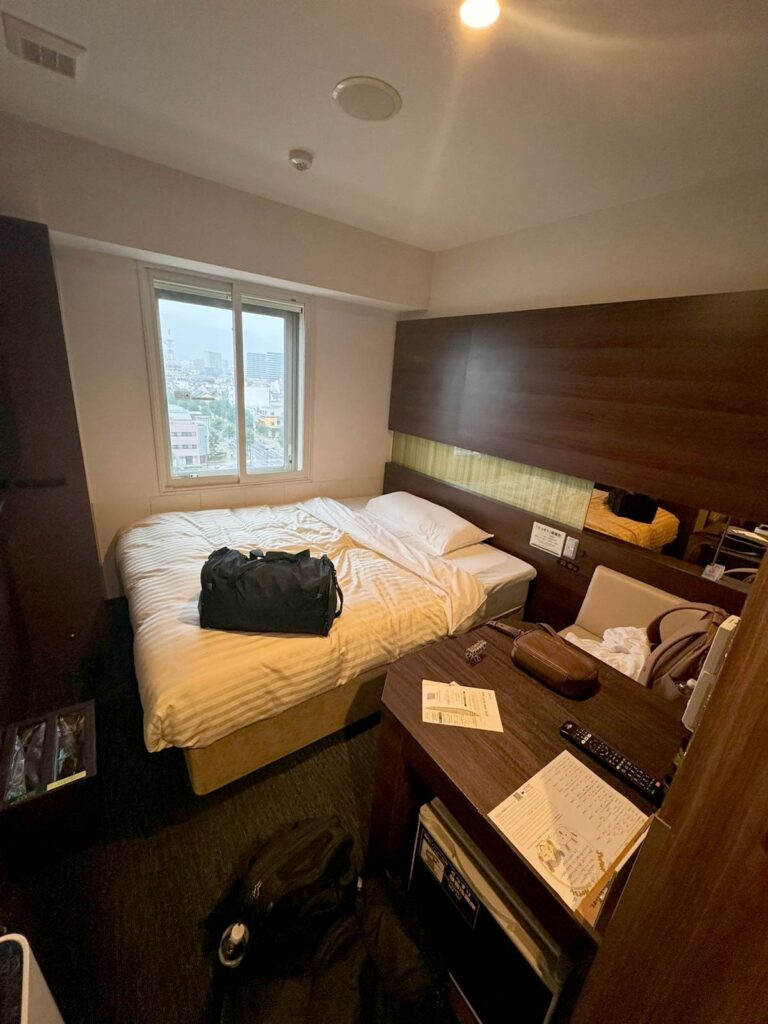
Typical room at Super Hotel Izumo Ekimae
Free drinks bar at Super Hotel Izumo Ekimae

How to Get to Izumo Taisha from JR Izumoshi Station

The easiest way to get from JR Izumoshi Station to Izumo Taisha is by bus.

From JR Izumoshi Station, take the Ichibata Bus bound for Izumo Taisha / Hinomisaki. The official Izumo Taisha English access page says to take the bus from bus stop number 1 and get off at Seimon-mae, which takes about 25 minutes.

This is the simplest option because it gets you close to the shrine entrance without needing to change trains.

Useful Bus Pass for Matsue and Izumo

If you’re visiting both Matsue and Izumo, it’s worth checking the local 3-day bus pass. It allows you to ride the Ichibata Bus and Matsue City Bus freely for three days, which can be useful if you’re using buses around Matsue and travelling out to Izumo Taisha.

You can find the English PDF here: https://matsue-bus.jp/wp-content/uploads/2022/03/English.pdf

At the time of our visit, the pass was available from places including the Matsue City Traffic Office and Twin Leaves Hotel Izumo.

You’ll need your foreign passport, and if you have an ICOCA card, bring it with you because it can make the pass cheaper.

Can You Get to Izumo Taisha by Train?

Yes, you can also get there by train using the Ichibata Electric Railway.

From Dentetsu-Izumoshi Station, take the Ichibata Electric Railway and change at Kawato Station for the train to Izumotaisha-mae Station. From there, it is a short walk to the shrine approach.

This route is slightly more involved than the bus, but the local trains are part of the charm in this region. If you enjoy small regional railways, it’s a nice way to travel.

One important note: on our trip, IC cards were not accepted on the Ichibata Electric Railway, so we bought a paper ticket at the office.

How to Get to Izumo Taisha from Matsue

If you are staying in Matsue, you can reach Izumo Taisha by using the Ichibata Electric Railway from Matsue Shinjiko-Onsen Station.

The railway connects Matsue and Izumo, and you can travel towards Izumotaisha-mae with a change along the way. It’s not the fastest transport in Japan, but it is scenic, relaxed and very fitting for this part of the country.

We travelled the opposite direction the next day, from Izumo towards Matsue, and the ride along the lake was delightful.

How to Get to Izumo Taisha from Hiroshima

You can also visit Izumo from Hiroshima by long-distance bus.

The official Izumo Taisha access page lists Hiroshima Bus Center to JR Izumo City Station as around 3 hours. From JR Izumo City Station, you then take the Ichibata Bus to Izumo Taisha, which takes about 25 minutes.

That makes Izumo Taisha possible from Hiroshima, though we’d personally rather stay overnight if you have the time. It gives the shrine more breathing room and avoids turning the day into a transport mission.

Walking the Approach to Izumo Taisha

After getting off the bus, make your way towards the Izumo Taisha Grand Gate of Seidamari, then follow the shrine approach through the third torii and onwards to the Bronze Torii, the fourth torii. When you leave the shrine area, look back down the main street and you’ll see the large torii at Uga Bridge in the distance.

The street has places to eat, drink and buy souvenirs, so don’t rush straight in and out. It’s a pleasant shrine town atmosphere and worth giving a little time.

Shimane Prefectural Rd 161 leading to / from Izumo Taisha
Grab a fresh brew at Taisha Coffee
Grand Torii at Uga Bridge (First Torii)

Coffee Near Izumo Taisha

We stopped at Taisha Coffee, which had a cosy atmosphere, friendly staff and good coffee. The upstairs seating was especially nice, overlooking the street below.

It made a perfect pause after visiting the shrine before heading back towards Izumo city.

Eating Back Near Izumoshi Station

Back in Izumo city, we ate at Sukiya Izumoshi Station South.

It wasn’t fancy, but Sukiya is a Japanese staple: quick, cheap, reliable and very useful after a travel day. Sometimes that’s exactly what you need.

How Long Do You Need for Izumo Taisha?

You can visit Izumo Taisha as a day trip from Matsue or as part of a longer journey through western Japan.

We stayed one night in Izumo, and that felt right for us. It gave us enough time to arrive by regional train, visit the shrine, stay close to the station and continue to Matsue the next morning without rushing.

If you are coming from Hiroshima, we’d consider staying overnight rather than trying to squeeze everything into one long day.

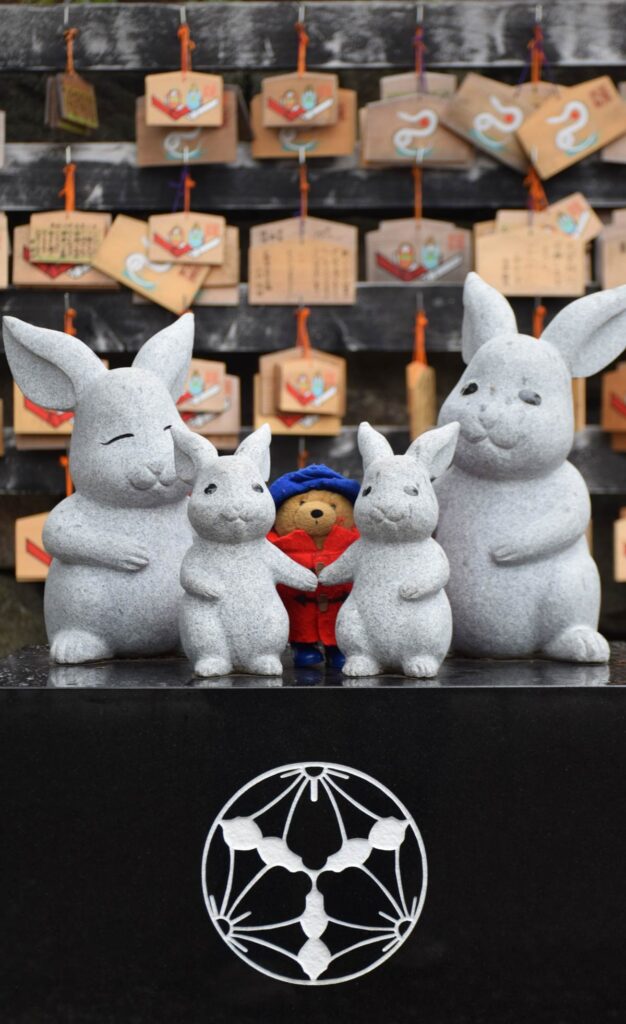
Paddington and the rabbits of Izumo Taisha
If your fortune is bad, leave it behind
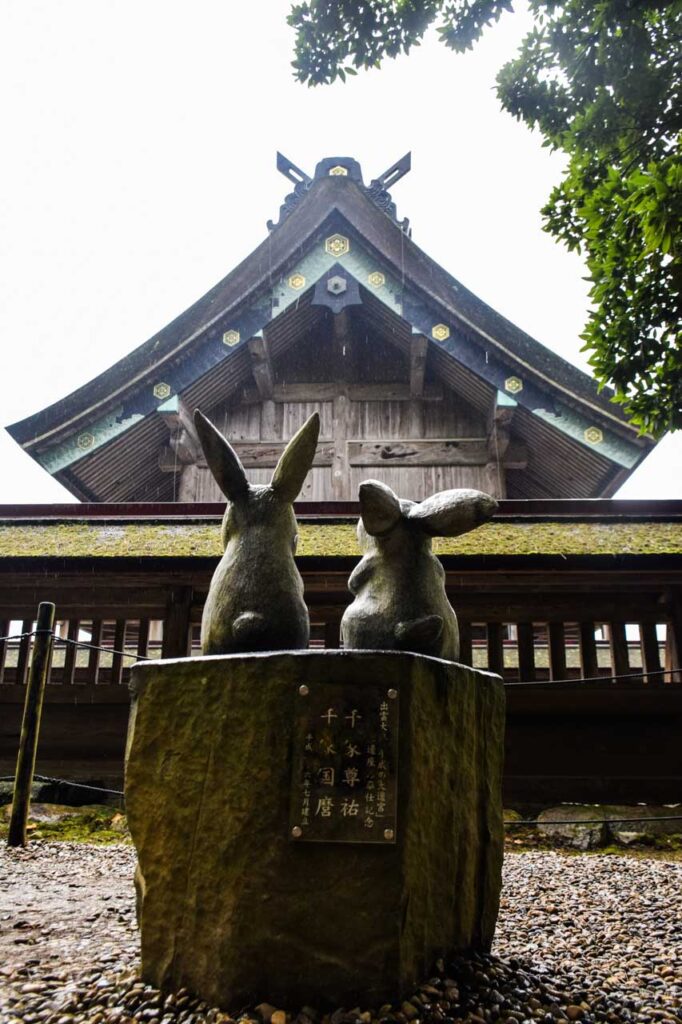
Rabbits everywhere at Izumo Taisha
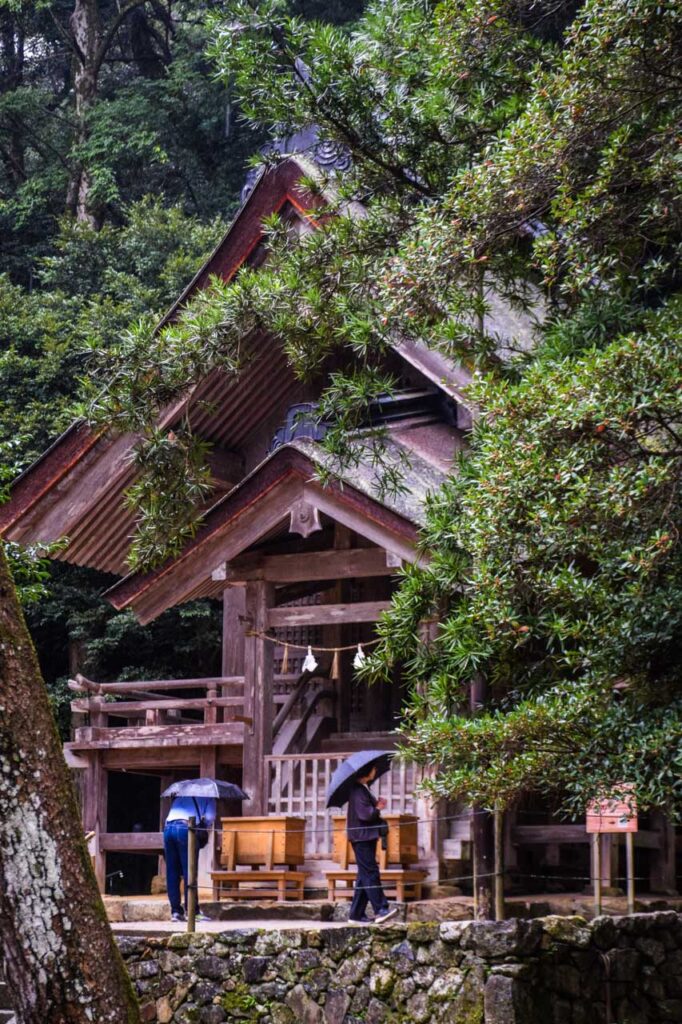
One of the many shrines at Izumo Taisha

Is Izumo Taisha Worth Visiting?

Yes, Izumo Taisha is absolutely worth visiting.

It is one of Japan’s most important shrines, but it doesn’t feel overrun in the way some famous shrine and temple areas can. For us, that made it even more special.

If you want a meaningful cultural stop in Japan without the overwhelming tourist crowds, Izumo Taisha is a brilliant place to add to a western Japan itinerary.

Izumo is well worth adding as a short stop along the way. We only stayed for one night, but it fitted perfectly into our 23 day slow train route through western Japan.

Our cute train from Tottori to Okayama

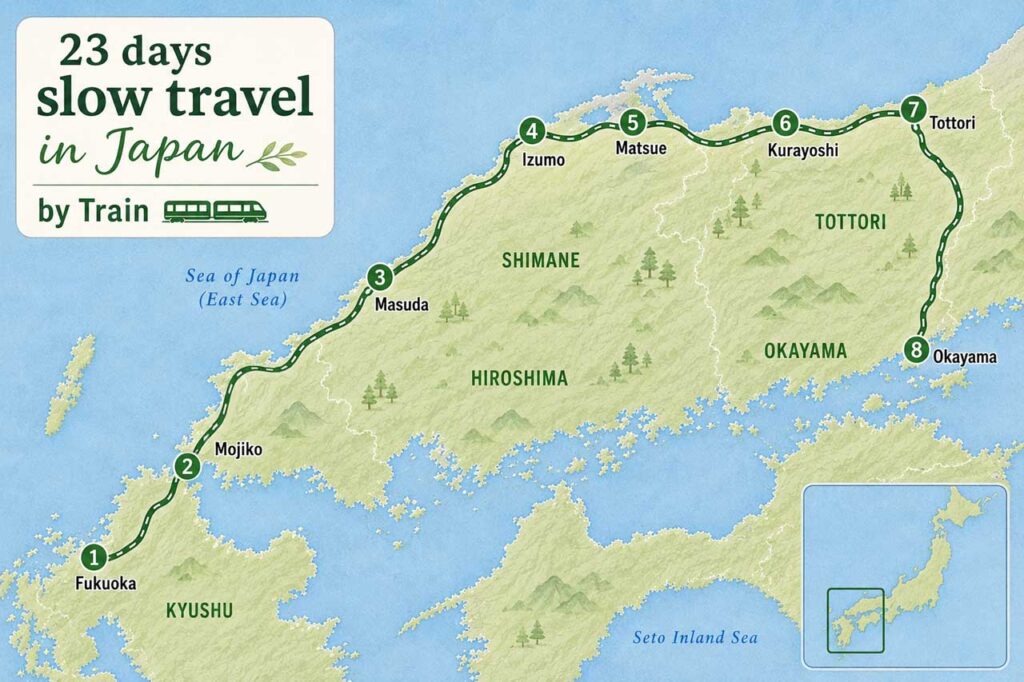
23 Day Japan Slow Travel Itinerary by Train

A 23 day Japan slow travel itinerary by train, following the San-Yo and San-In Line from Fukuoka to Tottori before heading south to Okayama.

July 20, 2026 0 comments
FacebookTwitterPinterestLinkedinRedditStumbleuponWhatsappTelegramThreadsOpenAIChatGPTEmail
Ebisu Shrine just outside Masuda
Japan

Masuda: A Quiet Stop on Japan’s San-In Line

by Sam July 20, 2026
written by Sam

Masuda was one of the most practical stops on our 23 day slow regional train journey through western Japan. It isn’t a famous destination, and it’s not somewhere we’d suggest going far out of your way for, but it worked well as a pause between Mojiko and Izumo.

This was the kind of place where people asked us, “Why Masuda?” and honestly, that was fair. There isn’t a huge list of things to do, but what we found was a quiet, local city with friendly people, a good hotel, a tattoo-friendly onsen, a lovely art museum, simple food and one of the warmest little travel moments of the whole trip.

Masuda was part of our 23 day slow regional train route through western Japan, travelling from Fukuoka across Kyūshū and along the San-Yō and San-In lines towards Tottori and Okayama.

Why Visit Masuda?

Masuda is worth visiting if it fits naturally into your train route. It makes sense as a stop between Shimonoseki, Mojiko, Izumo and Matsue, especially if you’re travelling slowly by regional train and don’t want long travel days.

It is not a polished tourist town, and that’s both the limitation and the charm. We saw no other tourists while we were there, and the city felt very local, very quiet and very ordinary in the best possible way.

If you’re looking for big sights, nightlife or a packed itinerary, Masuda probably isn’t the place. But if you want a useful stop with a few gentle things to do, it can work nicely.

Where to Stay in Masuda

We stayed at Mascos Hotel, which was one of the better hotel choices on this part of the trip. It was modern, comfortable and had an onsen, which made it a very easy place to recover after another regional train day.

The best part for us was that the onsen was tattoo-friendly. The staff understood we were foreign tourists, and tattoos were not an issue, which made the stay much more relaxing.

For a short visit to Masuda, we’d stay here again.

Our room at Mascos Hotel, Masuda

Things to Do in Masuda

Visit Iwami Art Museum

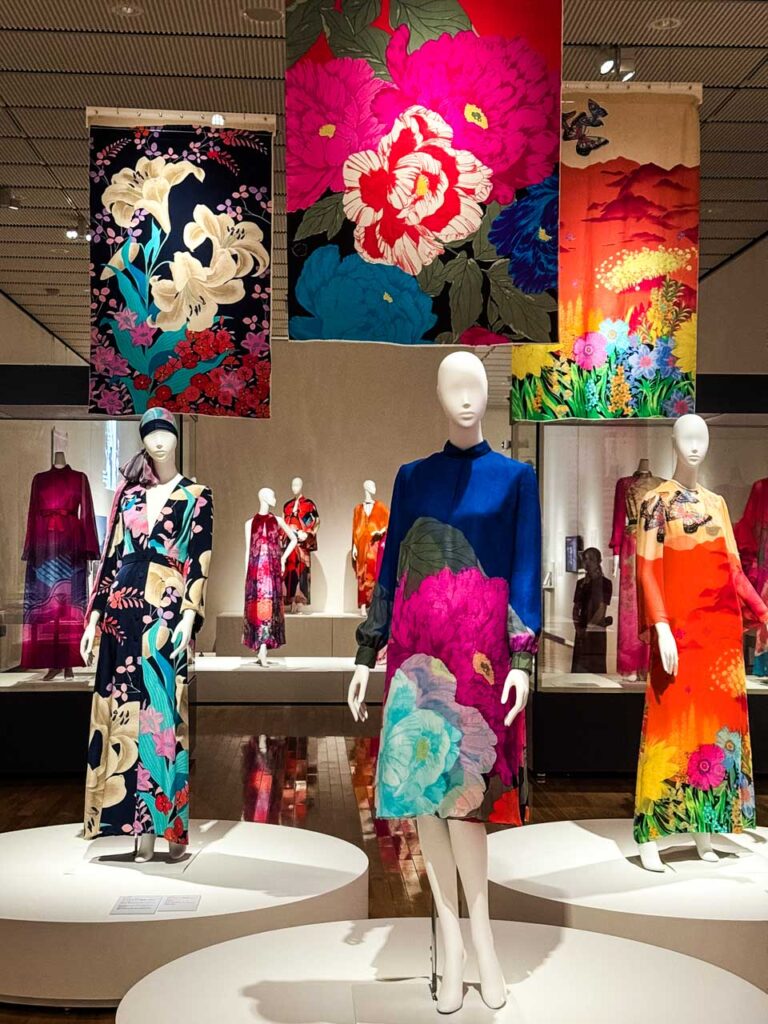
The Iwami Art Museum was our main planned stop in Masuda and a good way to spend part of the day. It had an interesting exhibition, including clothing from the famous Japanese designer Hanae Mori.

It’s not a huge museum, but it was peaceful, well-presented and gave us something worthwhile to do in a city where sightseeing options are limited. If you enjoy museums and slower travel days, it’s worth adding to your Masuda stop.

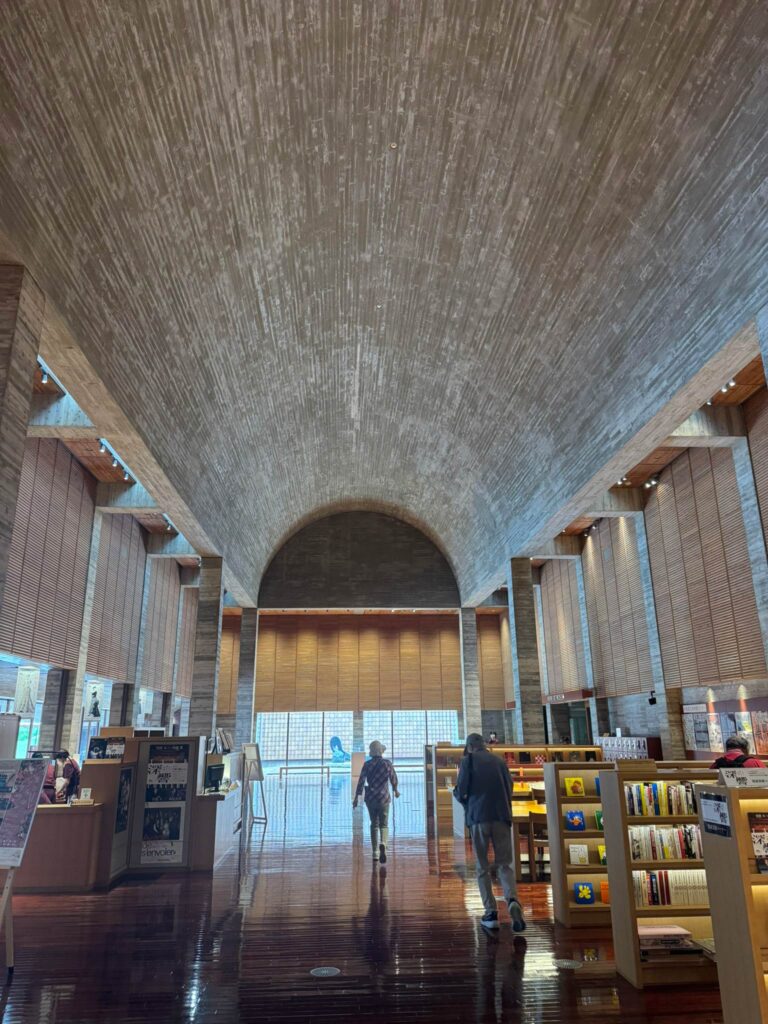
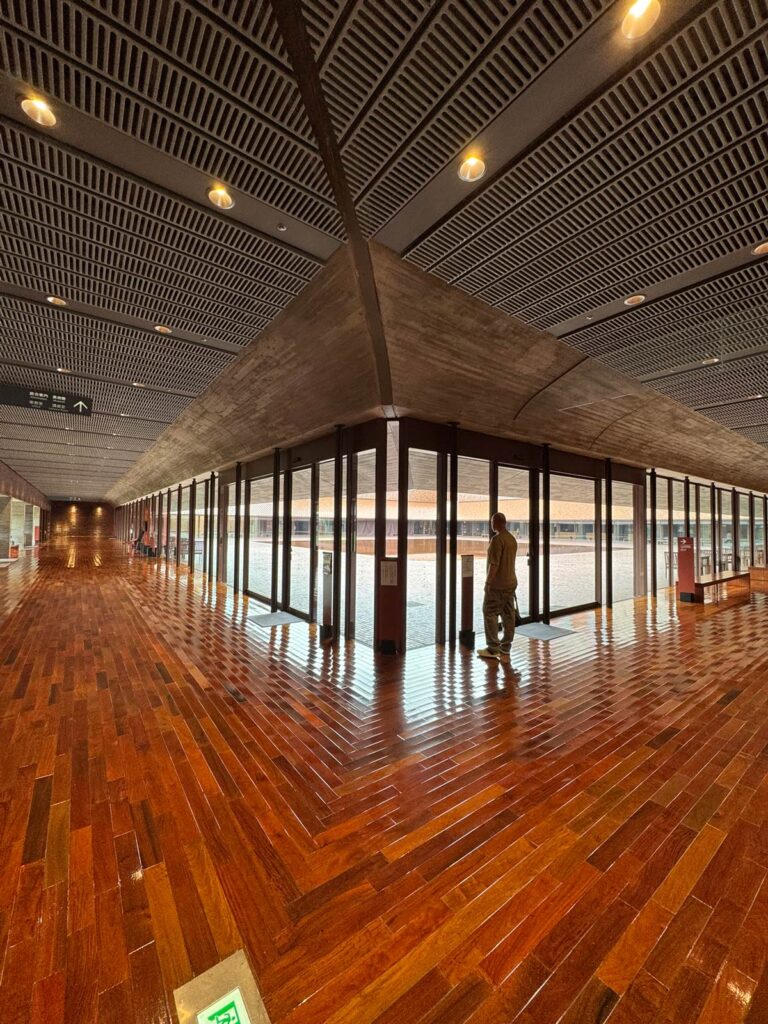
The Iwami Art Museum Masuda
Hanae Mori collection at Iwami Art Museum
Inside the Iwami Art Museum, Masuda

Visit Ebisu Shrine

Our visit to Ebisu Shrine became one of those unexpected travel memories that we could never have planned properly. Livia met a local woman in the hotel onsen, and after chatting as best they could, she offered to drive us to the shrine because it would have been difficult to reach by public transport.

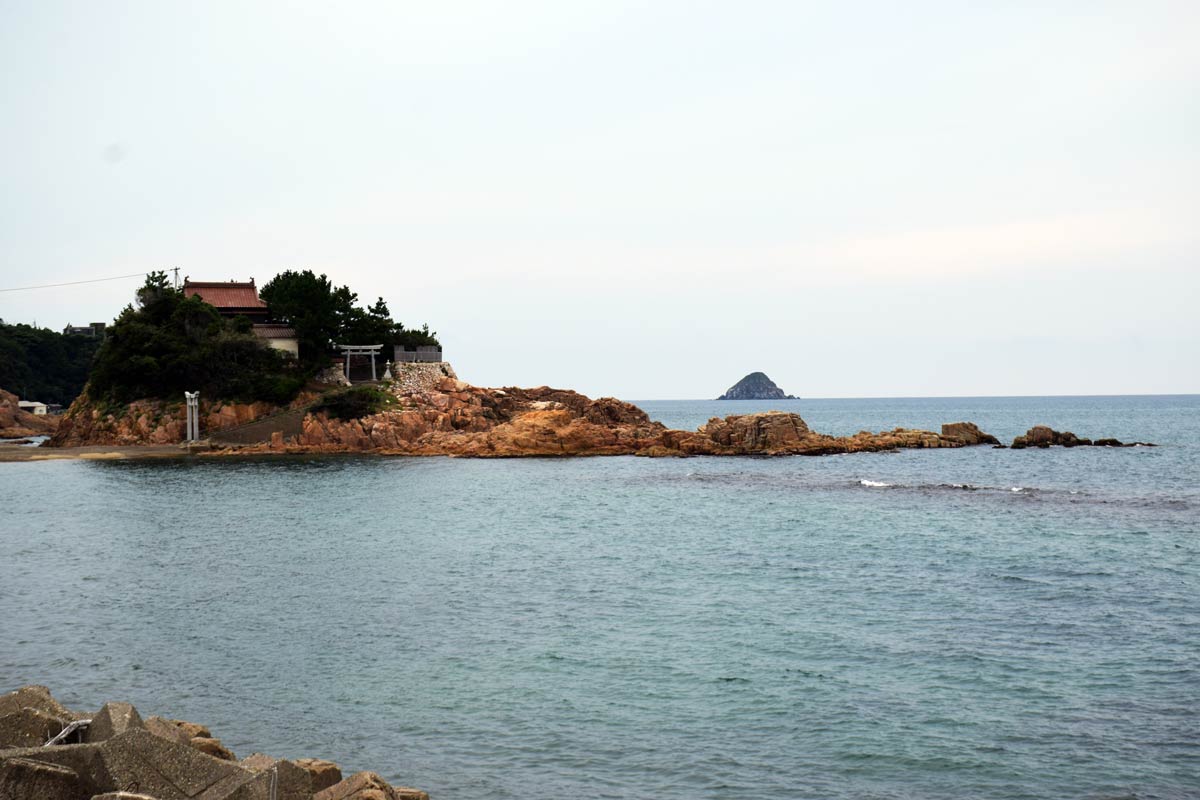
The shrine sits on a small coastal island and reminded us a little of a mini Mont Saint-Michel, though much smaller and simpler. It’s only accessible at certain times depending on the tide, which made it feel even more special.

The whole thing was incredibly kind, especially as we had only just met her, and she even insisted on buying us McDonald’s on the way back. Too funny, and very memorable.

Ebisu Shrine outside Masuda

Where to Eat in Masuda

Takenoya

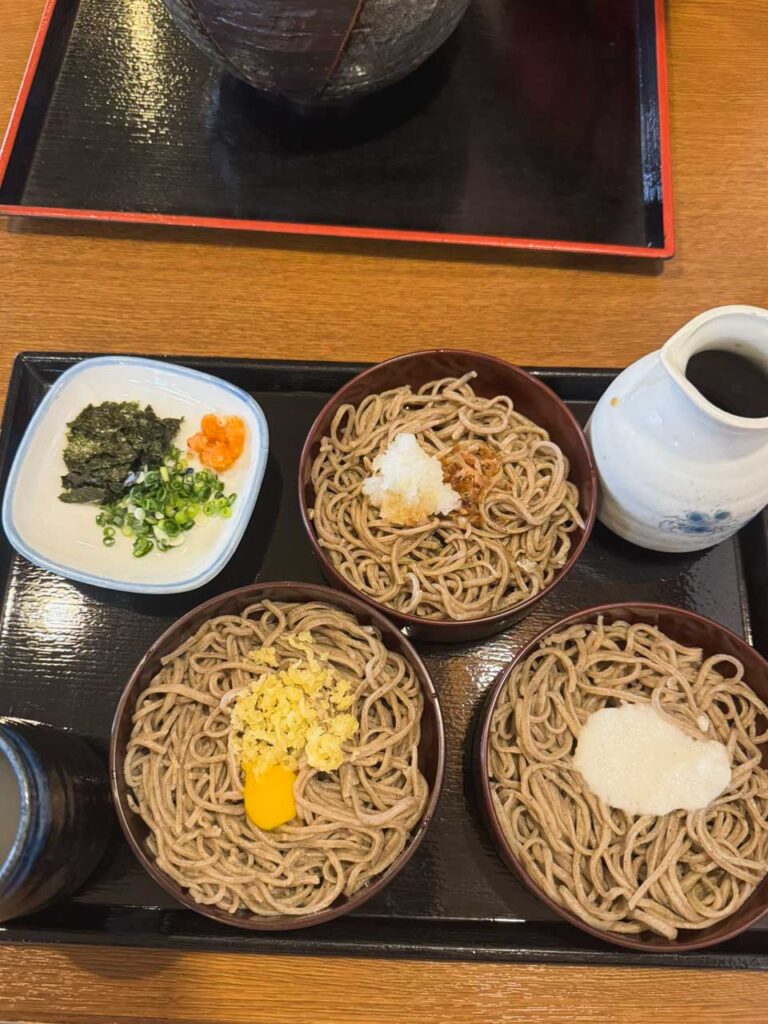
Takenoya was where we had our first taste of cold soba noodles on this trip. It was simple, local and exactly the kind of meal that suited Masuda.

Cold soba became a bit of a theme for us along this part of Japan, and this was a good introduction.

cold soba noodles
cold soba noodles
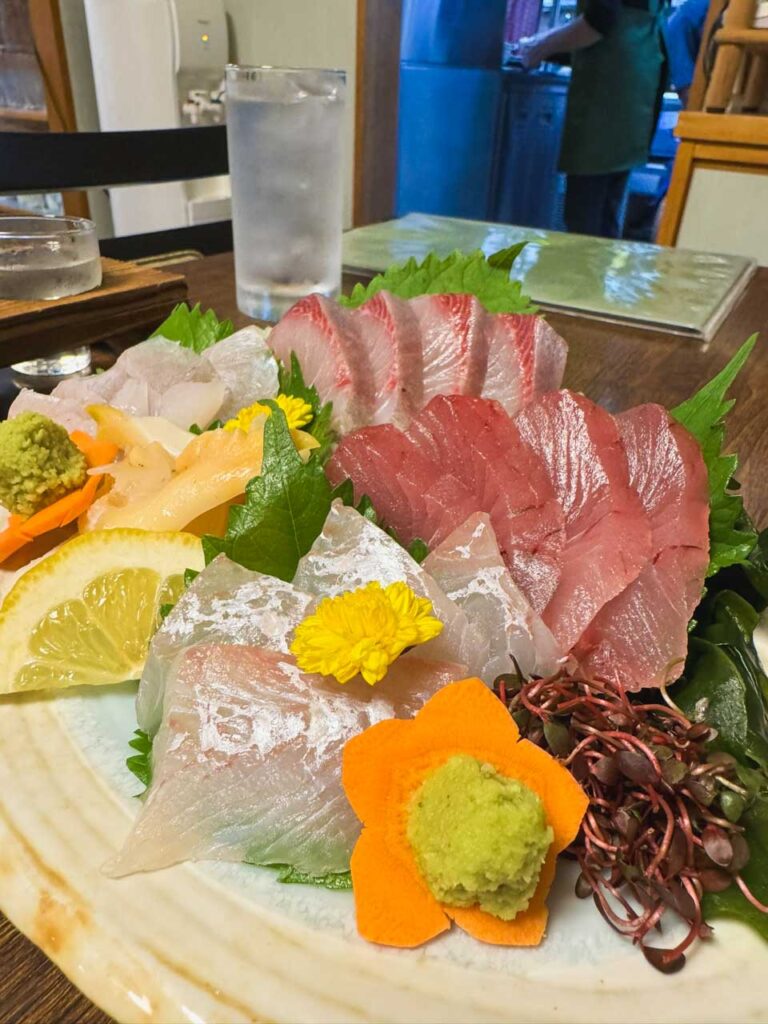
Sashimi plate in Masuda Japan
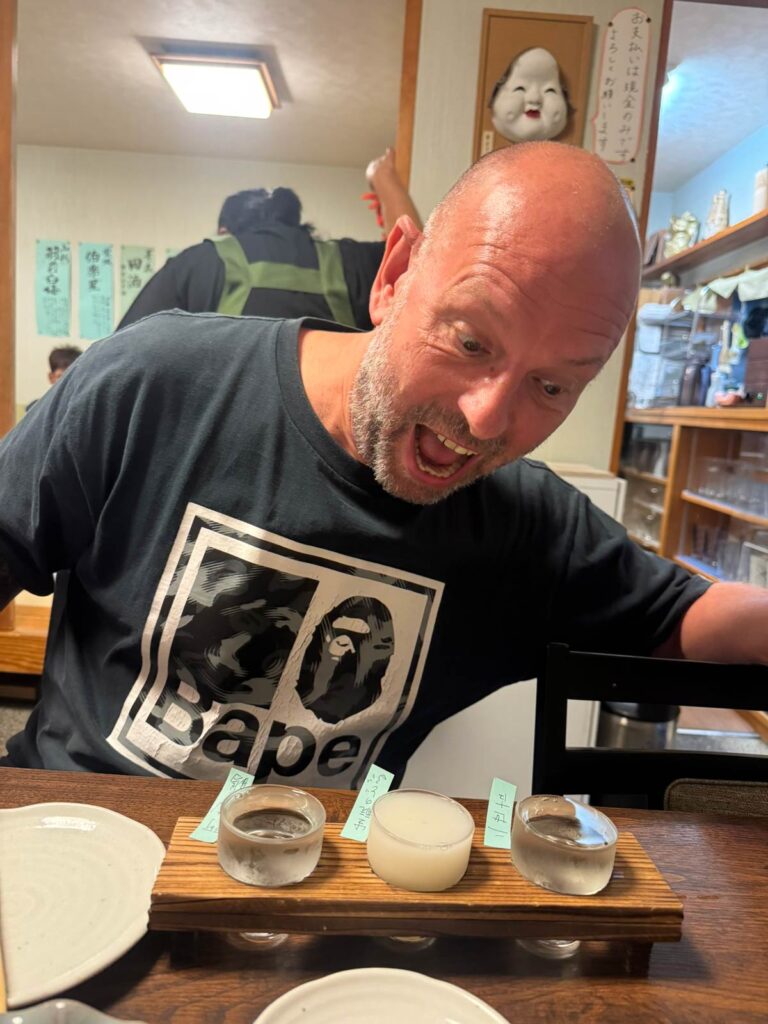
Local Sake tasting at Kasuri Izakaya, Masuda

Kasuri Izakaya

Kasuri was one of those local izakaya experiences where nobody spoke English and the menu was handwritten in Japanese. Google Translate struggled hugely, but we still managed to order, eat and enjoy ourselves.

It wasn’t polished or easy, but it was memorable. Sometimes those are the meals you remember most.

Important Train Ticket Tip for Masuda

One thing you really need to know before arriving in Masuda: the train station does not have an electronic ticket barrier, so you should buy a paper ticket from your departure station.

We learned this the awkward way.

We had tapped in with our ICOCA card earlier in the journey, but when we arrived in Masuda there was nowhere to tap out. The station master quickly realised we were not locals, asked where we were travelling next, and kindly let us through the gate.

A couple of days later, our IC cards had been frozen because the journey had never been completed properly. When we arrived in Izumo, the Masuda station master had already called ahead, explained what had happened, and the staff there helped us calculate the correct fare and fix the cards.

It was all handled with patience, very little English and a bit of Google Translate, but it would have been easier if we had bought a paper ticket in the first place.

How Long Do You Need in Masuda?

One or two nights is enough for Masuda.

We stayed two nights, which gave us time to visit the Iwami Art Museum, use the hotel onsen, eat locally and make the unexpected trip to Ebisu Shrine.

If you are only using Masuda as a route break, one night would also be fine.

Is Masuda Worth Visiting?

Masuda is worth visiting only if it makes sense for your route. We wouldn’t suggest going out of your way for it, and it isn’t one of the best places to visit in Japan if you’re planning a first trip.

But as part of a slow regional train journey through western Japan, it worked well. It gave us a quiet pause, a good hotel, a tattoo-friendly onsen, a couple of local meals and one of the kindest encounters of the whole trip.

Sometimes that’s enough.

If you’re on the San-in Line, Masuda is well worth adding as a relaxed stop along the way. Masuda made a great little stopover point for our 23 day slow train route through western Japan.

Our cute train from Tottori to Okayama

23 Day Japan Slow Travel Itinerary by Train

A 23 day Japan slow travel itinerary by train, following the San-Yo and San-In Line from Fukuoka to Tottori before heading south to Okayama.

July 20, 2026 0 comments
FacebookTwitterPinterestLinkedinRedditStumbleuponWhatsappTelegramThreadsOpenAIChatGPTEmail
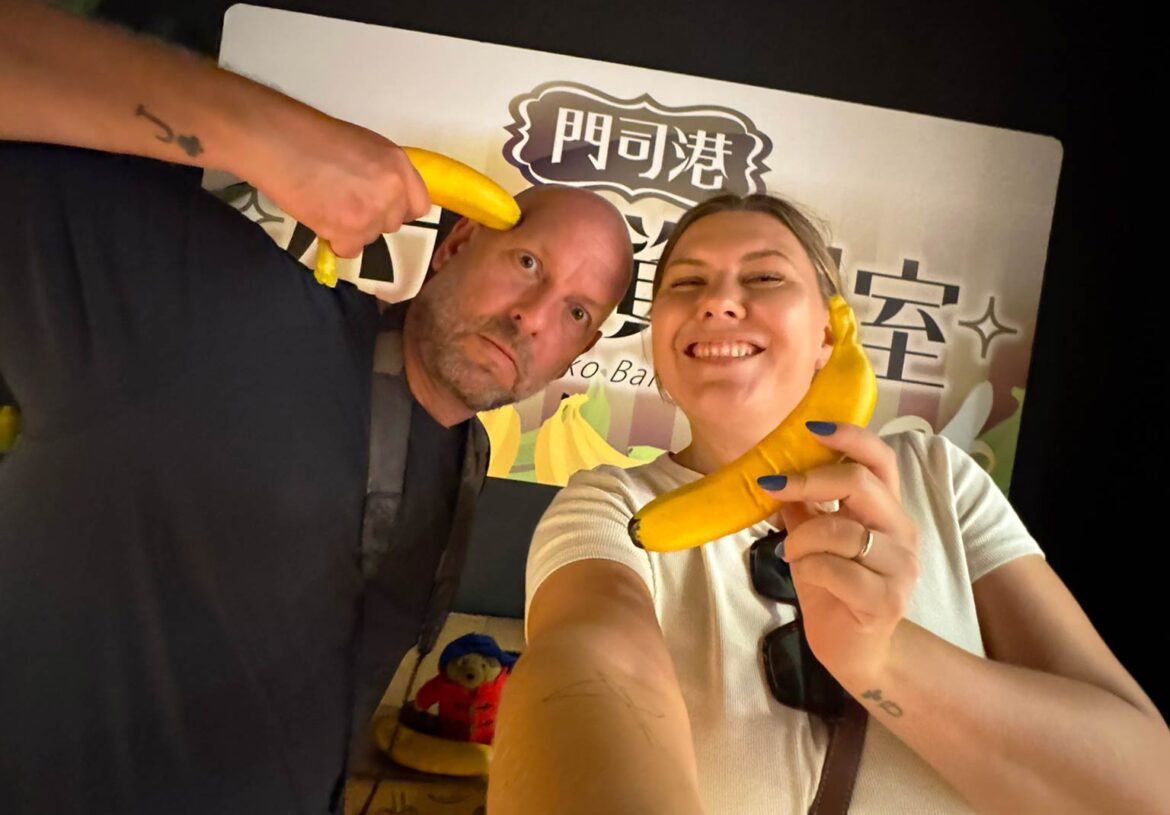
Your Banana Called!
Japan

Is Mojiko Worth Visiting? A Retro Port Stop Before Honshu

by Sam July 17, 2026
written by Sam

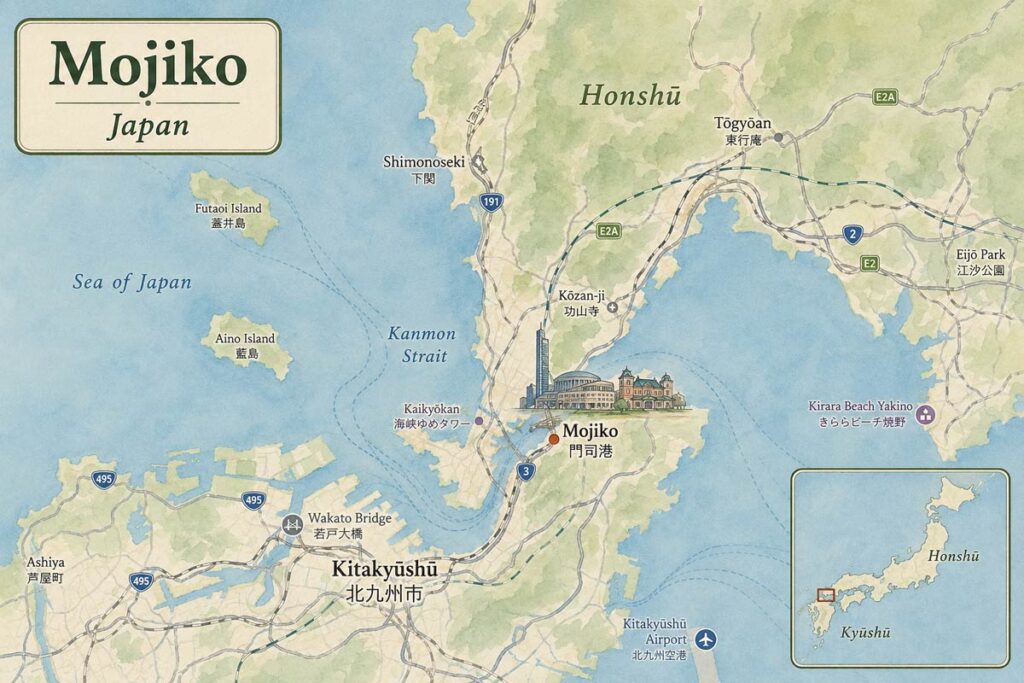
Mojiko, also known as Mojiko Retro, is a small port town at the northern tip of Kyūshū, just across the Kanmon Strait from Honshu. It isn’t the kind of place we’d tell you to cross Japan for on its own, but as a short stop before heading towards the San-yō or San-in Line, it worked beautifully.

Mojiko was our second stop on our 23 day slow regional train route through western Japan, and it made a charming pause before crossing from Kyūshū to Honshu.

It has a beautifully restored old train station, retro streets, sea views, banana-themed everything, curry, museums, a wharf, and one of the best-value hotel rooms we had on the whole trip. It’s compact, easy to explore, and ideal for one or two relaxed nights.

Mojiko Map
Mojiko Map
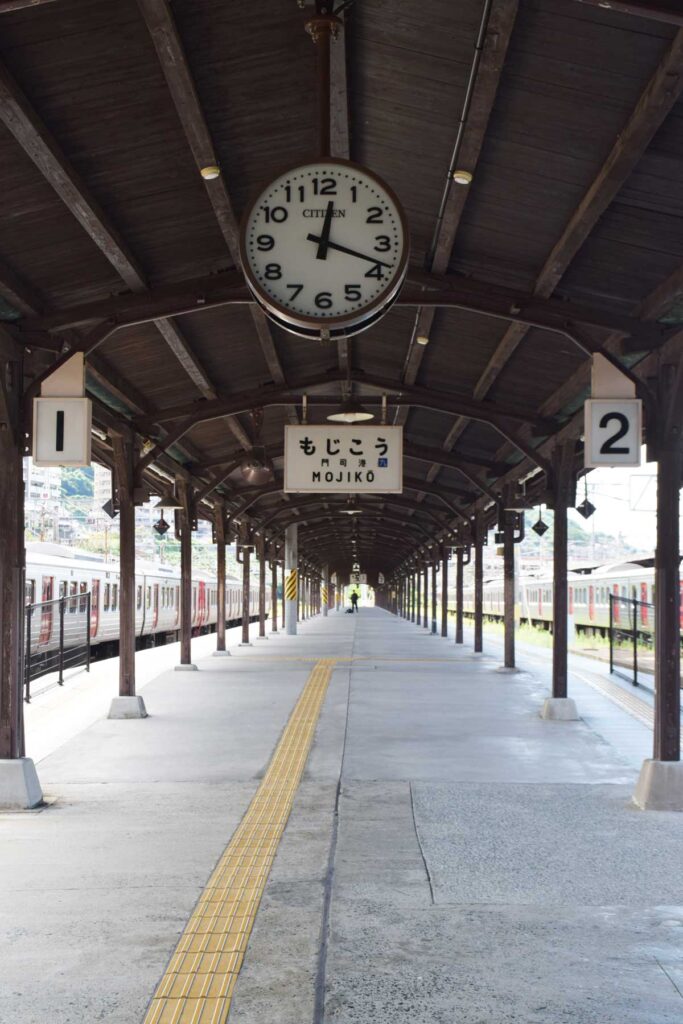
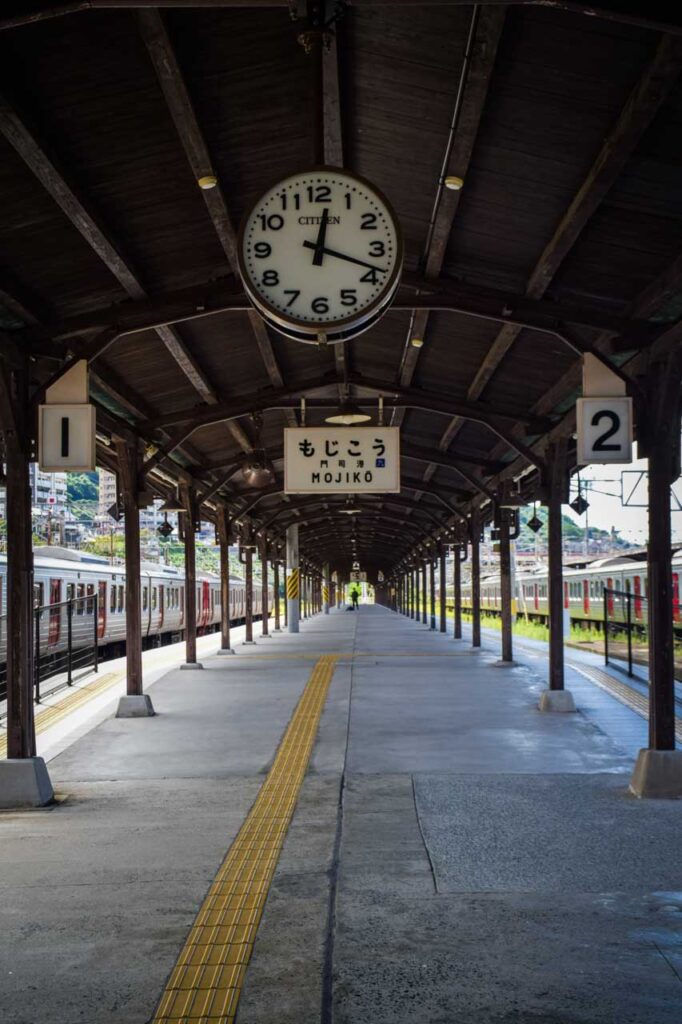
Mojiko Train Platform
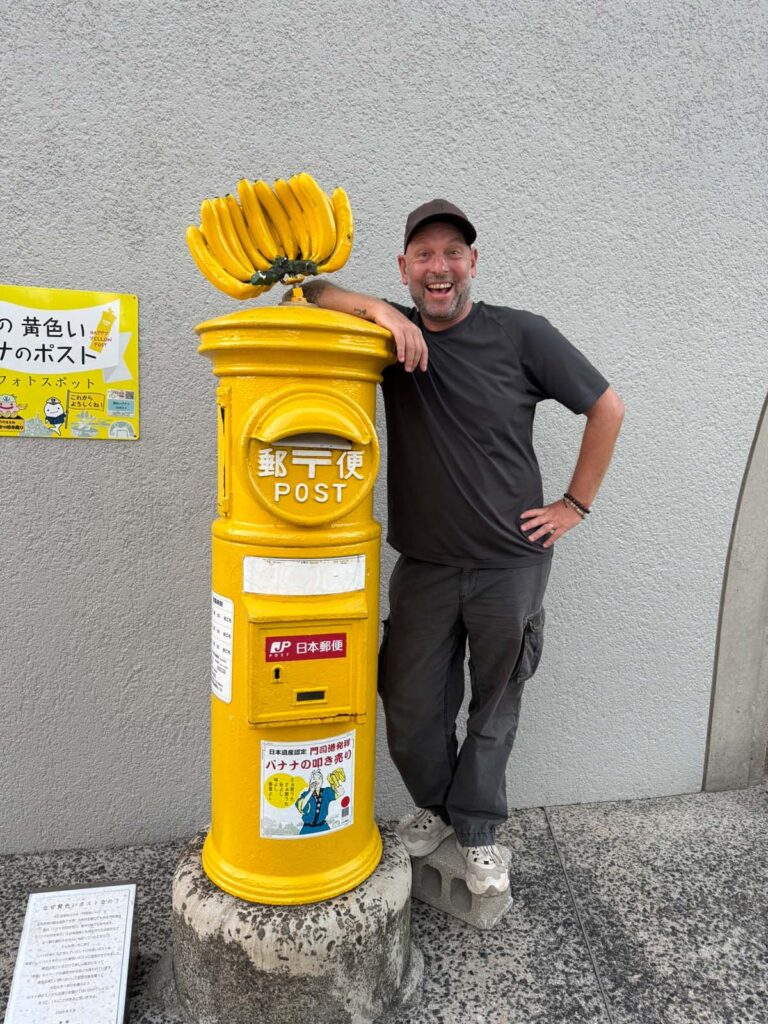
Even the postbox features bananas!
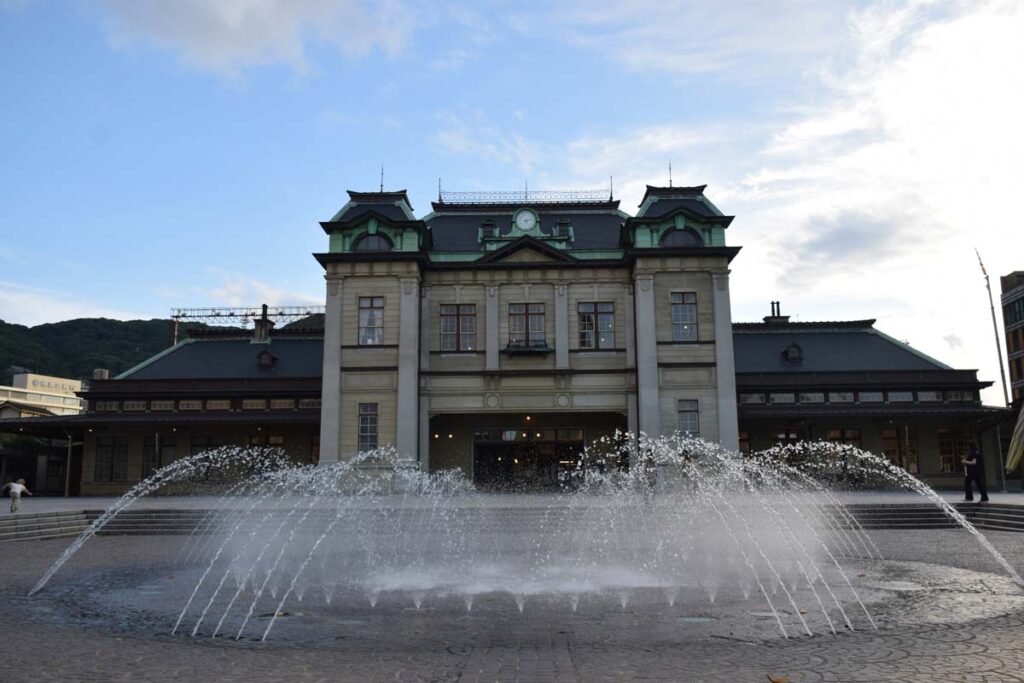
The charming Mojiko Train station

Why Visit Mojiko?

Mojiko is worth visiting if you enjoy small historic towns, retro architecture, quiet waterfronts and slightly quirky places. It doesn’t have the scale or drama of Japan’s major tourist cities, but that is part of the charm.

The town is branded as “Mojiko Retro”, and the area around the station and waterfront has a nostalgic, early 20th-century feel. You’ll find old buildings, sea views, museums, cafés, curry restaurants and the famous Bananaman statue.

It’s also a practical stop if you’re travelling by regional train. From Mojiko, it’s easy to continue towards Honshu and connect with Shimonoseki before heading along the San-yō or San-in route.

Where to Stay in Mojiko

We stayed at Premier Hotel Mojiko, and it was the biggest and best-value room of our entire 23 day slow regional train trip through western Japan.

The hotel is right by the waterfront, close to Mojiko Station, the wharf, restaurants and the main retro area. Our room had lovely views over the port, and the location made everything easy to reach on foot.

For a short stay in Mojiko, we’d recommend staying close to the station or waterfront. The town is small, so being central means you can arrive by train, drop your bags and start exploring almost immediately.

Things to Do in Mojiko

Take Your Time at Mojiko Station

Mojiko Station is one of the loveliest things about arriving here, so don’t rush off the platform as soon as your train pulls in. Take a moment to turn around, look back and enjoy the retro station atmosphere before heading out.

The station building itself is beautiful from the outside too, with a restored historic design that sets the tone for the rest of Mojiko Retro. It’s not just a transport stop; it’s part of the experience.

The charming Mojiko Train station

Wander Around Mojiko Retro

The main Mojiko Retro area is compact and easy to explore on foot. You’ll find old buildings such as the Former Moji Customs Office, waterfront views, small museums, cafés, restaurants and plenty of banana-themed details scattered around town.

It’s a nice place to wander without a strict plan. The charm is mostly in the atmosphere: the old station, the wharf, the sea air and the slightly unusual retro branding.

Find the Bananaman Statue

One of Mojiko’s quirkiest claims to fame is its banana connection. Bananas became linked with the town because Mojiko was once an important port for imported bananas, especially from Taiwan and Southeast Asia. Over time, banana selling and “banana叩き売り” street performances became part of the town’s identity.

Today, that history shows up in a much sillier way: banana souvenirs, banana curry, banana signs and the Bananaman statue near the waterfront. It’s odd, but fun, and very Mojiko.

Visit Mojiko Retro Observation Gallery

The Mojiko Retro Observation Gallery is one of the best places to get a proper view over the town and the Kanmon Strait. From above, you can see Mojiko’s waterfront, the bridge, the sea traffic and Honshu across the water.

It’s especially useful early in your visit because it helps you understand how the town sits between Kyūshū and Honshu. Mojiko is small, but from the observation deck, the location feels much more dramatic.

Strait views from the Kanmon Museum rooftop
Retro vibes at The free exhibition area on the first floor of the Kanmon Strait Museum

Visit the Kanmon Strait Museum

The Kanmon Strait Museum is close to the waterfront and focuses on the history and culture of the strait between Kyūshū and Honshu. We especially liked that you can go up to the café area for free and enjoy the views.

Even if you don’t spend much time in the museum itself, the building is worth stopping by for the location. The café views make it an easy and low-effort break while walking around Mojiko.

Stop at Retro Mojiko Old Street Museum

Adjoining the Kanmon Strait Museum is The Retro Mojiko Old Street Museum, also known as 海峡レトロ通り, is free to visit and gives you a small glimpse into the town’s nostalgic side. It’s not a huge attraction, but it fits well with the retro theme of the area.

For a short Mojiko itinerary, it’s a good quick stop between the station, wharf and observation area. You can walk quite easily to all three.

Views from the top of the Mojiko Retro Observation Gallery
Sunset views from the top of the Mojiko Retro Observation Gallery
The Old Mitsui O.S.K. Lines Ltd. Building

Hike to Mt. Kazagashira Observatory

If you want a proper walk, continue towards Mt. Kazagashira Observatory. The hike is worth it for the views over the strait, Mojiko and the surrounding coastline.

It’s a good option if you have an extra half day in town and want to do more than just the retro waterfront. The views from the top made Mojiko feel much bigger and more scenic than it first appeared.

To start, Walk to Kifune Shrine and follow the path and signs up the hill. We like adding small shrines like this to our routes because they break up the sightseeing and give you a better sense of everyday Japan away from the main tourist corners.

Kanmon Strait from Mt. Kazagashira Observatory

Consider the Kyushu Railway History Museum

Mojiko also has the Kyushu Railway History Museum, though we didn’t visit it ourselves. If you like trains, it could be worth adding to your itinerary.

There is even a small train you can drive around, which looked like the kind of slightly odd but fun activity Japan does so well.

Where to Eat in Mojiko

Curry Honpo Mojiko Retro

Mojiko is known for banana curry, and Curry Honpo Mojiko Retro is one of the obvious places to try it. Banana curry sounds strange, but in Mojiko it makes sense because of the town’s banana history.

It’s the kind of local speciality that is definately worth trying once, especially when a place has built so much of its identity around it.

Would you try Banana Curry?!
Sundowner spot Teppan Tiger

Mojiko Teppan Tiger

We also ate at 門司港鉄板タイガー, or Mojiko Teppan Tiger, a teppanyaki restaurant in Mojiko. It was a good casual meal and a nice option if you want something hot, filling and straightforward after walking around town. It’s right on the waterfront, which makes a great spot for a sundowner.

Mojiko isn’t a huge food destination, but for a short stay, there are enough good options around the retro area and waterfront.

How Long Do You Need in Mojiko?

Mojiko works best as a short stop. We stayed two nights, which felt just right for seeing the retro waterfront, taking in the views and adding a walk up to Mt. Kazagashira Observatory.

1 Night

One night is enough if you arrive early, explore Mojiko Retro, see the station, visit the observation gallery, eat curry, grab aphoto with Bananaman and continue onwards the next day.

2 Nights

Two nights gives you a more relaxed visit. You can add the Kanmon Strait Museum, Kifune Shrine, the hike to Mt. Kazagashira Observatory and still have time to enjoy the waterfront without rushing.
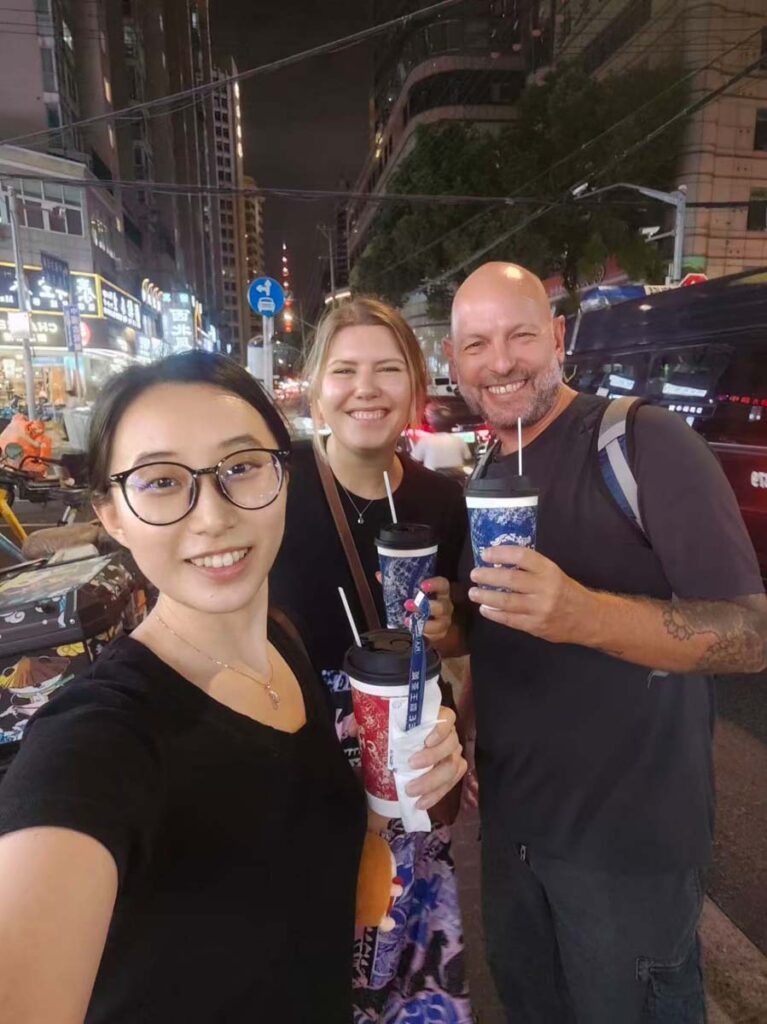
How to Get from Mojiko to Honshu

Mojiko sits just across the Kanmon Strait from Honshu. You can take a ferry across the water, which sounds like the more scenic option, but it isn’t necessarily the cheapest or most practical route.

For us, the easier and cheaper option was to take the train back to Moji, then continue through to Shimonoseki on Honshu. From there, you can connect with the San-yō Line and continue your journey west or east.

If you’re travelling by regional train, Mojiko makes a neat pause before crossing from Kyūshū to Honshu.

Find Bananaman!
Find Bananaman!
On the platform at Shimonoseki

Is Mojiko Worth Visiting?

Mojiko is worth visiting if it fits naturally into your route. It’s not a place we’d build an entire Japan trip around, but as a short retro port stop before Honshu, it was charming, easy and memorable.

The old station, banana theme, waterfront views, observation deck, quiet streets and good-value hotel made it a fun break between bigger travel days.

If you’re heading towards Shimonoseki, the San-yō Line or the San-in Line, Mojiko is well worth adding as a relaxed stop along the way. Mojiko made a great stopover point for our 23 day slow train route through western Japan.

Save the pin

July 17, 2026 0 comments
FacebookTwitterPinterestLinkedinRedditStumbleuponWhatsappTelegramThreadsOpenAIChatGPTEmail
Ohori Park Japanese Garden
Japan

Is Fukuoka Worth Visiting? A Calmer, Less Touristy Side of Japan

by Sam July 16, 2026
written by Sam

Is Fukuoka worth visiting? We think so, especially if you want a Japanese city that feels calmer, easier to handle and less touristy than Tokyo, Kyoto or Osaka before heading deeper into Kyūshū or along the San-In Line. This Fukuoka travel guide covers where to stay, what to do, where to eat, how long to spend in the city, and the practical tips we found useful during our stay.

Fukuoka was the starting point for our slow travel route through western Japan, and it turned out to be a gentle, easy introduction back into the country. Located on Kyūshū, Japan’s southern main island, Fukuoka has everything you want from a Japanese city without feeling overwhelming.

At first glance, it can look like another modern Japanese city: grey buildings, convenience stores, shopping streets, ramen shops and busy stations. But once we slowed down, Fukuoka became much more enjoyable. We found peaceful parks, excellent coffee, friendly neighbourhoods, shrines, castle ruins, easy transport and some seriously good food.

It may not have the obvious drama of Kyoto or Tokyo, but that’s exactly why we liked it. Fukuoka felt practical, relaxed and very liveable, making it a great first stop in Japan or a useful base before exploring more of Kyūshū.

Fukuoka Map
Fukuoka Map

Fukuoka was also the starting point for our 23 day regional train route through western Japan, which followed the Sanin Line from Kyūshū towards Tottori and Okayama.

Tori gate near Fukuoka Prefecture Gokoku Shrine
Fukuoka Prefecture Gokoku Shrine
Fukuoka Castle Ruins

Why Visit Fukuoka?

Fukuoka is one of the easiest large cities in Japan to enjoy. It has a good metro system, a compact centre, excellent food and a more relaxed atmosphere than many of Japan’s better-known destinations.

The city is especially famous for Hakata ramen, and if you love noodles, you’ll be very happy here. It’s also a great place for coffee, casual restaurants and late-night food, with plenty of places where you can eat well without spending a fortune.

What we liked most was the balance. Fukuoka doesn’t feel like classic tourist Japan: it’s smaller, calmer and far less crowded, with fewer visitors than the country’s big-name cities. One minute you can be eating ramen in the city, and the next you can be walking around Ohori Park, visiting a shrine, exploring castle ruins or taking a boat to a nearby island.

Fukuoka also works well as a starting point for a longer Japan itinerary. From here, you can continue deeper into Kyūshū, head north towards Mojiko and the Sanin Line, or connect easily to other parts of Japan by Shinkansen.

Where to Stay in Fukuoka

We stayed at APA Hotel Fukuoka Tenjin Nishi, which worked well for our visit. The location was convenient for getting around the city, with access to metro stations, restaurants, coffee places and shops nearby.
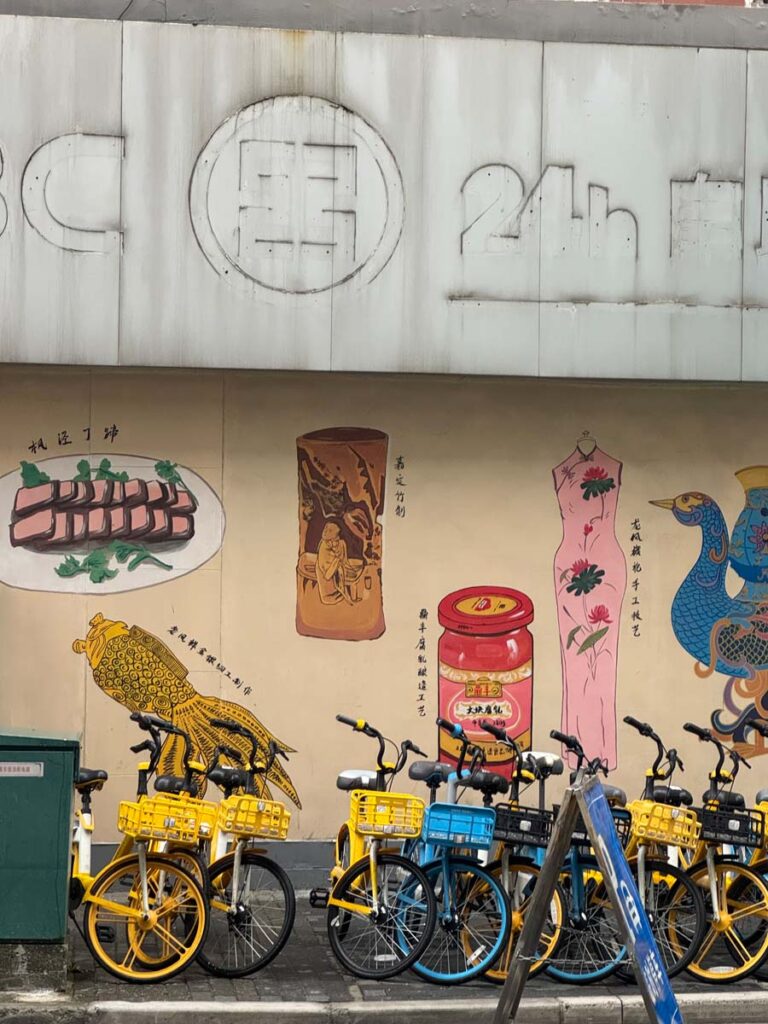
For most visitors, staying around Tenjin, Akasaka or Hakata makes the most sense. Tenjin and Akasaka are good if you want restaurants, cafés and a slightly more central city feel, while Hakata is useful if you want to be close to the main train station.

If it’s your first time in Fukuoka, we’d choose somewhere with easy metro access. The city is simple to get around, but being near a station makes day-to-day exploring much easier.

APA Hotel Fukuoka Tenjin Nishi - A typical Business Hotel
APA Hotel Fukuoka Tenjin Nishi – A typical Business Hotel

Best Things to Do in Fukuoka

Visit Fukuoka Prefecture Gokoku Shrine

Fukuoka Prefecture Gokoku Shrine is a peaceful place to visit if you want a quiet break from the city. It has a large wooden torii gate, open grounds and a calm atmosphere that makes it feel removed from the surrounding streets.

We liked that it didn’t feel overly busy or touristy. It’s the kind of place you can visit without needing a long plan: walk through, slow down for a moment and enjoy the setting.

It also pairs well with a visit to Ohori Park, as both are close enough to combine in the same relaxed morning or afternoon.

Walk Around Ohori Park

Ohori Park is one of the best places in Fukuoka to slow down. The large pond, walking paths and open views make it a lovely place for a gentle wander, especially if you’ve just arrived in Japan and want an easy first day.

It’s popular with locals walking, running, cycling or sitting by the water, which gives the park a nice everyday feel. We always enjoy places like this because they show you how a city actually lives, not just what it offers tourists.

If you want a calm start to your Fukuoka visit, Ohori Park is a good place to begin.

Visit Ohori Park Japanese Garden

Next to the park, the Ohori Park Japanese Garden is worth visiting if you enjoy landscaped gardens and quiet spaces. It’s not huge, but it’s beautifully arranged and makes a peaceful contrast to the city outside. On the hour they flood the small lake with fog which looks incredible.

You’ll find traditional garden design, carefully shaped trees, water features and places to pause rather than rush. It’s the kind of stop that fits well into a slower Fukuoka itinerary.

We wouldn’t build an entire day around it, but combined with Ohori Park and nearby cafés, it makes a very pleasant couple of hours.

Stop at &LOCALS Ohori Park Shop

&LOCALS Ohori Park Shop is a lovely little stop near the park, especially if you want a drink or snack in a peaceful setting. It has that clean, simple Japanese design we always enjoy, and it fits perfectly with a slower day around Ohori.

It’s not a major attraction, but it’s exactly the kind of small place that makes wandering in Japan so enjoyable. Sometimes the best travel moments are just a good drink, a nice view and nowhere urgent to be.

Cross Chamura Bridge

Chamura Bridge is a small but pretty stop while exploring the Ohori Park area. It’s not somewhere you need to go out of your way for, but it adds to the charm of wandering around this part of Fukuoka.

We liked this whole area because it was easy to explore without a strict route. You can move between the park, shrine, garden, cafés and small sights at a relaxed pace. After exploring the Shine, Park, Shop and bridge it’s an easy metro ride back from Ohori Park (Fukuoka Art Museum) Stop ID: K06.

Explore the Korokan Ruins Museum

The Korokan Ruins Museum gives you a glimpse into Fukuoka’s older history and its role as a place of exchange with the Asian mainland. It’s a small museum, but an interesting stop if you want to understand more about the city beyond food and shopping.

Because it’s near Maizuru Park, it’s easy to include while exploring the castle ruins and surrounding green spaces. We wouldn’t call it a must-see for everyone, but if you enjoy history, it’s worth a short visit.
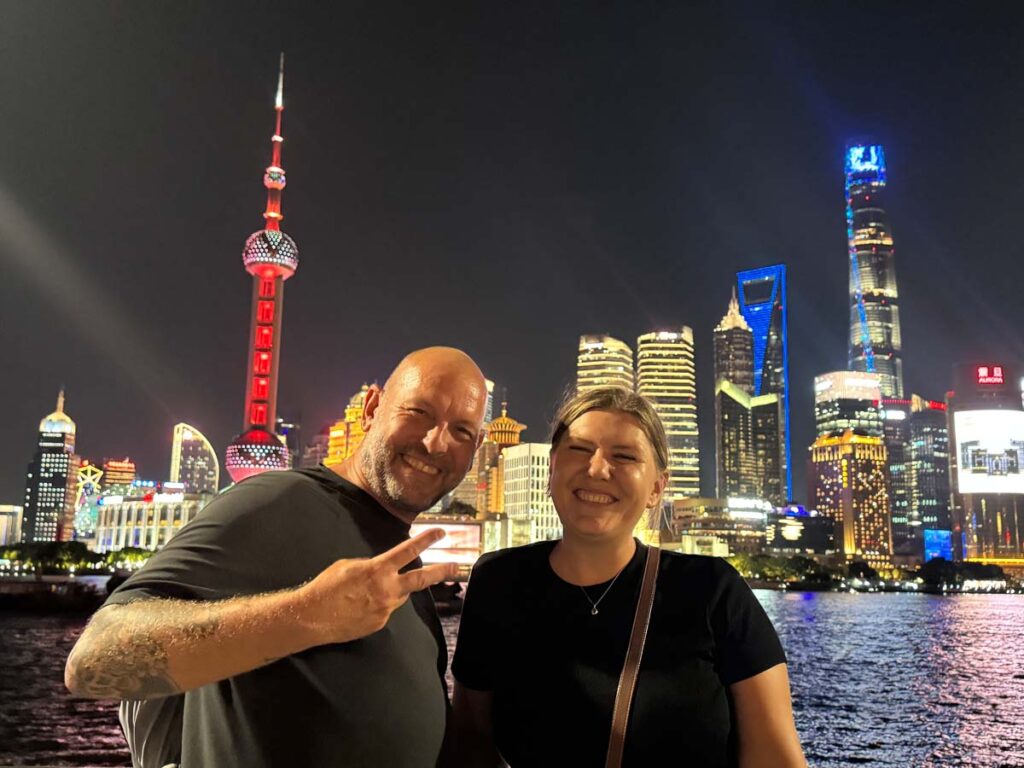
Walk Through Maizuru Park and the Plum Garden

Maizuru Park is home to the remains of Fukuoka Castle, and it’s a good place to walk, especially if you like castle ruins rather than fully reconstructed buildings. The stone walls and elevated viewpoints give you a sense of the city’s past without feeling too formal.

The plum garden is especially nice if you visit during the right season. Even outside peak bloom, this is a pleasant area to wander and a good reminder that Fukuoka has plenty of quieter corners.

Take a Boat Trip to Nokonoshima Island

One of our favourite things to do in Fukuoka was taking the ferry to Nokonoshima Island. To get there, take the ferry from Meinohama Ferry Passenger Terminal, then continue across to the island for a very different side of the city.

Once we arrived, we rented electric bikes and made our way to Nokonoshima Island Park. The entrance fee was ¥1,500 per person. There were also a few cute animals, such as rabbits and goats, which was really nice to see! Aside from the flowers and animals there are shops and restaurants in an old village with traditional Japanese houses. The island felt peaceful and scenic, with sea views, open spaces and a slower pace than the city.

It’s an easy day trip from Fukuoka and a great option if you want a break from urban sightseeing. If the weather is good, we’d definitely recommend adding it to your itinerary.

Electric bike rental on Nokonoshima island
Nokonoshima Island Park

Where to Eat in Fukuoka

Fukuoka is a brilliant food city. It’s best known for Hakata ramen, but we also found good izakayas, coffee shops, gyoza, sushi and casual places that made eating out easy.

These are some of the places we tried or marked during our stay.

The Original Ippudo Ramen Daimyo branch
Izakaya Kadono Uguisu Akasaka in Fukuoka
Lunchtime special at Gyoza Ittetsu

Ippudo Daimyo Branch

If you’re going to eat ramen in Fukuoka, Ippudo is an obvious place to start. The Ippudo Daimyo branch is close to where the original Ippudo story began, and it’s a fun stop if you enjoy ramen history as much as the food itself.

It’s popular, but for good reason. A bowl of rich tonkotsu ramen here feels like a proper Fukuoka introduction. Also head here for lunchtime specials. If you’re super hungry you can usually get a free refill, just ask.

博多珍珍 赤坂店

This was our spicy ramen (Dan Dan noodle) stop in Akasaka. If you want something with more heat and flavour, it’s a good option to add to your food list.

As with many smaller restaurants in Japan, don’t worry too much if English is limited. A little patience, pointing and translation help usually gets you there.

大衆とり酒場 とりいちず 福岡赤坂店

This casual chicken izakaya was a good option for an easy meal in Akasaka. They have great fried chicken and big glasses of cold beer and highballs. It’s a kind of working mans izakaya. Places like this are useful when you want something relaxed, filling and not too expensive.

Fukuoka has plenty of these casual restaurants, which is one of the reasons it’s such an easy city to spend a few days in.

Kadono Uguisu Akasaka

Kadono Uguisu Akasaka is another good food option in the area. It has the kind of local restaurant feel we enjoy when travelling in Japan: casual, atmospheric and focused on good food rather than fuss. The seared tuna pictured above was insane! We highly reccommend you drop in during the day and make an evening reservation. It gets quite busy,

Gyoza Ittetsu

After visiting the Fukuoka Prefecture Gokoku Shrine Gyoza Ittetsu is a good choice if you’re craving ramen and dumplings. Even better if you visit at lunchtime as they have a great special. Japan does gyoza very well, and this is the kind of simple meal that always works after a day of walking around the city.

KURA Sushi

For a cheap sushi fix, KURA Sushi is always useful. It’s not fancy, but it’s fun, affordable and easy, especially if you want a low-effort meal.

Sometimes conveyor belt sushi is exactly what you need.

光珈琲 HIKARU COFFEE

HIKARU COFFEE was one of the coffee stops we enjoyed in Fukuoka. It’s a bit bougie, our iced coffee came in a large wine glass. The city has a good coffee scene, and finding independent cafés became part of our daily routine.

Petrol Blue

Petrol Blue is another good coffee option, it’s also a bar in the evening too. It plays downtempo jazz and leftfield, classic furniture, concrete walls and lots and lots of vinyl. It’s worth adding to your Fukuoka map if you like seeking out hidden cafés while travelling. Note: it’s upstairs, so you have to get in the smoke smelling elevator to get up there.

British Pub MORRIS’ BLACK SHEEP

Sometimes, after a lot of travel, you just want a pub. MORRIS’ BLACK SHEEP gave us that familiar break, and it’s a good option if you fancy a drink somewhere casual in the evening.

How Long in Fukuoka Is Enough?

If you’re wondering how long in Fukuoka is enough, we think most travellers will be happy with two to four days depending on their pace.

We stayed 7 nights in Fukuoka, but that was longer than most visitors need. We used the time to catch up on work, sort photos and ease into our Japan trip before continuing towards Mojiko and the Sanin Line.

For most travellers, 2 to 4 days is enough, depending on how slowly you like to travel.

2 Days

With 2 days in Fukuoka, focus on the city highlights. Spend time around Ohori Park, visit Gokoku Shrine, explore Maizuru Park and the castle ruins, then enjoy ramen and a few casual food stops in the evening.

This is enough time for a quick introduction, especially if Fukuoka is part of a longer Japan itinerary.

3 Days

Three days is a better amount of time for most visitors. You can see the main city sights without rushing and still have time for good food, coffee and a slower afternoon.

With 3 days, we’d include Ohori Park, Maizuru Park, the Korokan Ruins Museum, a few ramen stops and some relaxed neighbourhood wandering.

4+ Days

With 4 days or more, add a trip to Nokonoshima Island. This gives you a completely different experience from the city and makes the itinerary feel more balanced.

If you like slow travel, Fukuoka is an easy place to stay longer. It may not be packed with famous attractions, but it’s comfortable, practical and enjoyable to live in for a few days.

Sam does love his KURA sushi
Coffee vibes at Petrol Blue
Enjoying a beer at the British Pub MORRIS' BLACK SHEEP
Enjoying a beer at the British Pub MORRIS’ BLACK SHEEP

Practical Tips for Visiting Fukuoka

Getting from Fukuoka Airport to the City Centre

One of the best things about Fukuoka is how close the airport is to the city. Getting from Fukuoka Airport to the city centre is quick and straightforward by metro.

This makes Fukuoka one of the easiest arrival cities in Japan. You can land, get through the airport and be in the centre without a long transfer.

Getting Around Fukuoka by Metro

Fukuoka’s metro is simple to use and connects many of the places visitors are likely to need. We used it to move around the city and found it reliable, clean and easy to understand.

If you’re staying near a metro station, you’ll have no trouble getting around without a car.

ICOCA, Suica and IC Cards

IC cards such as ICOCA and Suica make travelling around Japan much easier. If you have an iPhone, you can usually add one digitally to your wallet, which makes tapping in and out very simple.

On Android, it can be more complicated depending on where you purchased your device, so getting a physical IC card may be easier. Once you have one, you can use it for metro journeys, many trains, convenience stores and vending machines.

At the airport head to the Fukuoka Airport Subway Station and use the cash-only kiosks. You can purchase a local IC card (such as Hayakaken, nimoca, or Sugoca) for a minimum of ¥1,500 which includes a ¥500 refundable deposit.

Best Time to Visit Fukuoka

Spring and autumn are generally the best times to visit Fukuoka. The weather is more comfortable for walking, parks are pleasant, and it’s easier to enjoy the city without the heat and humidity of summer.

Spring is especially nice if you catch plum or cherry blossom season, while autumn usually brings milder temperatures and good conditions for exploring. We visited in September and it was HOT!

That said, Fukuoka is a year-round city. If you’re using it as a starting point for a longer Japan trip, it’s still a practical and enjoyable place to begin.

Internet, Payments and Apps

Japan is easy to travel with the right basic tools. We recommend having mobile data, either through an eSIM, pocket Wi-Fi or local SIM, as you’ll use maps, translation apps and transport information constantly.

Google Maps works well for metro and walking routes, while translation apps are useful in smaller restaurants where menus may not be in English.

For payments, Japan is much more card-friendly than it used to be, but it’s still worth carrying some cash. IC cards such as Suica and ICOCA are also useful for transport and small purchases. We use our Wise cards where we can, but Japan is a mostly cash society and you will need cash at almost all ramen stores throughout the country.

Final Thoughts on Visiting Fukuoka

Fukuoka was a great introduction to this part of Japan. It didn’t overwhelm us with major sights, but that was part of the appeal. Instead, it gave us good food, easy transport, peaceful parks, interesting history and a gentle start to our slow journey through western Japan.

We wouldn’t say Fukuoka is the most dramatic city in Japan, but it is one of the easiest to enjoy. It’s relaxed, practical and full of small moments that make travel in Japan so satisfying.

If you’re starting a Kyūshū trip, heading towards the Sanin Line, or simply looking for a Japanese city that feels approachable and liveable, Fukuoka is well worth adding to your itinerary and also made a great starting point for our 23 day slow train route through western Japan.

Save the pin

July 16, 2026 0 comments
FacebookTwitterPinterestLinkedinRedditStumbleuponWhatsappTelegramThreadsOpenAIChatGPTEmail
Our cute train from Tottori to Okayama
JapanTravel Itineraries

23 Day Japan Slow Travel Itinerary by Train

by Sam July 9, 2026
written by Sam

We’ve visited Japan four times now, but on this trip we wanted something different. Instead of racing between the classic first-time stops, we slowed everything down and followed a quieter route through western Japan by regional train.
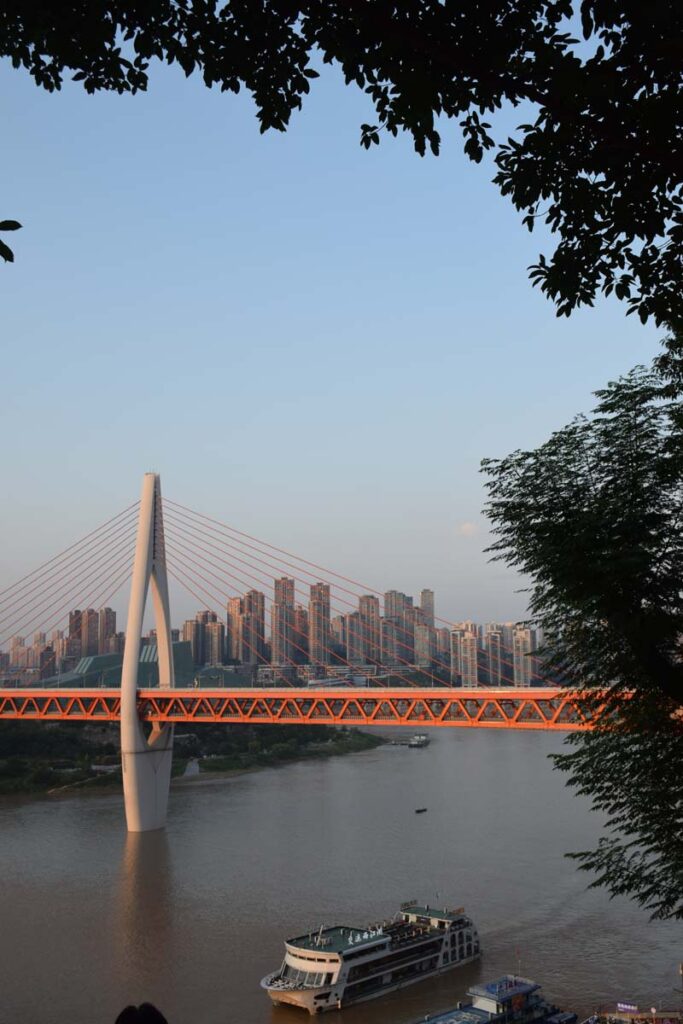
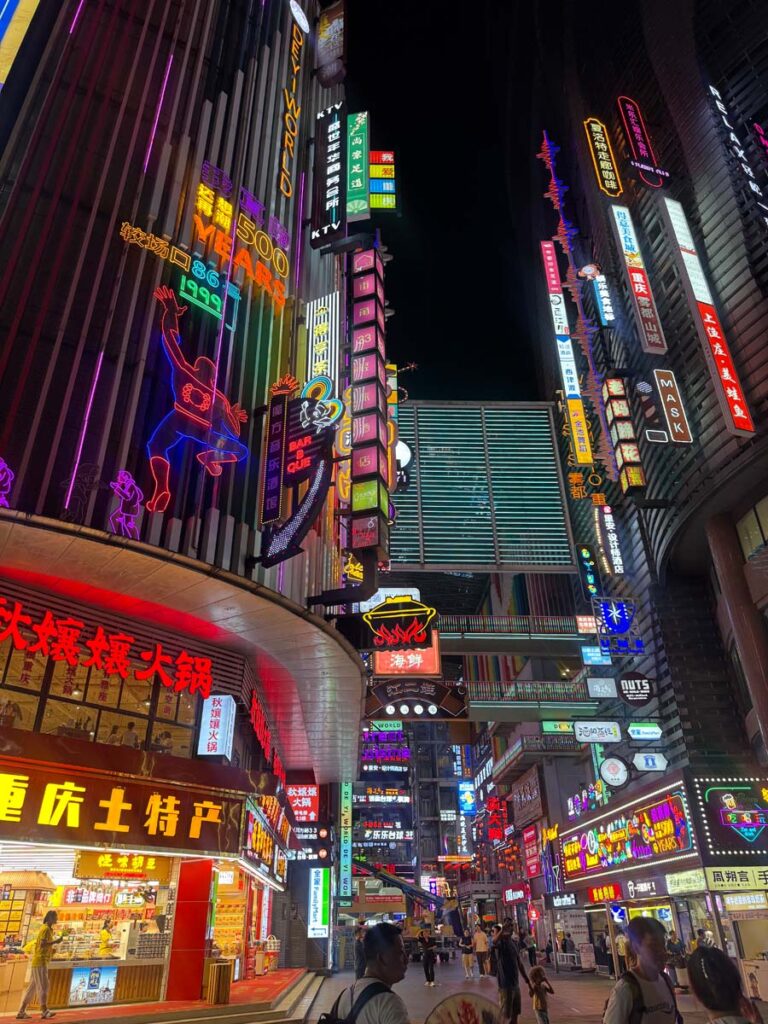
This 23 day Japan slow travel itinerary took us from Fukuoka on Kyushu, across to Mojiko, then along the San-Yo Line and changing to the San-In Line through Masuda, Izumo, Matsue, Kurayoshi and Tottori, before heading south to Okayama on the Imbi Line . It was one of the most rewarding trips we’ve done in Japan: quiet towns, friendly people, beautiful train journeys, excellent food and barely any international tourists.

If you’re looking for a Japan slow train route that goes beyond Tokyo, Kyoto and Osaka, this itinerary is a lovely way to see a different side of the country.

Slow train views
Slow train views
Train platform of Retro Mojiko
Platform life at the start of the San-Yo Line

Our Japan Route

We travelled between towns and cities entirely by regional train, with a few local buses and metro journeys used to reach sights along the way.

Our route looked like this:

Fukuoka → Mojiko → Masuda → Izumo → Matsue → Kurayoshi → Tottori → Okayama
Our Route on the San-Yo and San-In line in Japan

This is not a fast Japan itinerary. It is a slow travel route built around regional trains, smaller cities, coastal scenery, old towns, shrines, castles and quiet everyday moments.

Fukuoka 福岡市 — 7 Nights

Fukuoka was our arrival point after flying in from Shanghai, and it gave us time to settle back into Japan at an easy pace. At first glance it feels like a modern Japanese city of grey buildings, convenience stores and endless places to eat, but it also has great coffee, castle ruins, shrines and some brilliant food.

We visited the original Ippudo Ramen shop and also took a boat out to Nokonoshima, where we rented electric bikes and explored the island. Seven nights was longer than most people would need, but we used the time to catch up on work and reset before starting the train journey properly.

We stayed at APA Hotel Fukuoka Tenjin Nishi which was in a great area with lots of food places and easy access to the center by metro.

Read our full Fukuoka guide here

Tori gate near Fukuoka Prefecture Gokoku Shrine
Nokonoshima Island Park
Izakaya 大衆とり酒場 とりいちず 福岡赤坂店 in Fukuoka
Ohori Park Japanese Garden

Mojiko 門司港 — 2 Nights

Mojiko or ‘Retro Mojiko’ is a charming little port city with a slightly odd banana theme, a beautiful old station and a peaceful waterfront. We tried banana curry, visited the observation deck, wandered through the free old street museum and hiked up to Mt. Kazagashira Observatory for views over the strait.

The town has a quiet, nostalgic feel and made a gentle transition between city travel and the slower route ahead. From here, we crossed towards Shimonoseki and began following the San-Yo and San-In Line west to east.

We stayed at the Premier Hotel Mojiko one of our favorite hotels on this trip, it had a huge room (for Japanese standards) and pretty views over the port and the bananaman statue.

Read our full Mojiko guide here

The old customs office and Observation tower in Mojiko
Free museum next to the Kanmon Strait museum
Bananas are everywhere in Mojiko
View over the Kanmon Strait between Kyūshū and Honshu

Masuda 益田市 — 2 Nights

Masuda is the kind of stop that made people ask why we were going there, but it turned out to be one of the warmest places on the trip. We saw no tourists and everyone we met was friendly, patient and curious, including the staff at our hotel onsen, where tattoos were not an issue as we were foreign visitors.

We visited the Iwami Art Museum, ate cold soba for the first time and had one of those memorable izakaya meals where the menu was handwritten in Japanese and Google Translate struggled hugely. A local woman Livia met in the onsen even drove us to a small coastal Ebisu shrine that would have been difficult to reach by public transport.

We stayed at the Mascos Hotel which was modern with a large room and tattoo friendly onsen.

Read our full Masuda guide here

Life on a local train in Japan
Hanae Mori collection at Iwami Art Museum
cold soba noodles
cold soba noodles
Ebisu Shrine just outside Masuda

Izumo 出雲市 — 1 Night

Izumo is mainly known for Izumo Taisha, one of the most important shrines in Japan. The huge shimenawa rope is the famous image, but the whole shrine complex felt atmospheric, especially in the drizzle and forested surroundings. It was busy with Japanese visitors, but nothing like the crowded shrine experiences you get in the bigger tourist cities.

One night was enough for us, but it was a worthwhile stop on this slow travel route through western Japan. Many Japanese people are stil shocked we made it there, as many haven’t been themselves.

We stayed at the Super Hotel Izumo Ekimae a standard business Japanese hotel but with a 2 hour free bar every evening.

Read our full Izumo guide here

One of the many shrines at Izumo Taisha
Rabbits everywhere at Izumo Taisha
If your fortune is bad, leave it behind
The massive shimenawa at Izumo Taisha

Matsue 松江市 — 2 Nights

Matsue was a more substantial city with a strong sense of Edo-period history. We visited the castle, explored the samurai house area, saw the fox shrine, ate more cold soba and enjoyed sunset views over the lake. Staying near Matsue-Shinjiko-Onsen Station meant we were in a more appealing part of the city, even if it required a bus ride back to the main station when we left.

Good coffee, a great lunchtime BBQ deal and a fun evening in a local izakaya made Matsue one of the easiest stops to enjoy.

We stayed at Matsue New Urban Hotel it was close to the Castle and had a tattoo friendly onsen.

Read our full Matsue guide here

Matsue Castle
Matsue Castle
Our favourite coffee in Matsue
Matcha tea with Matcha Mochi
Lakeside sundowners
Lakeside sundowners

Kurayoshi 倉吉市 — 2 Nights

Kurayoshi gave us old-town charm without the crowds. We stayed near the main station and took the bus into the White Wall Warehouses district, where we found traditional buildings, small museums, good coffee and a much slower pace. We also visited the surprisingly fun Tottori Nijisseiki Pear Museum, which was far better than a pear museum has any right to be.

At Kurayoshi Yodoya, the former Makita Family Residence, we met a group of lovely volunteer ladies who didn’t speak English, but somehow, with smiles, gestures and a little translation help, we still managed to have a wonderful conversation.

Our favourite side trip was finding the abandoned Yamamori railway line, a quiet, overgrown place that felt like something from a Studio Ghibli scene.

We stayed at Hotel St Palace Kurayoshi which was conveniently close to the railway station.

Read our full Kurayoshi guide here. (coming soon)

Kurayoshi Old Town
Kurayoshi Old Town
Ghibli vibes at the abandoned train line
Meeting the ladies at Makita Family Residence

Tottori 鳥取市 — 2 Nights

Tottori is famous for its sand dunes, where the desert-like landscape meets the sea. It is one of the more unusual natural sights in Japan and definitely one of the best places to visit in Japan if you want something different from temples, castles and city streets. That said, it was also our least favourite stop on the San-In Line because it felt more touristy than the other places on this route.

The Sand Museum was strange but impressive, with huge sand sculptures that change regularly.

Wee stayed: Tottori Washington Hotel Plaza which was pretty close to the train station.

Read our full Tottori guide here. (coming soon)

Sam walking along the Tottori Sand Dunes
Sand Castle Museum in Tottori
Yakiniku in Tottori
Yakiniku in Tottori
Tottori Sand Dunes
Tottori Sand Dunes

Okayama 岡山市 — 4 Nights

Okayama marked the end of our regional train journey and felt like a return to a larger, more connected city. At first it seemed like another grey urban stop, but it opened up once we explored beyond the centre. We visited Kibitsu Jinja with its long covered walkway, cycled out to a five-storey pagoda and took a trip to Kurashiki for denim shopping and a beautiful old canal district.

After so many smaller towns, Okayama was a comfortable place to slow down, reflect and ease back into civilisation.

We stayed: HOTEL LiVEMAX Okayama West was was small, but very clean and close to the train station.

Read our full Okayama guide here. (coming soon)

Five-storied Pagoda of Bitchu Kokubun-ji Temple
The water town of Kurashiki
Kibitsu Jinja (Sanbi Ichinomiya)
Entrance to Kibitsu Jinja (Sanbi Ichinomiya)

Travelling Japan by Local Train

This route is not about bullet trains or rushing between major cities. It is about small local trains, two-carriage services, coastal views, quiet stations and the kind of journeys where the train itself becomes part of the experience.

For this itinerary, we would not bother with a nationwide or Regional JR Rail Pass. Local tickets were easy enough to buy, the journeys were flexible, and this route was much better suited to slow independent travel than a high-speed pass-based itinerary.

One important thing to know is that IC cards such as Suica or ICOCA may not work properly on some rural sections of the San-In Line. We tapped in at Shimonoseki and could not tap out at Masuda, which eventually froze our cards until station staff helped us fix the fare at Izumo.

If we did this again, we would buy paper tickets for the rural sections instead of relying on an IC card.

Our cute train from Tottori to Okayama

What We’d Change

We probably did not need seven nights in Fukuoka. That was useful for us because we had work to catch up on and photo backups to sort after travelling in China, but most travellers could spend three or four nights there and use the extra time elsewhere.

We also considered continuing further along the coast towards Obama, but by Tottori we were getting tired from planning each small stop, checking transport and figuring out where to stay and eat. Heading south to Okayama felt like the right decision at that point.

Is This Japan Itinerary Right for You?

This Japan slow travel itinerary is best if you have already visited the major tourist route and want to see a quieter side of the country. It is not the best route for a first trip if your dream is Tokyo, Kyoto, Osaka, Mount Fuji and the classic highlights.

But if you like small cities, local trains, ordinary neighbourhoods, regional food, shrines, castles, coastal scenery and slower travel days, this route is a lovely alternative. It reminded us why we keep coming back to Japan.

Final Thoughts

This was one of the most rewarding trips we’ve taken in Japan. By avoiding the busiest places and travelling slowly by regional train, we found a version of the country that felt calmer, friendlier and more personal.

The San-In Line gave us those perfect slow train moments: small stations, sea views, countryside, local food and quiet towns and beautiful shrines where people seemed genuinely surprised to see us. We would absolutely travel through Japan this way again.

Save the pin

July 9, 2026 0 comments
FacebookTwitterPinterestLinkedinRedditStumbleuponWhatsappTelegramThreadsOpenAIChatGPTEmail
China

Chengdu Travel Guide: The Perfect Introduction to China

by Livia July 3, 2026
written by Livia

Chengdu was our first introduction to China, after which we visited Chongqing and Shanghai. China had been on our travel wish list for years, but between visa requirements and uncertainty about how difficult it would be to travel there, we kept putting it off. When China introduced visa-free entry for our passports, we finally decided it was time.

Arriving in Chengdu, we were nervous. Immigration took around an hour as officials carefully checked our documents and even called our hotels to confirm our bookings. Nobody smiled, nobody explained what was happening, and we spent the entire time wondering whether we would actually be allowed into the country.

As soon as we cleared customs, our assumptions about China started to unravel. A security guard warned us away from an unofficial taxi driver, and while walking towards the train station two young men approached us with a camera. They asked if they could drive us into the city for free in exchange for filming a short interview for their YouTube channel.

My first instinct was that something felt suspicious. Sam’s first instinct was to jump in the car.

Thankfully, it turned out to be completely genuine. Interviewing foreign visitors is a popular type of content on Chinese social media, and what started as a chance encounter became one of our favourite memories from Chengdu. We ended up spending more time with them during our stay and it completely changed our first impression of China.

Looking back, Chengdu was the perfect introduction to the country. Relaxed, welcoming and full of surprises, it quickly became one of our favourite cities in China.

It was also the least touristy place we visited in China. Compared to Shanghai and even Chongqing, we saw very few foreign visitors during our time there. Most of the people we met were Chinese tourists or locals going about their daily lives. For us, that made the experience feel much more authentic and gave us a glimpse of a side of China that many international visitors never see.

Why Visit Chengdu?

Chengdu is one of the homes of the giant panda, and visiting the pandas is undoubtedly the city’s most famous attraction. It’s well worth doing and one of the highlights of any trip to China.

However, the pandas aren’t the main reason we enjoyed Chengdu so much.

What stood out most to us was the atmosphere and the people. Chengdu felt noticeably more relaxed than the other Chinese cities we visited. We were invited by complete strangers to share food and drinks despite us speaking no Chinese and them speaking very little English. Time and time again people went out of their way to help us, making us feel genuinely welcome.

We loved the mix of old and new. In the same day, you can explore modern shopping districts, visit historic temples and spend hours wandering through traditional neighbourhoods. Despite being a city of more than 20 million people, we were always able to find quieter corners away from the crowds.

One thing that made us smile was how much Chengdu embraces its giant pandas. They aren’t just found at the Chengdu Research Base, but throughout the city. We spotted panda statues, murals, souvenirs and artwork around almost every corner, with the giant panda climbing the side of the IFS shopping centre becoming one of the city’s most iconic landmarks.

In the evenings, locals gathered in parks and public squares to dance, play games and socialise. There was a sense of community and everyday life that made Chengdu feel different from what we experienced in Shanghai and Chongqing.

Food is another reason to visit Chengdu. The city is famous for its Sichuan cuisine, from hot pot and mapo tofu to countless street food stalls and local restaurants. Even if you’re not usually a fan of spicy food, trying the local dishes is a big part of the experience.

Chengdu is equally well positioned for exploring the surrounding area. Whether you’re visiting the giant pandas, heading to nearby ancient towns or continuing deeper into Sichuan Province, the city makes a convenient and enjoyable base.

Where to stay in Chengdu

Chengdu offers everything from luxury hotels to budget-friendly guesthouses, but for most visitors, staying around People’s Park, Tianfu Square or Kuanzhai Alley provides the best balance of sightseeing, restaurants and transport. We stayed at The Hidden House (Cheng Du Kuanzhai Alley People’s Park Subway Station Branch), a peaceful boutique hotel tucked away on a quiet street just a 5 to 10-minute walk from People’s Park, Kuanzhai Alley and the nearest metro station. It’s a great hotel to stay in the city, combining a tranquil courtyard setting with an excellent location for exploring the city on foot. 

Things to Do in Chengdu

Visit the Chengdu Research Base of Giant Panda Breeding

If there’s one attraction you shouldn’t miss in Chengdu, it’s the Chengdu Research Base of Giant Panda Breeding. Seeing giant pandas was the main reason we travelled to Chengdu, and it completely lived up to our expectations. Alongside the giant pandas, you’ll also have the chance to see the playful red pandas, which were just as entertaining.

Best time to visit: Arrive when the park opens. The pandas are most active during the cooler morning hours before settling down for a long nap. It’s also the least busy time of day. We arrived at opening, and it was still busy, especially by the “famous” panda enclosures and the baby pandas, which we skipped completely due to the queue.

How long to spend there: Allow around 3 to 4 hours to explore the park without rushing.

👉 Read our complete Chengdu Panda Base Guide for everything you need to know, including tickets, transport, opening times, the best route around the park and our top tips for making the most of your visit.
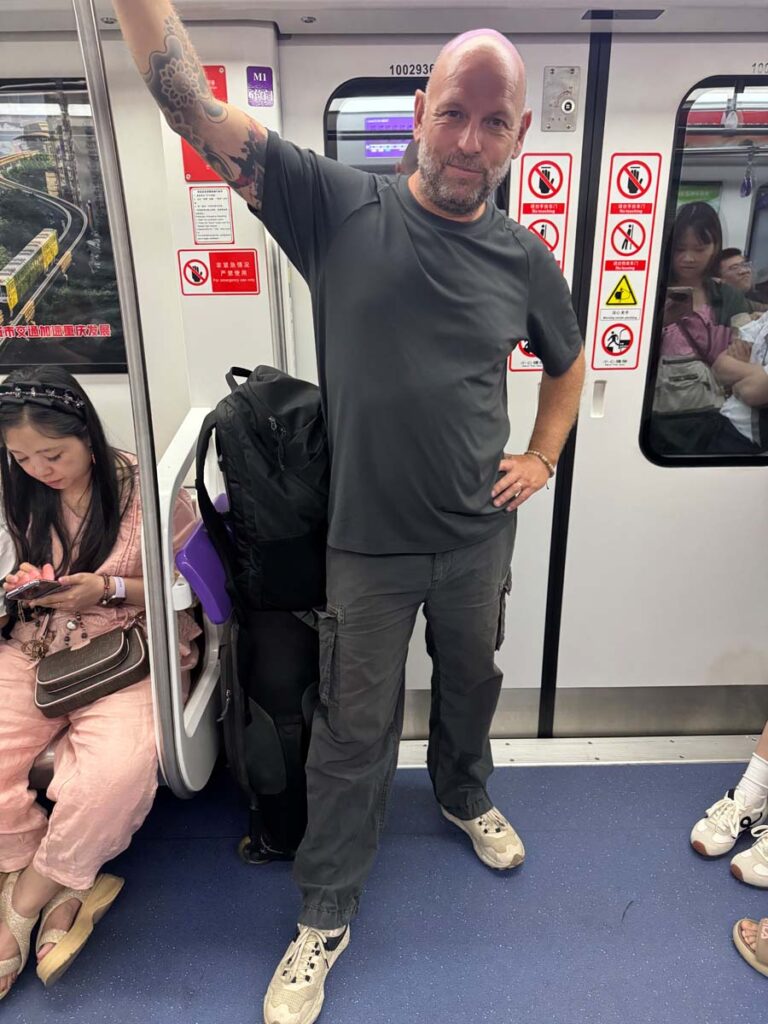
Relax in People’s Park

If you want to experience everyday life in Chengdu, spend a couple of hours exploring People’s Park. We visited on a Saturday and it was full of local families enjoying the weekend together, giving the park a lively and welcoming atmosphere.

The park itself is beautiful, with tree-lined paths, lakes and traditional gardens, but it was the people that made it memorable. As we wandered around, we came across dance performances, groups exercising, musicians, people playing mahjong and friends relaxing over tea. Everywhere we looked, there was something happening.

We’d recommend allowing 1 to 2 hours to explore the park at a relaxed pace. It’s one of the best places in Chengdu to slow down, people-watch and experience the city’s famously laid-back culture.

Visit Wuhou Shrine

Wuhou Shrine was one of our favourite places in Chengdu. Dedicated to the famous strategist Zhuge Liang and the Three Kingdoms period, it’s one of the city’s most important historical sites, but you don’t need to know much about Chinese history to appreciate it.
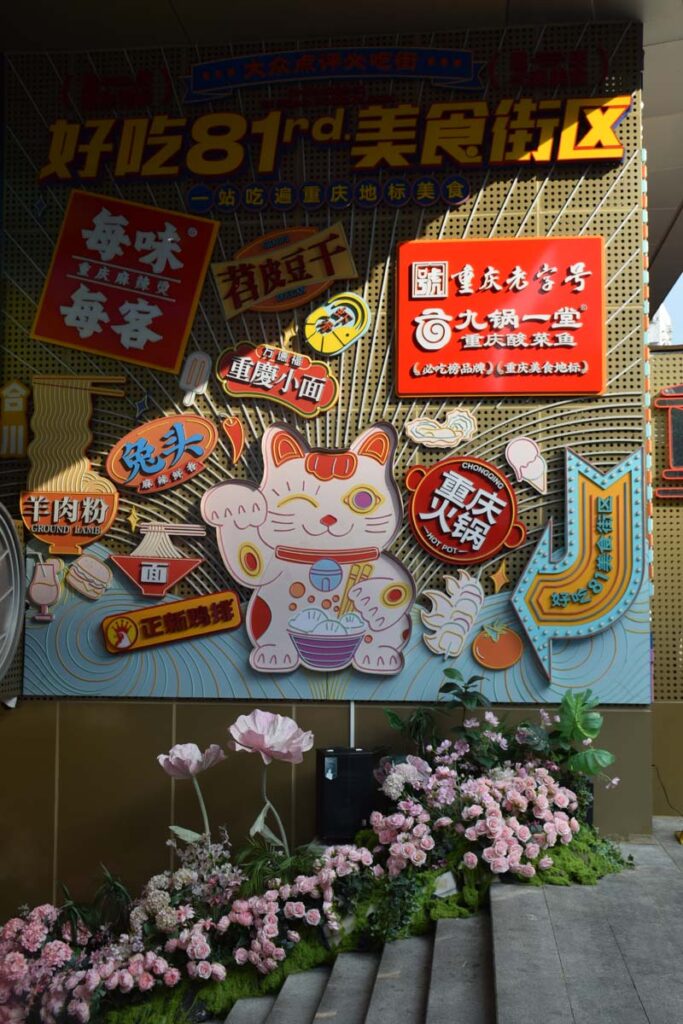
The entrance was quite busy when we arrived, but as we wandered further into the complex, the crowds quickly disappeared. We found ourselves strolling through peaceful courtyards, beautiful gardens and pathways lined with towering cypress trees. The combination of traditional architecture, colourful red buildings and quiet surroundings made it one of the most relaxing places we visited in Chengdu.

We’d recommend allowing 2 hours to explore the shrine and its gardens. Whether you’re interested in history or simply looking for a beautiful place to escape the city’s busy streets, Wuhou Shrine is well worth adding to your Chengdu itinerary.

Explore Chunxi Road – shopping

For a completely different side of Chengdu, head to Chunxi Road. This is the city’s modern shopping district, filled with huge shopping malls, international brands, restaurants and towering skyscrapers. It’s a great contrast to the historic temples and traditional parks found elsewhere in the city.

Even if shopping isn’t your thing, Chunxi Road is worth visiting for the atmosphere alone. The streets are busy from morning until late at night, with street performers, colourful billboards and plenty of places to stop for food or a coffee.

One of the biggest highlights is the IFS shopping centre, where you’ll find the city’s famous giant panda climbing the side of the building. It’s become one of Chengdu’s most recognisable landmarks and is a popular photo spot. If you’re feeling adventurous, you can also visit the rooftop terrace behind the panda for a different perspective.
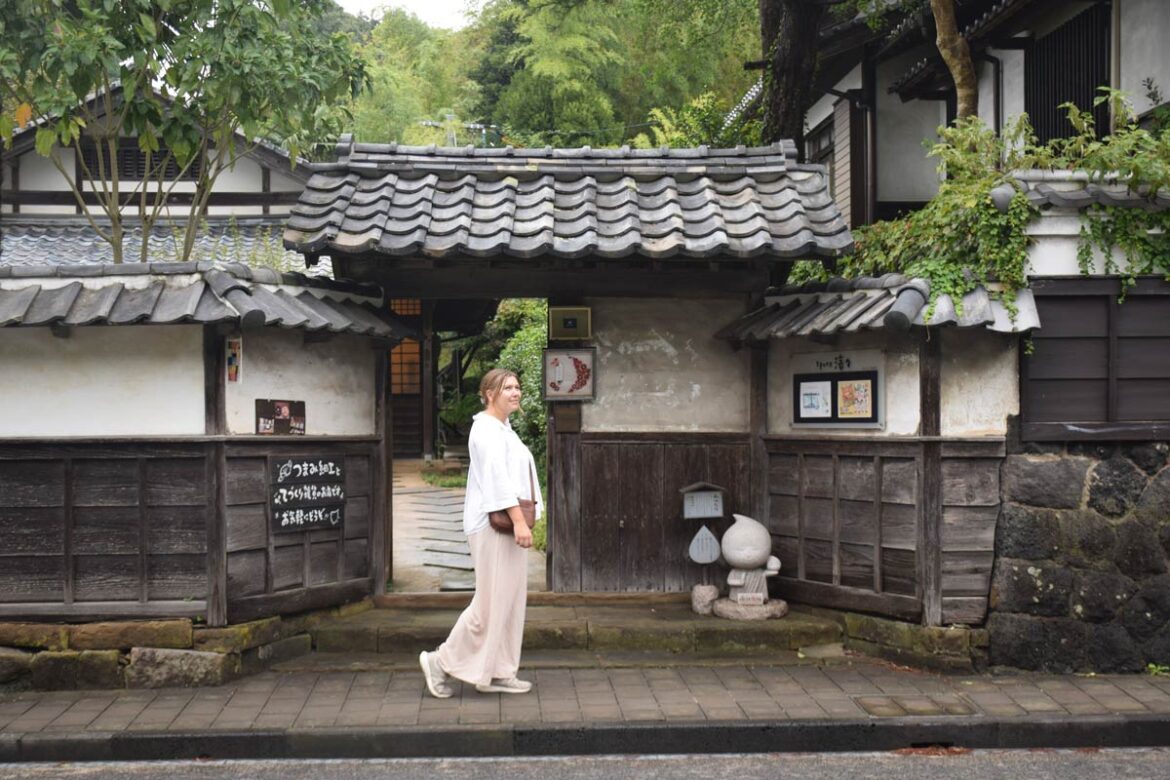
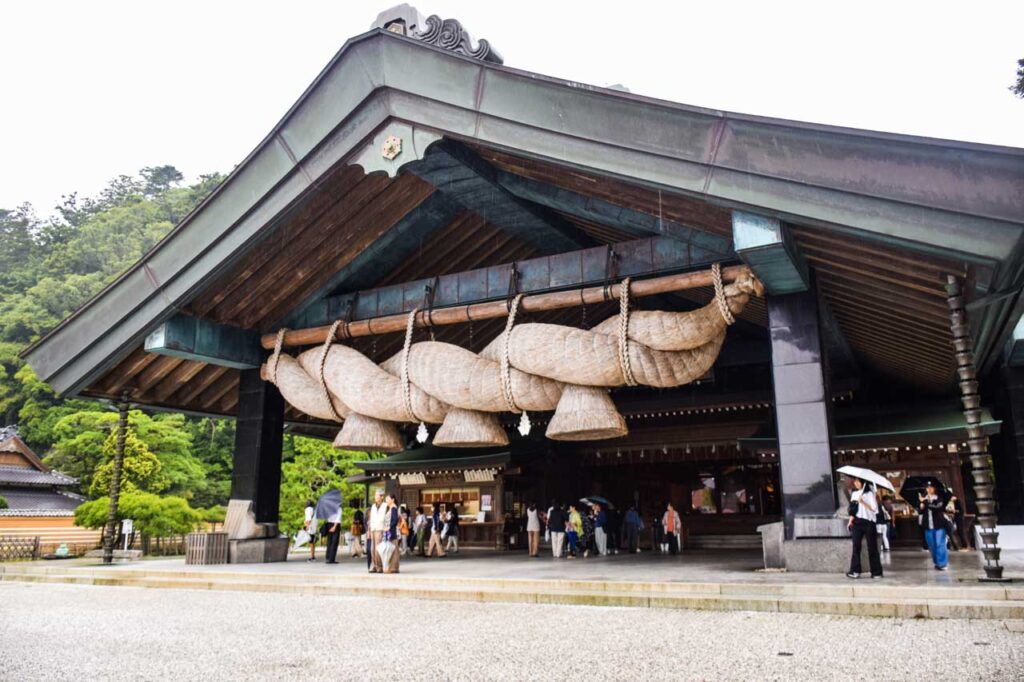
Wander Around the Guihua Lane Neighbourhood (桂花巷)

Just around the corner from where we stayed, the streets surrounding Guihua Lane became one of our favourite areas to explore in Chengdu. While it isn’t home to any major tourist attractions, it’s the perfect place to wander and experience a quieter, more local side of the city.

We loved walking through the surrounding streets, discovering independent cafés, local restaurants and small shops tucked away between the tree-lined avenues. Compared to the busy shopping district around Chunxi Road, this neighbourhood felt much more relaxed and gave us a glimpse into everyday life in Chengdu.

If you have a couple of spare hours, we’d recommend putting away the map and simply exploring the area at your own pace. Some of our favourite moments in Chengdu came from wandering these streets without any particular destination in mind.

Where to eat in Chengdu

Chengdu is the birthplace of Sichuan cuisine, and after our visit it’s become one of our favourite cuisines in the world. The bold flavours, fragrant spices and famous numbing Sichuan pepper make every meal an experience. While there are countless dishes to try, some of the local specialities we think you shouldn’t miss include Sichuan Hot Pot, Dan Dan Noodles, Mapo Tofu, Kung Pao Chicken, and street snacks such as Tang You Guo Zi, Bo Bo Ji, Bing Fen and Dan Hong Gao. Even if you’re not usually a fan of spicy food, trying the local cuisine is an essential part of visiting Chengdu.

Be prepared for the spice! Sichuan pepper creates a unique tingling, numbing sensation that’s just as memorable as the heat.

Explore Wangping Street

One of our favourite food experiences in Chengdu was spending an evening exploring Wangping Street, one of the city’s best-known snack streets. Rather than wandering on our own, we had a local show us around, introducing us to dishes we almost certainly wouldn’t have ordered ourselves.

We sampled everything from freshly fried Tang You Guo Zi (sweet fried dough balls) and Dan Hong Gao (egg cakes) to Bing Fen (a refreshing herbal jelly dessert with brown sugar), cold noodles and cold jelly, traditional tea drinks, and sticky rice desserts served with rice wine and brown sugar. One of our stops was Simei Benben Chicken, where we tried Bo Bo Ji, a Chengdu speciality of cold skewers served in a spicy, aromatic broth. It wasn’t our favourite bite of the evening, but that’s part of travelling. You won’t love every local dish, and trying Chengdu’s famous specialities was an experience we wouldn’t have wanted to miss. Every stop offered something different, giving us a fantastic introduction to the flavours that make Chengdu one of China’s great food cities.

Explore the Yulin Neighbourhood

If you’re looking to venture beyond the main tourist sights, head to Yulin. This lively neighbourhood is one of Chengdu’s best food districts, packed with traditional Sichuan restaurants, hot pot, barbecue, cafés and late-night eateries. It was the same guy who gave us a lift from the airport when we arrived who later took us here, introducing us to one of his favourite neighbourhoods. We ended up having one of our favourite meals in all of China at a tiny dumpling restaurant, but despite our best efforts, we’ve never managed to find its name again. Sometimes the places without a name on your map become the ones you remember most.

How Many Days Do You Need in Chengdu?

We spent 3 nights in Chengdu, which gave us enough time to visit the city’s highlights, including the Giant Panda Base, People’s Park, Wuhou Shrine and several of Chengdu’s fantastic food districts. We could easily have stayed longer. Chengdu has a wonderfully relaxed atmosphere, incredible food and plenty of attractions both in the city and nearby, making it somewhere that’s easy to slow down and enjoy.

2 Days

If you’re short on time, two days is enough to see the Giant Panda Base and explore Chengdu’s historic centre, including People’s Park, Kuanzhai Alley and a few of the city’s famous food streets.

3 Days

We think 3 days is the sweet spot for most visitors. It gives you enough time to see the main attractions, enjoy Chengdu’s incredible food scene, and experience the city’s relaxed atmosphere without feeling like you’re constantly on the move.

4+ Days

If you have four days or more, there’s plenty to keep you busy. We would have loved to spend a day exploring Dujiangyan, visit the Dujiangyan Panda Base, and check out Dongjiao Memory, Chengdu’s creative arts and cultural district. With extra time, Chengdu also makes an excellent base for exploring more of Sichuan Province, whether you’re taking day trips or heading further afield to places like Mount Qingcheng, Leshan or Jiuzhaigou.

Practical Tips for Visiting Chengdu

Getting Around Chengdu

Getting around Chengdu is affordable and relatively straightforward. We mostly walked, caught local buses and used Didi, but the city also has a metro system.

Metro

Chengdu has an extensive metro network that connects most of the city’s major attractions. We didn’t end up needing it during our stay, but it’s widely regarded as one of the easiest and most convenient ways to get around the city, especially for longer distances.

Bus

We used the local buses several times during our stay. They took a little more planning than using Didi, but were inexpensive and a good way to get around. We set up a Chengdu Transport Card in Alipay, which allowed us to simply scan our phone on the bus.

Didi

For longer journeys or when we wanted the easiest option, we used Didi, China’s equivalent of Uber. It was affordable, reliable and simple to book through the Alipay or WeChat app.

Walking

Many of Chengdu’s attractions are close together, making the city enjoyable to explore on foot. We especially enjoyed wandering around People’s Park, Kuanzhai Alley, Wangping Street and the quieter streets around our hotel.

Best Time to Visit Chengdu

We visited Chengdu in September and found it hot and humid, although it certainly didn’t stop us from enjoying the city. If you’re planning to spend a lot of time exploring on foot, spring (March to May) and autumn (October to November)generally offer the most comfortable temperatures. That said, Chengdu is a year-round destination, with each season offering a different experience.

Internet, Payments and Apps

China is largely cashless, and Alipay and WeChat quickly became one of the most useful apps on our trip. Along with paying in shops and restaurants, you can also set up a local transport card for buses and the metro, allowing you to simply scan your phone when travelling instead of buying individual tickets. This worked seamlessly across several cities we visited in China.

Our hotel offered free Wi-Fi, but without a VPN we still couldn’t access many of the websites and apps we normally use. We used an eSIM with built-in access to blocked services, which meant we could browse as normal throughout our trip.

We also recommend downloading Didi for taxis and Google Translate (or your preferred translation app) before you arrive. For a full breakdown of the apps we found most useful, including maps, payments, transport and VPNs, read our complete guide to the best apps for travelling in China.

Final Thoughts on Visiting Chengdu

Chengdu was our first stop in China, and we couldn’t have asked for a better introduction to the country. We arrived expecting giant pandas, spicy food and a culture very different from our own, but what stayed with us most was the warmth of the people. Everywhere we went, people were welcoming, curious and happy to help, making us feel at home from the very beginning.

Of the three cities we visited in China, Chengdu ended up being our favourite. We loved its relaxed atmosphere, incredible Sichuan cuisine and the way modern city life blends seamlessly with peaceful parks, historic temples and traditional neighbourhoods. Despite being one of China’s largest cities, it never felt overwhelming.

We only spent three nights here, but left wishing we’d planned a longer stay. Next time, we’ll definitely use Chengdu as a base to explore more of Sichuan Province, and we wouldn’t hesitate to recommend adding it to any China itinerary.

July 3, 2026 0 comments
FacebookTwitterPinterestLinkedinRedditStumbleuponWhatsappTelegramThreadsOpenAIChatGPTEmail
Newer Posts
Older Posts

Recent Posts

  • Is Tottori Worth Visiting on a Japan Trip?

  • North Sumatra Itinerary: Bukit Lawang, Berastagi & Lake Toba

  • Lake Toba & Samosir Island: Is It Worth Visiting?

We use Safetywing

We use THS

Trusted House Sitters

Here’s 25% off your annual membership to TrustedHousesitters - thanks to your pet loving pals at LBSBWorld.

Join now with 25% Off!

We use NordVPN

NordVPN

Get 3 months of NordVPN right now!


The best VPN service for a free, open internet

Get NordVPN!

We use Wise

Wise

Get Zero Fees on a transfer up to €500


Spend in 150+ countries like a local with Wise card

Get Wise!

Follow us on Instagram

A Bear Called Paddington abearcalledpaddington 🌍 7 years full-time travel
Follow on Instagram
©2026 LBSBWorld - All Right Reserved - Designed and Developed by Livia & Sam
LBSB World
  • Home
  • Destinations
    • Africa
      • Namibia
    • Asia
      • China
      • Indonesia
      • Japan
    • Europe
      • Albania
      • Bosnia-Herzegovina
      • Croatia
      • Montenegro
      • Netherlands
      • North Macedonia
      • Serbia
    • North America
      • Dominican Republic
  • Travel Itineraries
    • Our 9-Day Namibia Tour with Chameleon Safaris: An Honest Review
    • Our 2 Week Albania Itinerary
    • Bosnia and Herzegovina Itinerary: Our 1 Month Route by Bus
    • Namibia Self Drive: Everything We Learned Driving a 4×4 Across Namibia
    • Our 3-Month Balkans Itinerary: 93 Days by Bus Through Southeast Europe
    • 23 Day Japan Slow Travel Itinerary by Train
    • North Sumatra Itinerary: Bukit Lawang, Berastagi & Lake Toba
  • Plan Your Trip
    • How to Deal with Travel Burnout (And Start Enjoying Travel Again)
    • Sam’s Fulltime Travel Packing List
    • Using Trusted House Sitters to Support Your Travels
    • Trusted House Sitters Promo Code: Save on Your Membership
  • About Us
    • About Sam & Livia
    • The Story Behind Our Full-Time Travel Life
    • abearcalledpaddington